
Barbecue is probably the world’s oldest cooking method and that is the only thing about it that is beyond dispute (see my companion article on The Story of Barbecue and the Origin of the Word). Everything else about barbecue is controversial and in some quarters likely to start a fight.
Folks can’t even agree on how it is spelled. Is it Barbecue, Barbeque, Barbaque, BBQ, B-B-Que, Bar-B-Q, Bar-B-Que, or Bar-B-Cue? For the record, linguists and historians generally agree that the proper spelling is barbecue because it is derived from the word barbacoa, and that other spellings are colloquial.
Some folks think barbecue is hamburgers on the hibachi. Others say no, that’s grilling, not barbecue. Some say barbecue is only pork. Some say it is only beef. The Kansas City Barbeque Society (KCBS), which sanctions hundreds of competitions, says it’s both, and chicken, too. Others think it is only whole hog. In North Carolina it is only hog, but the state is riven in two parts over what part of a hog can be called barbecue. Some say it must be whole hog, others shoulder only. And their neighbors in South Carolina aren’t even allowed to enter the debate.
Some say it is only cooked outdoors over live fire, in which case there are probably only a dozen barbecue restaurants in the US. Others say it must be smoked with indirect heat in which case the African American slaves who created classic Southern barbecue were cooking something else when they dug pits and put the meat above glowing embers.
Just what the heck is barbecue, anyway?
There are many legitimate definitions, including verbs, nouns, and adjectives. There is even a legal definition. One definition just will not do the job. When you cut through the haze, ultimately, it is smoke that differentiates barbecue from other types of cooking. The fact is that there are many forms of barbecue around the world and it is the presence of smoke that unifies them all.
Common usage is one way to define a word. The reputable data analytics firm YouGov asked 7,680 American adults “What main dishes are part of your ideal barbecue plate? Select all that apply.” Burgers and hot dogs were the most popular top, selected by 61% and 46%, respectively, with ribs third with 43%, pulled pork fourth with 27%, and brisket 25%. I can hear the moaning and groaning from the purists.
Click here to read a review of a wonderful movie about barbecue around the world. It makes it inescapably clear that the word has a much wider definition than a lot of purists think, as I explain below. Click here to go right to the 1 hour 41 minute movie on Netflix (You must have a Netflix account to access this movie). You will not regret watching it.
Let’s cut to the chase
Here is what I have learned: Smoke is what differentiates barbecue from other types of cooking.
This page explains in detail the definition of the word barbecue, and refutes revisionist attempts to redefine it. A study of history, lexicogaphy, and culinary techniques teaches us that the word barbecue is a large umbrella word that encompasses a variety of cooking styles, and it is expanding.
Alas, there are a number of revisionists who seek to shrink the definition to mean what is more properly called “Southern Barbecue” or “Low & Slow Smoke Roasting”. It also explains, in concert with my article on the history of barbecue, that barbecue is not American in origin or practice. That said, barbecue cooking, in all its styles, is more popular in the US than anywhere in the world, and its methods, techniques, and recipes have reached an unmatched zenith here. Here’s a summary of the facts:
From a historical standpoint, barbecue is the oldest cooking method probably first practiced by homo erectus in Europe, Asia, or Africa. These proto humans threw meat onto hot coals.
Today it is practiced over campfires, indoor fireplaces, open pits, in smokehouses, and today millions of people use a bewildering array of steel devices to produce barbecue with a variety of fuels. Thousands of barbecue restaurants produce barbecue very well indoors, typically on gas fired ovens that burn logs for smoke flavor.
From a lexicography standpoint, barbecue is derived from the word barbacoa, used by Taino Indians in the Caribbean to describe an elevated wooden rack on which they slow smoked at low temperatures fish, lizards, alligator, and other game.
The word barbacoa was brought to Europe by Spanish explorers and it first appeared in print in Spain in the 1526. Even though the word originally meant a structure, not the food or the method, it expanded to include both in Europe.
As the word expanded barbecue came to mean
(1) food cooked by a barbecue method
(2) a cooking device
(3) an event at which barbecue is cooked, an
(4) a flavor that is similar to sweet ketchup-based barbecue sauce.
That is the way the word is commonly used by most people. The fact is that, to most Americans, cooking burgers, hot dogs, and steaks is barbecue. A handful of snobs can try all they wish, they cannot change a definition based on widespread common usage.
From a culinary standpoint, barbecue is a cooking method that usually involves fire and smoke.
Over the centuries, several culinary methods of barbecue have evolved around the world. Beloved long-established barbecue joints like Dreamland in Tuscaloosa, AL, and several other hallowed locations in Memphis and Texas cook their barbecue hot and fast directly over coals. I’m not going to tell the University of Alabama football team that Dreamland isn’t barbecue yet the internet is full of snobs demeaning their wonderful food. Then there’s Korean barbecue (thin cut marinated beef, typically grilled over a hibachi in the center of the table), Chinese barbecue (marinated pork loins, ribs, or duck roasted while hanging in a gas oven), Santa Maria barbecue (beef tri-tip grilled over oak on an open top brazier), and Kentucky barbecue (mutton and other meats simmered in a stew in large cast iron kettles over an open flame). None of these treats fit the revisionist definition.
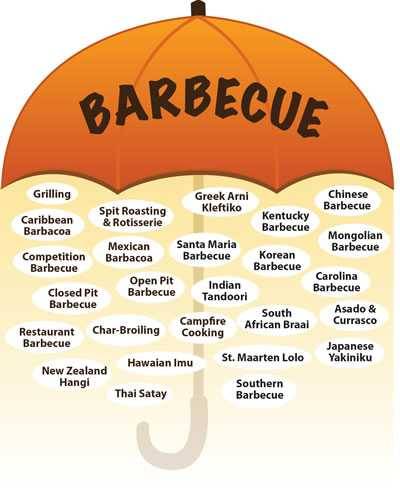
Barbecue encompasses several forms of cooking including open pit barbecue, closed pit barbecue, Southern barbecue, competition barbecue, gas fired restaurant barbecue, smoke roasting, grilling, Santa Maria barbecue, Kentucky barbecue, spit roasting, Mexican barbacoa, Korean barbecue, Chinese barbecue, Argentine asado, Brazilian churrasco, Japanese yakiniku, St. Maarten lolo, Indian tandoori, Greek arni kleftiko, Thai satay, South African braai, Hawaaian imu, New Zealand hangi, and more. The one thing they have in common is smoke. All these techniques produce smoke.
Revisionists have tried to shrink the definition of the word to mean barbecue cooked in steel closed “pits” similar to the method practiced at modern barbecue competitions, which they call “real barbecue” and which they claim is low and slow, cooked with indirect heat and smoke. In practice, many of them are now cooking with high temperatures and wrapping the meat in foil, which is another culinary method entirely called braising.
When they speak of real barbecue they are thinking of the popular style of low and slow smoke roasting as developed in the American South. In fact, they are speaking of Southern Barbecue. Alas, they are forgetting that barbecue is practiced around the world in different ways, and that the majority of the public just doesn’t agree with them.
Summary. So let’s try to come up with one overarching all encompassing definition, and hope that my effort does not precipitate violence:
Barbecue has many meanings. The bottom line is that it is a cooking method that produces smoke. It often involves flame for heat. Barbecue is also a cooking device that produces the smoke. In addition, barbecue is an event, usually festive and outdoors, at which food is barbecued on a barbecue. And finally, barbecue is a flavor produced by cooking with a barbecue, often with a sweet ketchup based sauce called barbecue sauce, on a barbecue at a barbecue event. Unless it is cooked on an electric barbecue, with any other sauce you like, and eaten alone indoors.
Where does the word come from?
The word “barbecue” was derived from a Taino Indian word that Spanish explorers said sounded like barbacoa. The Indian use of the word presaged today’s controversies by having multiple meanings. It was a cooking device, a storage device, a bedlike device, a shelter, and perhaps even the food cooked on the device.
Most of the Caribbean and AmerIndian tribes used the barbacoa for drying and smoking fish, turtles, lizards, alligators, snakes, rats, frogs, birds, dogs, and other small animals for preservation as well as for dinner. Occasionally deer and turkey were cooked on the barbacoa. The smoked, salted, dried meats were often reconstituted weeks later and eaten in stews. It was more like making jerky than what we think of as barbecue.
Carl O. Sauer wrote “Indian Food Production in the Caribbean in “Geographical Review” published by American Geographical Society in 1981: “Salting, smoking, and preparing of fish to keep and trade were widely established and this extended to shellfish and other creatures taken from the sea. This preparation involved the use of the stands from which Spaniards took the word barbacoa, and which we know as barbecue, a regular part of the equipment. The fish taken in tropical waters, full of fats that turn rancid in a terrific hurry, were rushed onto these grills over which they were dried, smoked, salted, and changed into keeping quality.”
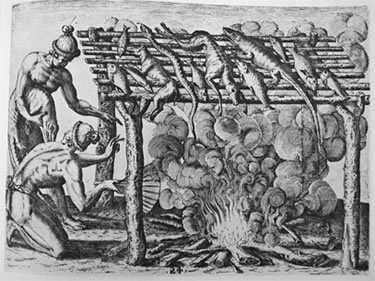
A barbacoa is shown here in a 1583 engraving by Theodore deBry based on a 1564 painting by Jacques LeMoyne, a French explorer in Florida. Click here to read more about the history of modern barbecue and its roots in the Caribbean and the origins of the word.
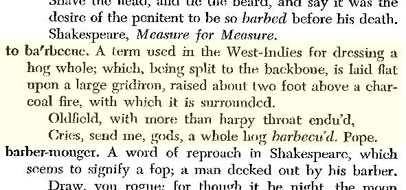
Samuel Johnson, the British lexicographer, essayist, and editor included the word “barbecue”, spelled properly, in his landmark Dictionary of the English Language in 1755. It says: “to ba’rbecue. A term used in the West-Indies for dressing a hog whole; which, being split to the backbone, is laid flat upon a large gridiron, raised about two foot above a charcoal fire, with which it is surrounded.”
Johnson then quotes a poem by Alexander Pope from his Satire on the Second Book of Homer written in the 1730s:
“Oldfield, with more than harpy throat endu’d,
Cries, send me, gods, a whole hog barbecu’d.”
Of course this is not entirely accurate since the Caribbean Indians had been doing barbacoa long before Spaniards brought hogs to the New World in 1539. But the trend was set. Confusion.
To this day students of history in the Carolinas insist that barbecue can only be pork which is some sort of subtle white supremacy at work ascribing too much influence to the Spanish and American cultures. Remember, original barbacoa was fish, lizards, alligator, and other game cooked by native Americans.
Barbecue in the US
Although barbecue was not invented in the US, and many other nations have deep rich barbecue traditions, none of them can hold a briquet to the way barbecue has ingrained itself in the culinary culture of the US. Per capita ownership of outdoor cookers in the US far surpasses any other nation, and our polyglot origins have produced hundreds of recipes, techniques, and methods that permeate our dining rooms. Every one of the world’s barbecue styles is practiced in the US with a high degree of refinement and enthusiasm. In that sense, it is truly America’s cuisine. It is like American baseball. It started in England as cricket, but evolved into something far more refined and complex in the US.
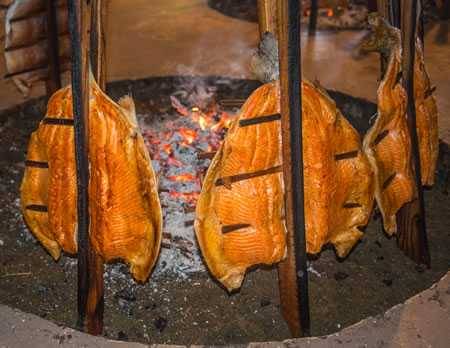
Here we see how the Tillacum people of the Pacific Northwest cooked and dried salmon with a combination of wood heat and smoke. They still demonstrate this technique on Blake Island State Park in Puget Sound off Seattle, and visitors can dine on the delicious results.
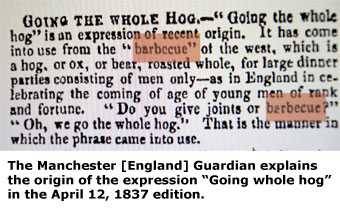
In the US, pork quickly became identified with barbecue. In January 1829, in a letter to a friend discussing what might happen when the new president, Andrew Jackson, arrives in Washington, Daniel Webster used the colloquiallism “whole hog” in speculating “He will either go with the party, as they say in New York, or go the whole hog, as it is phrased elsewhere, making all the places he can for friends and supporters, and shaking a rod of terror at his opposers.” In 1837 The Manchester Guardian, from England of all places, defined the idiom “whole hog” as having derived from a barbecue term. In 1830, the American Dictionary of the English Language By Noah Webster, 4th Edition called barbecue a verb: “To dress and roast a hog whole; to roast any animal whole.”
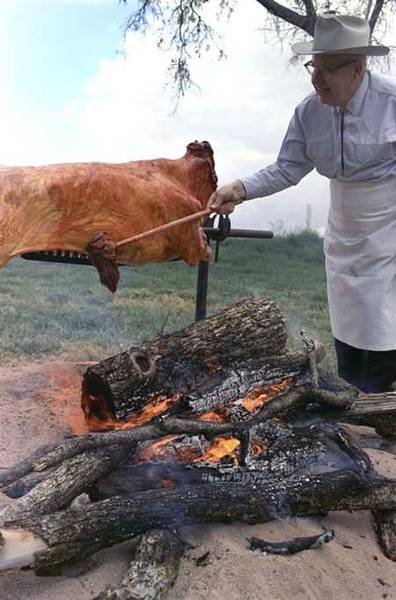
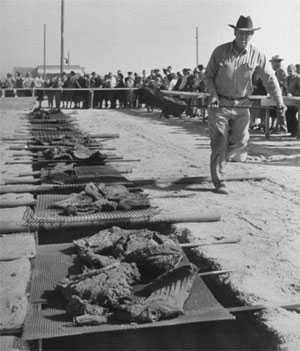
In colonial America all the way up through the Civil War, the word barbecue came to mean cooking a whole large animal, including sheep and “beeves”. A stack of logs was set afire, and a spit was built a few feet to the side. The animal was turned, usually by a slave, and the meat slowly roasted. In the below you can see President Lyndon Johnson’s barbecue chef, Walter Jetton barbecuing a steer in just this manner in Texas in 1967 (photo courtesy of the LBJ Library & Museum).
In the Journal American Speech published by Duke University Press, Volume 16, Number 3, in October 1941, Thomas Pearce of the University of New Mexico wrote an article called “Trader Terms in Southwestern English”. He defines barbecue as “To cook over slow fire in the open” (italics are mine) and cites the writing of Josiah Gregg’s Commerce of the Prairies in 1844 “Numbers of buffalo are slaughtered, and the flesh jerked, or slightly barbecued by placing it on a scaffold over a fire.” Below you can see something similar in Texas in the 1960s.
On October 12, 1844, The Daily Picayune of New Orleans published the definition of “A Barbecue”. It provide a detailed description of the type of event that was often reported in 19th century newspapers, political gatherings with speakers and a huge meal for thousands of participants.
We believe that out of this country people are ignorant of what barbecue is. It may be said to be peculiar to the West, but is known in the South-West and South, though in somewhat modified form. It is at once a text to the open-heartedness and hospitality of our people. We saw some time ago a graphic description in the Louisville Journal of a Western barbecue, but do not now remember its precise import.
We have seen ourselves some few of those barbecues, and will give a brief outline of the manner in which they are got up. First a good site is selected at which to hold a public meeting – generally some natural amphitheatre, well shaded by forest trees. In the neighborhood large trenches are dug, some three feet wide by four feet deep. In this dyke large wood fires are kindles at the proper time, poles are laid across it, and those oxen, deer, sheep, pigs, &c., are roasted whole. The planters or farmers in the neighborhood furnish bread, turkeys, geese, ducks, and other fowl, dressed in a variety of ways, and, indeed all the condiments necessary for a great public feast. A temporary table of pine planks, sufficient to accommodate thousands of people, is laid, and generally in the midst of the business of a public meeting, they adjourn. They take a respite from the discussion of politics, and proceed to discuss the good things of life. With characteristic American gallantry, the ladies – of whom there are always goodly numbers present – have a table appropriated to their exclusive use and that of their friends, and on this the delicacies of this day are sure to be found. – After partaking of the creature comforts so liberally spread before all, the business of the meeting is resumed and concluded. Of the bountiful supplies or edibles furnished for these occasions, the following, from an Ohio Journal, will furnish the uninitiated reader with a tolerably correct idea:
There was a mass meeting at Columbus, Ohio, recently, and something of a dinner, as will be seen by the following list of good things which were provided: 1400 weight of ham; 5700 pounds of beef, mutton and pork; 2100 loaves of bread; 500 pies; 300 pounds of cheese; 10 barrels of cider; 4 wagon loads of apples, and 25 barrels of water; with a large number of chickens, ducks, &c., occupying 1700 feet of table in the grove.
Also in 1844 one of the first cookbooks authored in the United States, The Improved Housewife or Book of Receipts by A Married Lady, published a receipt (recipe) for Barbecue Shoat (Hog), one of the first recipes in print to use the word barbecue. Here it is:
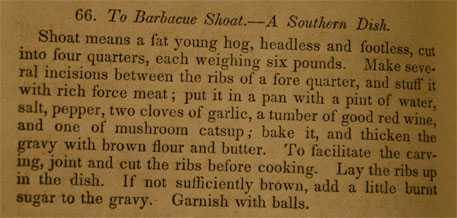
To Barbecue Shoat. – A Southern Dish
Shoat means a fat young hog, headless and footless, cut into four quarters, each weighing six pounds. Make several incisions between the ribs of a fore quarter, and stuff it with rich force meat; put it in a pan with a pint of water, salt, pepper, two cloves of garlic, a tumber of good red wine, and one of mushroom catsup; bake it, and thicken the gravy with brown flour and butter. To facilitate the carving, joint and cut the ribs before cooking. Lay the ribs up in the dish. If not sufficiently brown, add a little burnt sugar to the gravy. Garnish with balls.
You will notice that it is baked in a pan indoors in a wood burning oven. Force meat was like sausage without a casing. Catsup at the time was a sauce made from any number of things including mushrooms or anchovies. Jointing the ribs meant to cut them free of the backbone at the joint. Balls are not what you are thinking. They were like meatballs, typically chopped meat mixed with onion, egg, and break crumbs, then rolled in flour and deep fried in lard.
The definition broadens
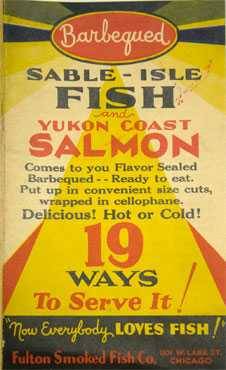
The definition of the word was broadening. In the Johnson & Wales Culinary Arts Museum of Johnson & Wales University in Providence, RI, I found a 1929 brochure and recipe booklet for the Fulton Fish Co. of Chicago promoting “Barbequed Sable-Isle [Nova Scotia] Fish and Yukon Coast [Alaska] Salmon”. And why not? Fish was among the most popular items on the original Indian barbacoas?
It appears that it was early cookbooks that created the notion that if meat had barbecue sauce on it, it was barbecue. In the influential 1918 Boston Cooking School Cookbook by Fanny Farmer, there are several “barbecued” recipes. Here’s the “Barbecued Ham” recipe. The ham it is referring to is salt cured ham. “Soak thin slices of ham one hour in lukewarm water; drain, wipe, and cook in a hot frying-pan until slightly browned. Remove to serving dish and add to fat in pan three tablespoons vinegar mixed with one and one-half teaspoons mustard, one-half teaspoon sugar, and one-eighth teaspoon paprika. When thoroughly heated pour over ham and serve at once.” Here’s her Barbecued Lamb: “Cut cold roast lamb in thin slices and reheat in sauce made by melting two tablespoons butter, adding three-fourths tablespoon vinegar, one-fourth cup currant jelly, one-fourth teaspoon French mustard, and salt and cayenne to taste.
The 1936 movie, Petrified Forest, which featured the debut of Humphrey Bogart, takes place in diner in Arizona with a large neon sign that says “Bar-B-Q.” When a diner asks what Bar-B-Q is, the waitress, a young Bette Davis replies it is a hamburger.
Because the early use of the word often was for large animals on a spit, for many experts barbecue meant rotisseried meats. In her 10 million selling landmark 1947 cookbook, Let’s Cook it Right, Adelle Davis said “When meat is barbecued over an open fire or charcoal flames, a revolving spit allows it to broil on one surface while the other surface cools; the flames some distance away cause the meat to be surrounded by dry heat, as if it were in a slow oven, thus barbecuing is a combination of broiling and roasting.”
It will surprise no one that eventually the US Government had to stick its snout into the debate. Because the USDA regulates the production, safety, and labeling of food traveling across state lines and for export, and because companies were packaging and labeling foods labeled “barbecue”, USDA felt obligated to codify the word. In 1984, smack in the middle of the Reagan administration, the Food Safety and Inspection Service set about revising the definition. It invited letters and held public hearings across the nation to determine what it should allow to be called barbecue. I was practically thrown out of the University of Memphis Library for laughing aloud at the reports from the hearings in the Memphis Commercial Appeal. Apparently “A few respondents took the subject so seriously that their postings were peppered with language that seldom appears in family newspapers.” One devotee from South Carolina opined that “Chickens, cows, and goats cannot be barbecued, and you cannot make barbecue with tomato sauce.” Of course in many parts of South Carolina, barbecue sauce has always been mustard based.
On January 1, 1985 USDA revised the Code of Federal Regulations, Title 9, Chapter III, Part 319, Subpart C, Section 319.80. It now says “Barbecued meats, such as product labeled ‘Beef Barbecue’ or ‘Barbecued Pork’ shall be cooked by the direct action of dry heat resulting from the burning of hard wood or the hot coals therefrom for a sufficient period to assume the usual characteristics of a barbecued article, which include the formation of a brown crust on the surface and the rendering of surface fat. The product may be basted with a sauce during the cooking process. The weight of barbecued meat shall not exceed 70 percent of the weight of the fresh uncooked meat.” One commercial producer in Oklahoma groaned that he would fire his chef if he lost 30% of the weight of the meat in the cooking process.
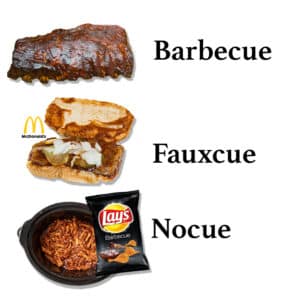
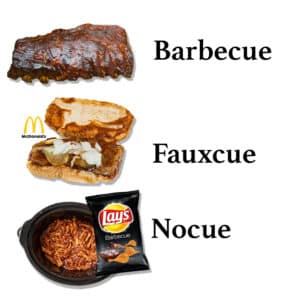
Before long we had Barbecue Flavored Potato Chips, and worse.
Let’s stop the revisionists right here and now
In the January 2014 issue of the trade magazine Restaurant Hospitality, Van Sykes, pitmaster of Bob Sykes Bar-B-Q founded in 1957 in Birmingham, AL, wrote “I’ve increasingly noticed how many restaurants call smoked pork ‘barbecue’. According to the true definition of barbecue, it has to be cooked over a live fire or hot coals. Therefore a smoker or an indirect system is not barbecue.” Oy!
The US is full of barbecue deniers and snobs. They love to say “This is real traditional barbecue and that is not” or “That’s not barbecue, that’s grilling”. What they mean is “this is the way I do it and if you don’t do it my way, you’re not doing barbecue.” They draw lines in the ashes. Alas, they are ignorant of the history of barbecue, the way the word began and how it is used around the nation and the world, or culinary arts.
In this day and age, when the word “barbecue” has hundreds of years of use across many national cultures and a definition that is broadening, this movement to narrow the definition is way off the mark and unfortunately the media have swallowed this propaganda often repeating the lie. Before I go there let me put on my flak jacket, because there are radical fundamentalists among us who think of barbecue as a religion, and they will not be pleased with this enterprise. As with most fundamentalists, facts do not get in their way.
The trend to narrow the definition may well have begun in 1942 when George W. Martin wrote his book Come and Get It, The Compleat Outdoor Chef. He says “We don’t refer to the misnamed ‘Bar-B-Q’ hot dog stands that disgrace the scenic beauties of our highways, nor do we concede that because a piece of meat is cooked more or less out of doors it deserves to carry the label of this time-honored cooking method.” Our first barbecue snob.
In the past 10 to 20 years, these fundamentalists have fomented a wrongheaded revisionist movement whose goal is to redefine barbecue to something like this: “Barbecue is large hunks of meat roasted low and slow with indirect heat and wood smoke.” Everything else, they say, “is just grilling”. Grilling they maintain is hot and fast.
You have probably read this definition in many newspaper articles, magazines, books, and websites. A lot of people have swallowed this specious logic. In July 2010, one of our best food writers, Josh Ozersky of TIME Magazine wrote an article titled “Five Things Americans Need to Know About Barbecue”. Most of the reader comments say something like this “this article is about grilling not bbq”. What they mean is “that’s not Southern barbecue, it’s grilling”.
Ardie Davis, who was around at the time, says that the “hogma” took hold in Kansas City in the 1980s when he and others founded the Kansas City Barbeque Society. He has since recanted: “Grilling hot and fast or smoking slow and low: both are barbecue… [yet] the dogma persists. A few old-timers and newbies defend it with vigor, as if it is proof that they know barbecue and you don’t.”
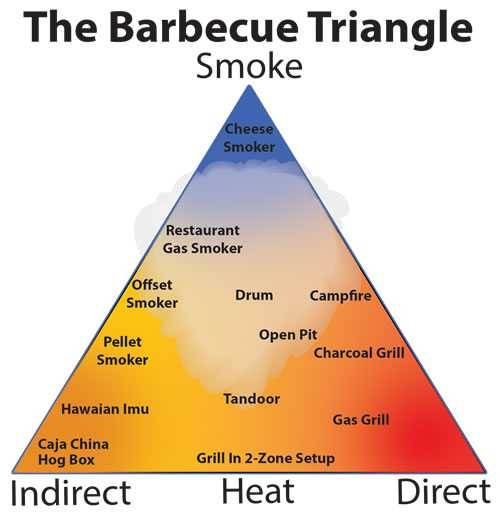
I say: Cut out the snobbery and get your facts straight! Barbecue around the world is far too complex and wonderful to be oversimplified like that. It was not invented in the US, and it is not exclusive to the US. Barbecue is a big word that encompasses grilling and many cooking methods as shown in the illustration above. What you are describing is more properly called “Southern Barbecue” or “Low & Slow Smoke Roasting”.
Flaws in the revisionist logic
Remember, it is the production of smoke that makes a cooking method barbecue. All the revisionist attempts to redefine the word have serious flaws in their logic.
Flaw in the revisionist logic. Modern barbecue competition cooks and backyard barbecue snobs like to say they are honoring “traditional barbecue.” But these “traditionalists” are far from old school. They rely on tightly welded insulated enclosed steel contraptions that produce indirect convection heat with the meat separated from the heat source by a barrier, often with a water pan for increased humidity in the cooking chamber. This method has more in common with a New England clam bake than it does with original Amerindian barbacoa, with the methods used by our founding fathers, or even the methods used by the people who did more to advance the art than any others, pre-Civil War Southern slaves.
Southern barbecue techniques, which are the direct parents of the best contemporary methods, were perfected over an open pit dug in the ground, and the meat was placed in direct heat over wood embers and ambient air above. Not indirect. Often not even low and slow. The enclosed steel smokers loaded with charcoal that modern “traditionalists” use has nothing in common with this authentic method.
Even Walter Jetton, a man revered by serious barbecue students, is at odds with the revisionists. In his 1965 book LBJ Barbecue Cookbook, Jetton says, not surprisingly, that “I believe that barbecue started in Texas in the old cowboy days.” He goes on to describe how they cooked: “They took baling wire or whatever they had , and tied the main body of this steer to a tree limb that stuck out over the ground. Underneath it they built a low fire out of oak or any other wood they had and cooked the steer right then and there. When it was ready, they made some fixings to go with it (usually there might be a little pot of hard cider) and everybody came around and had themselves a nice hoorah before the boys went out. That hoorah is what they called the barbecue.” So, in Walter Jetton’s version of old Texas, barbecue was an event at which meat was cooked open air.
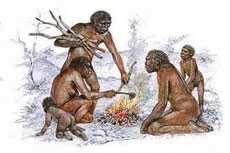
Flaw in the revisionist logic. Revisionists get caught in a trap when they tell people that barbecue and grilling are two different cooking methods. In an article in the Miami Herald, no less a barbecue luminary than Steven Raichlen , author of numerous wonderful cookbooks, got snared when he gave the reporter the “barbecue is different than grilling” definition. He then went on to talk about how barbecue was the world’s oldest cooking method. I hear these two statements a lot. Well, I’m here to tell you, it is highly likely the oldest cooking method, invented by homo erectus, was meat tossed right onto the embers orperhaps suspended over flames, which, if you buy the revisionist definition, is grilling, not barbecue. You can’t have it both ways folks. If you want to claim barbecue as the oldest cooking method, you’re gonna hafta broaden your definition.
Flaw in the revisionist logic. The revisionist say that barbecue is large cuts of meat like pork shoulder and beef brisket. But the inventors, the Caribbean tribes, used the barbacoa for drying and smoking fish, lizards, alligators, snakes, rats, frogs, birds, and other small animals for preservation as well as for dinner. To our Founding Fathers, barbecue was whole hog, beef, or lamb. Neither was barbecuing cuts of meat. That probably came later when plantation owners took the best cuts for themselves, like the loin, from along the back, so they could eat high off the hog, and left the tough cuts, like the sides and shoulders to the slaves. Today competition barbecue cooks compete in four categories, one of which is chicken, and most of them cook small thighs.
Flaw in the revisionist logic. The revisionists talk about the importance of low and slow and wood smoke. Then why doesn’t your definition include Smithfield ham? Bacon? Jerky? Smoked oysters? Smoked mullet? Frankfurters? Bagels with cream cheese and smoked salmon? And what about pastrami? Pastami is brisket that has been heavily seasoned, salted, aged for a few days, and then smoked. It is essentially smoked brisket, and that makes Katz’s Delicatessen, in the same location since 1888, the oldest barbecue restaurant in the nation…
Flaw in the revisionist logic. The revisionists also forget that the word barbecue has been used in this broad sense in all English speaking countries for centuries. It has common usage, squatting rights if you will, in its favor. Millions of people around the world use it correctly to include all forms of outdoor cooking.
The first book on the subject that I know of, Sunset’s Barbecue Book, written by George A. Sanderson and Virgina Rich, published in 1939 by California’s Sunset Magazine, was already wise to the controversy over nomenclature. It says, right at the beginning, “The noun ‘barbecue’ is defined in the dictionary as ‘a social entertainment of many people usually in the open air, at which one or more large animals are roasted or broiled.’ Through common usage, however, the word has come to mean the structure – fireplace or stove – on which any sort of outdoor cooking is done. We use the word this way throughout this book. It seems simpler all around not to argue about it.”
James Beard, who wrote the first great barbecue cookbook in 1954, The Complete Book of Barbecue & Rotisserie Cooking, uses the terms barbecue and grilling interchangeably. So do Julia Child, Craig Claiborne, and MFK Fisher, all the founding fathers and mothers of contemporary American cuisine.
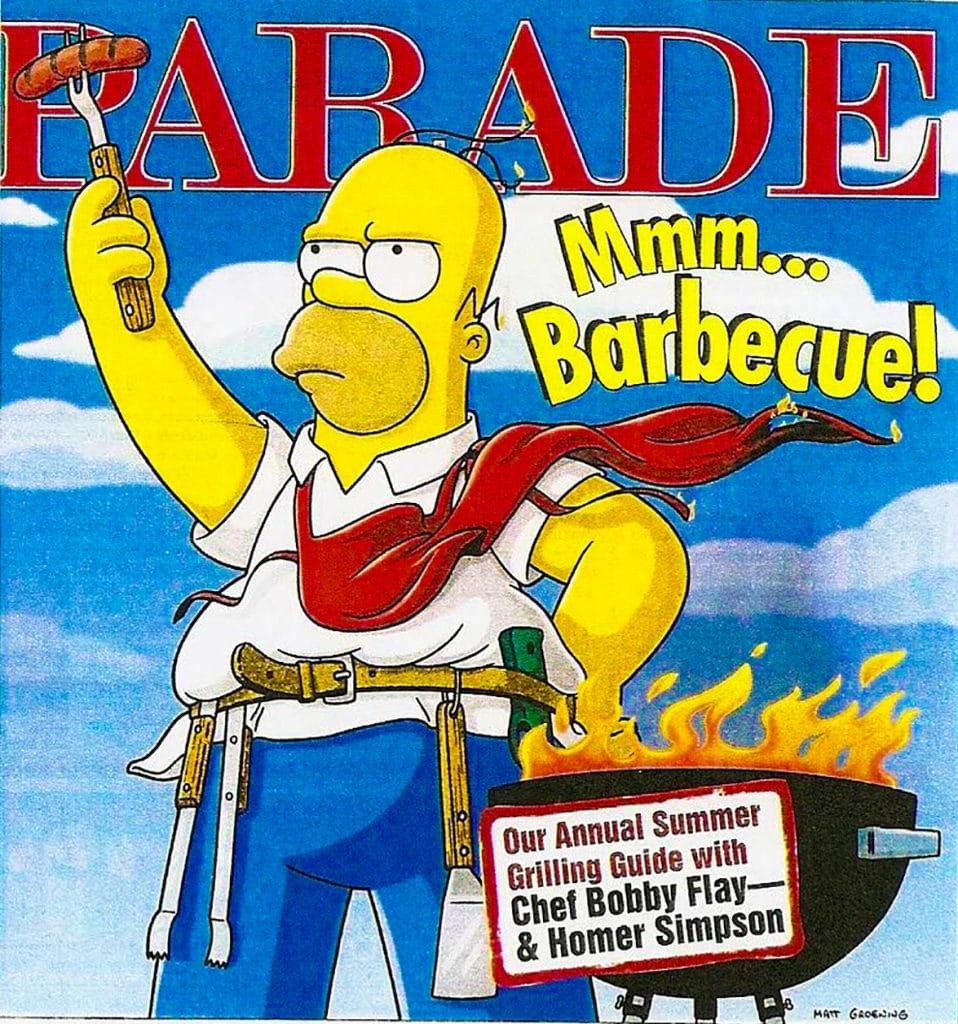
And if that’s not enough, as you can see above, even Homer Simpson considers hot dogs barbecue, and you don’t get more popular culture than that. If you want further proof, Google “Barbecue Ribs”. About half the hits will be cooked in an oven or slowcooker. That’s because those methods are what the public is looking for when they search for barbecue. One might argue that Google is redefining barbecue, or that Google is simkply reflecting popular usage.
What this means is that you can’t just up and redefine a word whenever the whim takes you. That job belongs to linguists, lexicographers, semanticists, and historians. A handful of revisionists cannot undo hundreds of years of history and the way millions of people use a word.
Flaw in the revisionist logic. Closer to here and now, the revisionists forget that many of the finest barbecue shrines cook hot and fast over direct heat. Let’s take the fabled Dreamland BBQ in Tuscaloosa, AL, where they cook over an open hickory pit at 600°F and a rack of spareribs is done in less than an hour. Feel free to argue about the quality but you tell the Crimson Tide legions that they are not eating authentic barbecue! Not me. Nosiree.
Flaw in the revisionist logic. In Memphis, bastions such as Corky’s, The Rendezvous, A&R, and Cozy Corner cook with only charcoal briquets, no wood, over direct heat. The smoke comes from charcoal. Chicago is famous for its “aquarium” pits that also cook with direct heat over logs or coals. Is this not barbecue? Many of the top Texas barbecue joints use “pulley pits” that cook with direct heat over wood embers. Daniel Vaughn the full time barbecue critic of Texas monthly says “Nobody who eats at Cooper’s Old Time Pit Bar-B-Que in Llano, which famously uses the direct-heat method, argues about whether they’re eating barbecue or grilled meat. Their mouths are too full of brisket.”
Flaw in the revisionist logic. Let’s consider one of the hallmarks of Texas barbecue: Hot guts, a coarsely ground sausage revered by all who taste it. The local barbecue joints sook it and sell it to groceries around the state. Says the estimable Mr. Vaughn: “We have no problem taking fully-cooked, pre-smoked sausages, warming them over a fire and calling it Texas barbecue. The only difference between that and grilling a hot dog is girth and the grinding method.”
Flaw in the revisionist logic. Most of the best barbecue restaurants in the US now use gas ovens by Ole Hickory Pits or Southern Pride and just toss a few logs into the flames for flavor. In many of the best places in the Carolinas they don’t even bother with wood. Is this not barbecue? Sure is according to millions of devoted followers and the owners’ bank accounts.
Flaw in the revisionist logic. How about native Americans in the Pacific Northwest who nail salmon to alder planks and pound them into the ground surrounding an open campfire? How can we say that’s not barbecue? If barbecue is supposed to be a native American cooking style, then how can our definition exclude Native Americans?
Flaw in the revisionist logic. How about Southern California, specifically Santa Maria, where barbecue almost always means tri-tip steak over hardwood embers on an open top grill cooked to medium rare?
Flaw in the revisionist logic. The revisionists say barbecue is low and slow and grilling is hot and fast. So where do you draw the line? What is hot? 226°F? What is fast? Less than 5 hours? 3.25? 1.64398 hours? At what time does my meat cease to be barbecue and become grilling?
Flaw in the revisionist logic. And before I rest my case, let’s look at the priesthood of the revisionists, tens of thousands of Kansas City Barbeque Society (KCBS) members. KCBS members are quick to draw the line between barbecue and grilling. But reality is right before their sensitive noses. KCBS requires four categories to compete for a Grand Championship: Pork ribs, pork shoulder, beef brisket, and chicken. Let’s look at how KCBS competitors cook the most difficult, most ornery, most challenging chunk of meat on their menu: Beef brisket. Nowadays many of the top competitors are paying big bucks for packer sized briskets cut from the rare Wagyu breed of beef cattle. Wagyu, recently imported from Japan is responsible for the prized beef of Kobe Prefecture, known for highly marbled muscles. That weaving of fat between muscle fibers, when melted, adds moisture, and a rich unctuousness to the presentation that often translates into prize money. But in order to get it to melt, most of these barbecue traditionalists cook their briskets at well over 300°F. Are we still “low and slow” here?
Worse still, for their chicken entries, most of the competitors are now cooking only thighs, first soaking them in a brine in order to add moisture and salt, then they remove the bones, then they fold back the skin and scrape the fat from the underside of the skins, than they gingerly place it back on tucking the edges into folds in the meat. To cook the thighs they first partially submerge them halfway in margarine or butter and braise them. Others put their boneless thighs into muffin pans to achieve perfectly uniform shape. Many, perhaps most, use no smoke at all while they cook. Finally, at the end, they grill the thighs skin side down over high heat in order to get the skins crisp. In case the revisionists and die hard traditionalists forgot: That’s not a large cut of meat, that’s not low and slow, that’s not smoked, and that’s braising!
Bottom line: Fully half, that’s 50%, exactly 2 of 4 categories of a barbecue Grand Champion’s score may not even be “barbecue” if you use the revisionist definition.
Let’s call it by its right name: Southern barbecue
Not only are the revisionist efforts flawed, they are downright inhospitable, even snobbish. In July 2010, no less a barbecue superstar than Ardie Davis, a founder of the 15,000 member Kansas City Barbeque Society (KCBS) wrote on the subject in the National Barbecue News. “Why does the world’s largest barbecue organization have only 13,000+ members? There are surely many reasons, but let’s not let one of the reasons be ourselves. Backyard cooking with wood fires, charcoal, solar power or gas is a gateway to our network. Let’s open wide the gate, unfurl the red carpet, and welcome all backyard cooks and others to our fold!” He continues “Let’s celebrate barbecue in all its manifestations. Let’s welcome the millions who should be among us but don’t know they are welcome!” Perhaps because we’ve been telling them that what they are doing is not barbecue?
If you feel the need for a term to describe your favorite cooking method permit me to suggest “Southern barbecue” will do the job. If you don’t like this, create a new one word, but quit trying to redefine a perfectly good word used by millions for centuries in many countries. In the words of one of the all-time great barbecue cooks, Dr. BBQ, a.k.a. Ray Lampe, “To most people grilling is barbecue. Get over it.”
KCBS: Stop quoting the Code of Federal Regulations!
Worse still, the esteemed KCBS, the largest and most important barbecue competition sanctioner, has for years used used the silliest most arcane definition of barbecue: The definition issued in 1985 by the USDA. Remember that it says “Barbecued meats, such as product labeled ‘Beef Barbecue’ or ‘Barbecued Pork’ shall be cooked by the direct action of dry heat resulting from the burning of hard wood or the hot coals therefrom for a sufficient period to assume the usual characteristics of a barbecued article, which include the formation of a brown crust on the surface and the rendering of surface fat. The product may be basted with a sauce during the cooking process. The weight of barbecued meat shall not exceed 70 percent of the weight of the fresh uncooked meat.”
The problem with relying on this is that this is a definition used by the Feds to control the labeling of products for sale in interstate and international commerce, usually pre-cooked meats peddled in grocery stores. Now read it again carefully. Rendering of surface fat? Not intramuscular fat? Brown crust? On chicken thighs? Direct action of dry heat? Is that what’s going on in your huge offset smoker with a water pan? Do your ribs weigh less than 70% of the raw product when you serve them? I hope not. Therefrom?
Now I ask you, why do so many of my barbecue buddies, fierce individualists who are none too fond of the government getting into their lives, why do they blindly accept this goofy bureaucratic definition as gospel? Why does the esteemed KCBS disseminate this as the definition of record? KCBS needs to dissociate itself from the Code of Federal Regulations and broaden its definition in order to encourage all kinds of healthy delicious barbecue. They need to stop circulating this nonsense!
Among the many formal definitions, the one that may come closest to the truth is the definition given by Barry Foy in his hilarious book, The Devil’s Food Dictionary: A Pioneering Culinary Reference Work Consisting Entirely of Lies : “One or another of several approaches to cooking one or another type of food, usually meat except when it is something else, which make use of one or another cooking technique that most often involves smoke, though not always, and in which a sauce of one sort or another plays either an essential, a prominent, or a negligible role. Barbecue has a nearly fanatical following in North America, particularly in the southern United States, where it carries a lore rich in history, culture, and the sort of factionalism that often leads to gunplay.”
So just what is barbecue?
Simply put: Smoke cooking. Below is an attempt to organize the various uses and definitions of the word barbecue in a more meaningful, historically accurate, multicultural, inclusive form than ever before.
Barbecue (verb)
-
A method of cooking.
Barbecue (noun)
Barbecue (adjective)
- (1) Southern Barbecue or Low and Slow Smoke Roasting.
- A method of cooking involving roasting food, in a closed oven or in open air, indoors or out, in the presence of smoke, usually created by the combustion of hardwood, but other sources of smoke are occasionally used including tea and herbs. Most often applied to meat (including poultry or seafood), but occasionally applied to vegetables and other foods. Heat is transferred mostly by convection and temperatures of the oven are usually in the 200-300°F range.
Example: “Tonight I’m going to barbecue that damn dog iffen he don’t shut up.”
- (a) Spit Barbecue or Spit Roasting or Rotisserie.
- Probably the oldest method of barbecue. Meat, originally whole animals, are impaled with a stick, sword, or spear and rotated above or near a heat source and smoke. Probably invented by cave dwellers, Middle Eastern and Asian kebab cooking is derived from this concept. Vertical rotisseries include Middle Eastern schwarma, Greek gyros, and Turkish doner kebabs. Eventually mechanical devices were invented to rotate the meat with a hand crank, then a weighted pulley system, and modern rotisseries use a motor.
Example: “For his wedding to Anne Boleyn, Henry VIII had many whole beeves spit roasted for hours.”
- (b) Caribbean Barbacoa.
- The AmerIndian method of cooking from which the word barbecue gets its name was done by suspending the food, usually fish, several feet above or around burning wood or coals on an open air rack so it cooks slowly and is exposed to smoke. Today, the term barbacoa is used almost exclusively in Mexico to describe a closed pit cooking technique, see Mexican Barbecue below.
Example: According to his diaries, on May 17, 1540, Spanish explorer shared a barbacoa near present day Salisbury, NC, with the natives. They had corn and small dogs. According to etymologist Michael Quinion, William Dampier, in his New Voyage Round the World of 1699, used the word in English for the first time to describe a raised wooden sleeping platform that protected Indians from snakes: “And lay there all night, upon our Borbecu’s, or frames of Sticks, raised about 3 foot from the Ground.” This same design was used for smoke roasting meats and storing food.
- (c) Open Pit Barbecue.
- A radiation method of smoke cooking derived from barbecoa probably by slaves in the Southern part of what is now the United States. They typically dug long pits in the dirt approximately 3′ wide and 3′ deep, burned hardwood down to coals in the bottom, put green saplings across the top, and laid meat on top of the crossmembers. The meat was basted with water, vinegar, and spices to keep it from burning. Eventually the saplings were replaced by metal gridirons, and the pits were built with stones or bricks above ground.
Example: “I don’t care if your family has been cooking whole animals over a pit, Mr. Gianopolis, the health department won’t let you cook like that for your restaurant.”
- (d) Closed Pit Barbecue.
- Roasting in an enclosed oven or a mostly enclosed oven which can take many forms around the world:
- d1) Modern Restaurant Barbecue
- Modern Restaurant Barbecue is more often than not made in a huge box with a ferris wheel type arrangement erroneously called a rotisserie. Meat is placed on long wire shelves that orbit around a central pivot while fats and juices drip on the shelves below. Heat is usually gas burners in a chamber in the rear, and logs can be placed in the burn box to create smoke and heat. The whole affair is controlled by a thermostat and timer. Another variation burns wood pellets made from sawdust. The pellets provide both the heat and smoke flavor. These units produce very high quality food with set it and forget it ease, and they can run all night unattended.
Example: Honey! I just got a job as pitmaster at Famous Dave’s! I start tomorrow with a 1 hour training session!
- d2) American Competition Barbecue
- American Competition Barbecue in which the food is usually cooked by indirect heat from charcoal with hardwood, straight hardwood, or hardwood pellets, in well insulated steel ovens with precise temperature and smoke control usually managed by constricting airflow.
Example: “Nowadays, if you want to win a competition dedicated to upholding the traditions of Southern American cooking you have to barbecue with a stainless steel thermostat controlled auger feed electronic ignition extruded pellet cooker.”
- d3) Mexican Barbacoa.
- Today, in Spain and other Spanish speaking countries, the word barbacoa is used similarly to the word barbecue in the US, to describe outdoor cooking, especially spit roasting. But in Mexico and Texas, classic barbacoa is often the head of a steer wrapped in agave leaves, laid in a pit with hot coals, and covered with dirt. Nowadays it can also be goat, beef, pork, or lamb, wrapped in aluminum foil and buried or cooked in an oven. This is also an early method of cooking, but it bears little resemblance to what we call barbecue other than it is done outdoors.
Example: “Que pasa, baby. Do you remember where I buried the barbacoa?”
- d4) Indian Tandoori Cooking.
- Tandoors in India were originally clay ovens that were heated with coals, the meat inserted, and then sealed. Modern tandoors are similar to the Japanese Kamado and the American Big Green Egg.
Example: “Is that your best price for the barbecue?”
- d5) Greek Arni Kleftiko.
- Barbecue historian Dr. Howard Taylor tells the story: “According to legend, thieves living in the mountains would steal a sheep, burn wood in a small cave till the area was hot, butcher and dress the lamb, wrap it in leaves or cloth, put it in the cave, close it with a boulder, seal it with clay around the rock, and let the meat cook for four or more hours. The lamb was seasoned with lemon, garlic, salt, onion, oregano, olive oil, and other spices. Sometimes, vegetables were cooked with the lamb. Modern Greeks sometimes follow this procedure for a party.”
Example:”After the wedding, we’ll have an arni kleftko barbecue with lots of music by Abba.”
- d6) Hawaiian Imu.
- An underground pit lined with hot rocks. Kalua pig, a whole hog, is cooked in an imu. It is wrapped in leaves and/or wet cloth, laid on the rocks, and buried by covering the pit with dirt or sand.
Example: “It must be a Hawaiian state law that all tourists go to a luau, eat kalua pig cooked in an imu, and dance the hula.”
- d7) New Zealand Hangi.
- Ditto.
Example: “If you don’t like lamb, skip the hangi.”
- d8) New England Clam Bake.
- Clams, corn, and other foods are wrapped in wet seaweed and buried in a sand pit with hot coals or rocks.
Example: “Am I an old fart if my ringtone is ‘This was a real nice clambake, And we all had a real good time,’ from Carousel by Rogers & Hammerstein?”
- d9) Bean Hole Cooking.
- Developed by the Penobscot Indians of Maine, they dug a large hole, lined it with rocks, heated them with burning logs thrown in the hole, placed a clay pot with beans in it into the hole, and covered the hole with dirt.
Example: Nah, I’m not going there. Write your own example.
- (2) Grilling or Char-broiling.
- Cooking with direct heat radiation above or below a flame or heat source, usually at temperatures of 300°F or more. The act of cooking with a barbecue device. The food may be covered by a lid or not. This is the definition that most people use around the world. According to etymologist Michael Quinlon, the first example of the verb is in a work by Aphra Behn in 1690: “Let’s barbicu this fat rogue,” showing that the word was known well enough by then to be used figuratively. Seriously!
Example: “Tonight I’m going to barbecue that damn parakeet iffen he don’t shut up.”
- (a) Asado.
- The traditional method of grilling in Argentina, Brazil, Uruguay, and other Latin American countries.
Example: “Man, now I need a new bolas. That idiot new gaucho from Buenos Aires forgot to take them off the ostrich before he put it on the asado.”
- (b) Churrasco.
- A method of rotisserie barbecueing over coals or embers popular in Brazil. It was originally done outdoors, but now many restaurants, called churrascaria, have sprung up in Brazil and even in the US, where many offer all you can eat for one price. The word comes from Portugese.
Example: “I’m not eating for a week so I can make room for our trip to the churrascaria Friday.”
- (c) Yakiniku.
- Roughly translated, yakiniku means grilled meat. It is the traditional Japanese method of grilling small pieces of meat, usually on a wooden skewer over a long narrow ceramic-lined trough filled with charcoal. Thegrill is called a konro and the fuel is often a unique hardwood charcoal called binchotan charcoal. Yakitori is the most famous dish, painted with tare sauce, a sweet soy sauce based barbecue sauce, and there ar hundreds of yakitori-ya, small restaurants or stands, in the cities, like hot dog stands in New York and Chicago.
Example: “At the last Hokkaido Nippon-Ham Fighters game I sat in the bleachers and bought yakiniku squid from the vendors. Great stuff with beer. And it was a great game. They really clobbered the Hiroshima Toyo Carp. I wonder if they make yakiniku carp?”
- (d) Satay.
- Satay is marinated grilled meat cooked on a barbecue in many Southeast Asian, especially Thailand, Malaysia, Singapore, Indonesia, and the Philippines.
Example. “My favorite part of chicken Satay is the peanut sauce. Do they have jelly sauce too?”
-
A cooking device, food cooked with barbecue methods or equipment, a cookout, a restaurant, a beautiful woman (slang).
- (1) A Cooking Device.
- A wide range of outdoor cooking devices made with a variety of materials from steel to brick whose heat sources can include wood, charcoal, gas, and electricity are commonly called barbecues. There are hundreds of such devices manufactured around the world. Also called a “barbie” in Australia.
Example: “Honey, our Smokey Joe barbecue finally fell apart. Why don’t we spring for a real Weber kettle barbecue?Example: “Maybe Santa will bring me Or better still, how about a cast iron barbecue with Michelin tires?”
Example: “Yessir, Mr. restaurant owner, with our Plug-N-Play Electric Barbecue you don’t even need a chef, and you can still hang a sign that says ‘barbecue’ in front of your restaurant.”
- (2) Food Cooked by Barbecue Methods or Equipment.
- In many places barbecue is something to eat.
Example: Presidential candidate Barack Obama gave a speech at a Sunday barbecue in Eau Claire, WI on 8/24/2008. He began his remarks by saying: “There was a debate about whether technically this could be called a barbecue. Because my theory is that if there’s no barbecue, it’s not a barbecue. It’s a cookout.” Perhaps realizing that he might have offended the organizers or taken on an issue too hot to handle, he ended his speech with a politically correct pivot: “Let’s go get a bratwurst!”
- (a) Chinese BBQ.
- Chinese BBQ is usually marinated pork loin, ribs, or duck roasted by hanging in an oven. Although it used to be smoked centuries ago, hardly anybody smokes it anymore. Some restaurants use charcoal, but most use gas nowadays. Fundamentalists are outraged at the idea that this could be called barbecue. Unfortunately for them, some historians argue convincingly that the Chinese invented barbecue. Also called char siu.
Example. “You no like eels, Mister Meathead. Have some barbecue ribs instead. Velly popular.”
- (b) Korean BBQ.
- Korean BBQ is usually thin cut marinated beef, and it is typically grilled by the diners on an as needed basis over a hibachi in the center of the table.
Example: “You put slaw on your barbecue, I put kimchi. Both cabbage. Same thing.”
- (c) Mongolian Barbecue
- Mongolian Barbecue is actually Taiwanese, not Mongolian. It is meats and vegetables stir fried on an iron griddle.
Example: “At our restaurant you can cook this barbecue beef yourself in two minutes and we can still charge you as much as if our chef had done the cooking.”
- (d) Carolina Barbecue.
- In much of the Carolinas barbecue is defined as chopped pork, usually from a whole hog or pork shoulder, often cooked with gas, usually served on a hamburger bun, often topped with coleslaw. And often the slaw is made with ketchup. In many places they insist that barbecue can be made only from whole hog, and if you use only the shoulder it is not barbecue. Whole hog is often served up at a “pig pickin” where you can slide up to the carcass and pick off what you want. Both sides usually agree that ribs are not barbecue. Chicken? Don’t make them laugh.
Example: “Let’s go git some barbecue at the pig pickin’ at the church.”
- (e) Packaged Barbecue Meat.
- The US Federal government regulates labeling of food products for sale in interstate commerce, including pre-cooked meats sold in grocery stores. According to the Code of Federal Regulations, Title 9, Chapter III, Part 319, Subpart C, Section 319.80, revised 1/1/1985 issued by the US Department of Agriculture’s Food Safety and Inspection Service “Barbecued meats, such as product labeled ‘Beef Barbecue’ or ‘Barbecued Pork’ shall be cooked by the direct action of dry heat resulting from the burning of hard wood or the hot coals therefrom for a sufficient period to assume the usual characteristics of a barbecued article, which include the formation of a brown crust on the surface and the rendering of surface fat. The product may be basted with a sauce during the cooking process. The weight of barbecued meat shall not exceed 70 percent of the weight of the fresh uncooked meat.”
Example: “Would you like to sample our new barbecue in a tub, sir?”
- (3) A Cookout.
- A social event centered around an outdoor meal or picnic at which food that was cooked outdoors is served. It doesn’t even have to include meat. That’s the broadest, and by far the most common definition, and it has been used in this context since the 1600s. In 1769 George Washington wrote in his diary that he “went up to Alexandria to a barbicue”. Colonials cooked everything from squirrels to venison at their barbicue parties. In 1860 newly elected Texas Governor Sam Houston was the featured speaker at the “Great American Barbecue” in Austin thrown by the American Party, to which all Texas citizens were invited for free. Thousands showed up. At these events meat was usually cooked directly over coals in dirt pits dug in the ground, not a steel tube with a digital thermostat. Today, a barbecue can include any food cooked over an open flame or coals, such as chicken, fish, or even vegetables. Sometimes the food is even wrapped in foil and never touches the flame.
Example: “At the Fourth of July barbecue we’ll be cooking ribs, steaks, hamburgers, hot dogs, and marshmallows. Anything we can fit on the grill.”
- (a) Santa Maria Barbecue.
- Named after Santa Maria, California, this is an event at which food is cooked over an open uncovered charcoal or hardwood flame. The food is suspended on a grate than can be raised or lowered with a pulley and crank to control the cooking temperature. The substrate is usually tri-tip (beef sirloin), but can also include everything from clams to artichokes. Beef is always served rare or medium rare at a Santa Maria Barbecue.
Example. “Like, let’s go to the barbecue, man, and afterwards, let’s see if the chicks want to go surfing.”
- (b) Kentucky Barbecue.
- An event in Kentucky at which burgoo is served. Burgoo is a complex savory stew that is cooked in a large cast iron cauldron over an open flame.
Example: “Double, double toil and trouble; Fire burn, and barbecue bubble.” Paraphrased from Macbeth, Act 4, Scene 1, by William Shakespeare.
- (c) Sheboygan Fry Outs.
- In the days before smoke detectors, the German settlers in Wisconsin liked to cook bratwurst sausages on the indoor stovetop in a frypan. So when they cooked in the backyard, it became a “fry out” or an “outdoor fry”. The term has extended to refer to all sorts of outdoor cooking.
Example: “Sure is hot today, honey. Get the brats and a pan and I’ll set up a fry out.”
- (d) Braai.
- A cookout in South Africa is called a braai in the Afrikaans language, and it is as big a part of their culture as it is to ours. There is even an official holiday devoted to barbecue, National Braai Day, on September 24. The “Bring and Braai” is a popular sort of potluck at which the host provides the grill and the fuel and the guests bring the food, often boerewors (a coarsely ground sausage), sosaties (marinated mutton skewers), steaks, and lobster. Braavleis is barbecued meat. A typical side dish is pap, made from cornmeal, a bit like grits.
Example: In 2007 Nobel Peace Prize laureate Archbishop Desmond Tutu became the patron of National Braai Day. “This is something that can unite us. It is so proudly South African, so uniquely South African,” he said. “There are so many things that are pulling us apart, this has a wonderful potential to bring us all together. We’ve shown the world a few things. Let’s show them that ordinary activities like eating can unite people of different races, religions, sexes.” And then he added short people, tall people, fat people, lean people.”
- (e) Barbecue Singsong
- In England there is another interesting variation on the barbecue cookout, the “barbecue singsong”, where food is cooked outdoors, a social event occurs, and singing breaks out. In a classic episode of the BBC sitcom “Keeping Up Appearances”, Season 3 Episode 3, Hyacinth and Richard hold a barbecue singsong. Hyacinth claims that the concept is a party game invented by Henry VIII. She alone appears to be the inventor of the “outdoor indoor luxury barbecue with finger buffet.”
Example. “Hello Elizabeth and Emmett! Welcome to our barbecue with the unique sing-for-your-supper speciality!”
- (4) Barbecue.
- A restaurant that specializes in serving barbecued products.
Example: Let’s go on down to Big Bill’s Barbecue and watch the barbecue chef barbecue up some ribs and get a big juicy barbecue sandwich swimming in barbecue sauce.
- (a) Lolo.
- A makeshift barbecue stand on St. Maarten island in the Caribbean. Often nothing more than a few tables around a 55 gallon drum sawn in half along the side of roads, on the beach, or in somebody’s front yard. Their inexpensive shrimp and lobster dishes are usually highly regarded by foodies.
Example. “Meet me at Johnny B Under the Tree in Cole Bay for dinner. Wear your bikini.”
- (5) Barbecue (slang).
- Jazz slang for a beautiful woman. “Struttin’ with Some Barbecue”, the classic instrumental jazz tune by Lil Hardin Armstrong and her husband Louis Armstrong, does not refer to a promenade with a pulled pork sandwich. Perhaps this is the origin of the expression that she or he is “smokin’ hot”. Click here for more information.
Example: “Mighty tasty barbecue you had at the Cotton Club last night, my brother.”
- (6) Barbecue (nickname).
- In Robert Louis Stevenson’s classic adventure novel “Treasure Island” (1883) the pirate Long John Silver signed on the ship Hispanola as the ship’s quartermaster, the mate who handles food and drink, and was nicknamed “Barbecue” by his shipmates.
Example: “The mention of his name leads me on to speak of our ship’s cook, Barbecue, as the men called him.”
-
The flavor associated with food cooked with barbecue methods or equipment.
- (1) Barbecue.
- A modifier used to describe any food cooked on a barbecue device.
Example: “I love barbecue endive!”
- (2) Barbecue Sauce.
- Around the world there are a variety of sauces and bastes used in preparing barbecue whose flavors people are associated with the barbecue flavor. In the US their main ingredients are most commonly ketchup or tomato paste, vinegar, mustard, and sweeteners such as molasses, sugar, or corn syrup. In other countries they may include soy based sauces.
Example: “My girlfriend makes great barbecue by putting ribs in my slow cooker and then she dumps in two bottles of KC Masterpiece Barbecue Sauce.”
- (3) Barbecue flavor.
- In South Texas, Barbecue Crab has long meant blue claw crabs, split and cleaned, heavily dosed with a spice mix similar to a barbecue spice rub, and then deep fried. In New Orleans, Barbecue Shrimp has long meant whole shrimp, heads and tails on, sauteed in butter laced with Worcestershire sauce.
- (4) Barbecue Potato Chips, etc.
- Food scientists have created flavorings that simulate the flavors of barbecue foods and when they are applied to foods marketing people call it barbecue.
Example: “Mr. Lay! We’ve done it! Barbecue Banana Chips!”
Special Thanks to Dr. Howard Taylor whose input, advice, and historical expertise made this possible.
Then there is instant barbecue
A lady went into her hardware store and bought a big box labeled “Instant Barbecue” for $39.99, the one with the pictures of succulent foods on the lid.
The next day, she appeared at the customer service desk complaining that there was no food inside, pointing at the picture on the box.
The employee told her that it was just a barbecue grill and that the food was not supplied with it. “Oh dear” said the lady. “I’d better take the other one out of the freezer then!”

High quality websites are expensive to run. If you help us, we’ll pay you back bigtime with an ad-free experience and a lot of freebies!
Millions come to AmazingRibs.com every month for high quality tested recipes, tips on technique, science, mythbusting, product reviews, and inspiration. But it is expensive to run a website with more than 2,000 pages and we don’t have a big corporate partner to subsidize us.
Our most important source of sustenance is people who join our Pitmaster Club. But please don’t think of it as a donation. Members get MANY great benefits. We block all third-party ads, we give members free ebooks, magazines, interviews, webinars, more recipes, a monthly sweepstakes with prizes worth up to $2,000, discounts on products, and best of all a community of like-minded cooks free of flame wars. Click below to see all the benefits, take a free 30 day trial, and help keep this site alive.
Post comments and questions below
1) Please try the search box at the top of every page before you ask for help.
2) Try to post your question to the appropriate page.
3) Tell us everything we need to know to help such as the type of cooker and thermometer. Dial thermometers are often off by as much as 50°F so if you are not using a good digital thermometer we probably can’t help you with time and temp questions. Please read this article about thermometers.
4) If you are a member of the Pitmaster Club, your comments login is probably different.
5) Posts with links in them may not appear immediately.
Moderators