Hot and Fast Brisket (6 Hour Brisket Recipe)
Most people avoid smoking their own brisket because who wants to stay up all night babysitting meat for 16+ hours? With this recipe and a little food science know-how, you can make an outstanding smoked brisket in just 6 hours. It’s a brisket speed run that works remarkably well, creating tender, juicy brisket is less than half the time.
Special Tools
- wire rack
- disposable aluminum pan
- Aluminum foil
- butcher paper (or foil)
- Spray bottle
Ingredients
Brisket and Rub
- 1 full packer brisket about 15 pounds
- 5 tablespoons Morton’s coarse kosher salt (or 1/2 cup Diamond Crystal Kosher salt, 68 grams)
- 1/2 cup coarse-ground black pepper
- Water as needed
- 1/4 cup melted beef tallow optional
Optional Cure
- 1/2 cup water
- 1/4 teaspoon curing salt #1
Method
- Trim the brisket. Trim the fat from all over the brisket to about 1/8 to 1/4 inch thickness. Trim the meat to create a slab of brisket with relatively even thickness from end to end. For a 15-pound brisket, trimmed may yield a final weight of about 9.5 pounds (about 5.5 pounds of trim, including about 3 pounds fat and 2 pounds meat). The goal is the shape the brisket so it cooks evenly and there is no bad slice. Here’s a useful brisket trimming video from Joe Yim at Leroy and Lewis Barbecue in Austin.
- Mix the optional cure. This recipe cooks the meat before it can take on smoke and create a pink smoke ring. To create a smoke ring with this recipe, put the water and curing salt in a spray bottle and shake to dissolve. Spray the curing solution all over the trimmed brisket.
- Mix the rub. Mix together the salt and pepper. If you prefer, use your own spice rub. Scatter the rub evenly all over the meat.
- Monitor the temp. Insert a wireless probe Combustion Predictive Thermometer into the thickest part of the meat (in the point muscle) at a slight downward angle so that the probe tip is in the thickest part of the meat and probe end is just below the surface (the probe handle will remain outside the meat).
- Fire up. Fire up your grill or smoker (a gas grill works great!) to about 550°F. Keep the cooker between 500 and 600°F. You do not need to add woodsmoke at this point. In fact, you do not want to, or you could oversmoke the brisket.
- Steam the brisket. Place the brisket on a large wire rack set in a large disposable aluminum pan. Pour enough water into the pan to cover the pan bottom by about 1/8 inch. Cover the pan tightly with aluminum foil, place the pan in the center of your cooker, and cook until the internal temperature reaches 205°F, about 2 1/2 to 3 hours. The water creates steam that cooks the brisket quickly, powering through the stall. Add more water to the pan as necessary to keep a thin layer of liquid in the bottom of the pan at all times (you’ll add about 1 cup water each time). Near the end of the 2 1/2 to 3 hours, you can also spray the brisket again with the optional curing solution. With this method, the brisket becomes tender and the collagen converts to gelatin faster due to the sped-up rise in the internal temperature. Keep in mind that most of the collagen conversion happens during the latter fourth of a brisket cook, especially during the traditional “resting” or “holding” period, or in this case, during the smoking phase.
- Smoke the brisket. Fire up your smoker to 350°F with a water pan in place. (If you started with a smoker, just reduce the target temperature.) This relatively high temperature ensures that the meat’s core temperature does not drop too rapidly, so collagen conversion can continue apace, and it helps develop the bark. Unwrap the brisket, remove it from the aluminum pan and place the brisket on your smoker grate away from the fire (save the rack and pan for wrapping the brisket later). Smoke the brisket until the surface bark is deeply browned and the internal temperature returns to 205 or 206°F, about 2 1/2 to 3 hours. Add wood/fuel to the smoker as necessary to keep the smoker temperature between 300 and 350°F.
- Wrap and rest the brisket. Tear off a piece of butcher paper or foil large enough to wrap the brisket several times (you may need two overlapping smaller pieces). Place the paper or foil on a work surface with the short side near so the long side stretch away from you. Spray the paper or foil all over with water. On the short end nearest you, drizzle or spoon half of the optional beef tallow over an area the size and shape of the brisket. Place the brisket on the tallow area and drizzle or spoon on the remaining optional tallow. Wrap up the brisket tightly in the paper or foil: begin by folding in the corners toward the brisket and then over the brisket to eliminate gaps. Then fold in the long sides toward the center, creasing the paper or foil to create a “runway” the width of the brisket. Now roll the brisket toward the opposite end to tightly wrap it. in the paper or foil to eliminate gaps, and then folding in the long side. Place the wrapped brisket on the wire rack set in the disposable aluminum pan. Rest until the internal temperature of the brisket comes down to about 160°F, about 1 hour.
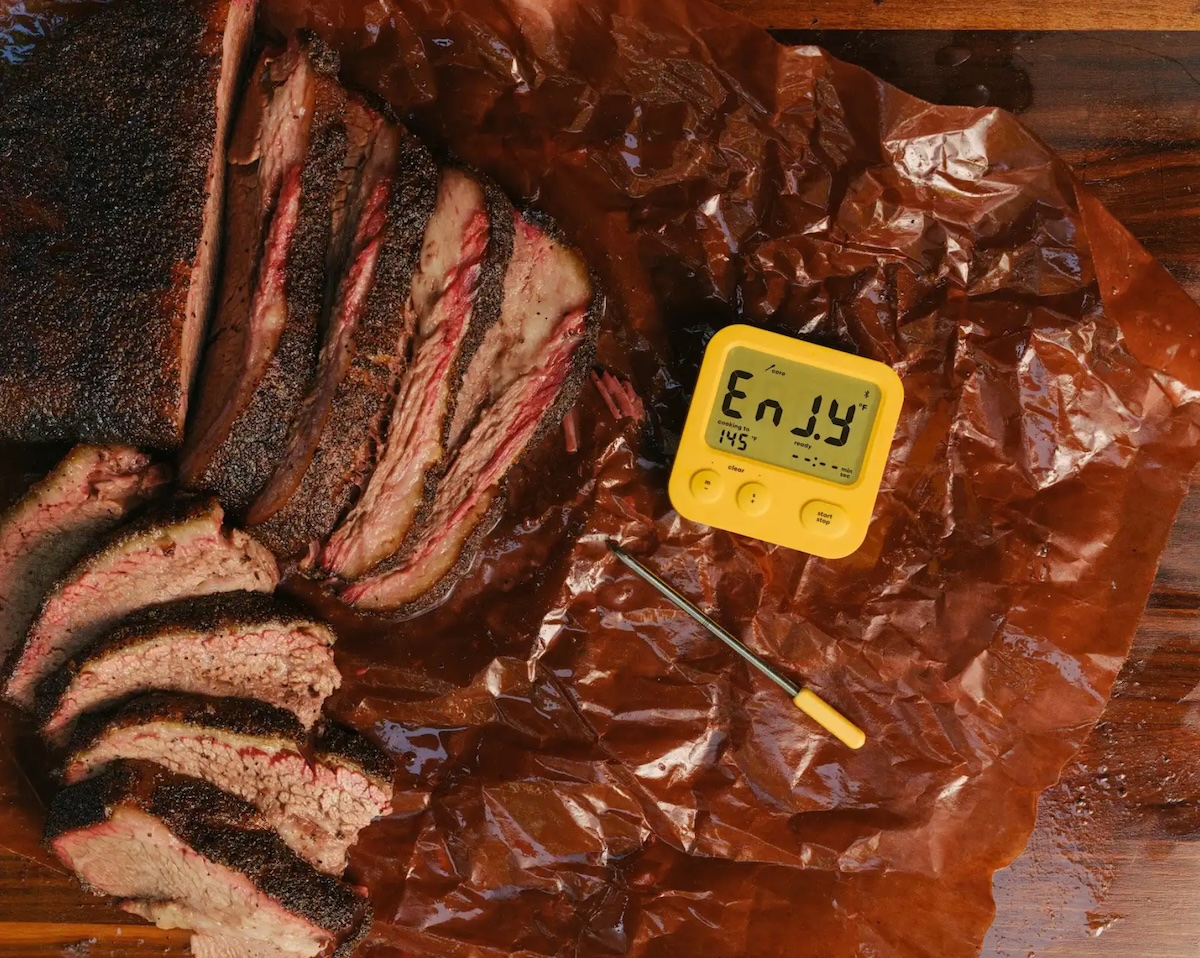
- Slice. Unwrap the brisket and place it on a cutting board. Slice it across the grain and serve with the juices.
Notes
About the curing solution. Normally as brisket absorbs smoke, the smoke itself supplies nitric oxide that reacts with myoglobin in the meat, creating a pink smoke ring. In this recipe, the myoglobin denatures before it can take on smoke. To create a smoke ring, the nitrite in curing salt #1 turns into nitric oxide as the brisket cooks and reacts with the meat to create the telltale pink smoke ring.
About the salt and pepper. Dalmatian rub keeps it simple here. If you have a preferred brisket rub, replace the salt and pepper with 1/2 cup to 1 cup rub, depending on the size of your brisket.
All content © AmazingRibs.com. All rights reserved.