




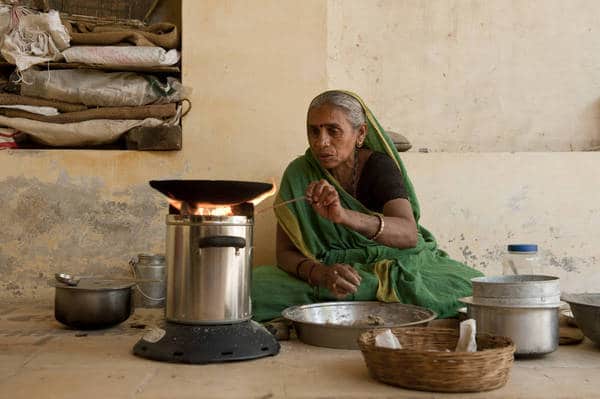
We support The Clean Cooking Alliance with donations from memberships to our Pitmaster Club. This remarkable a 501(c)(3) not-for-profit organization develops and distributes high-efficiency cookstoves to the needy around the world. Many are wood burning but they require much less wood than the old-fashioned stoves that also filled their huts and eyes and lungs with soot. These new designs are practically smokeless. Many use propane which is very clean. Some burn biomass such as rice husks or even dried dung and some use solar energy. Some are even manufactured locally.

Some of these clever designs have come from the recreational camping world, and many have migrated the other way, into the camping world. Below is a well insulated high efficiency unit that can burn wood, biomass such as crop byproducts like corncobs, it can run on solar, and can even store enough energy to power a light or charge a cell phone. Reducing the amount of wood means less deforestation in dry areas and women spend less time collecting wood and are at less risk. Learn more about the Clean Cooking Alliance here.
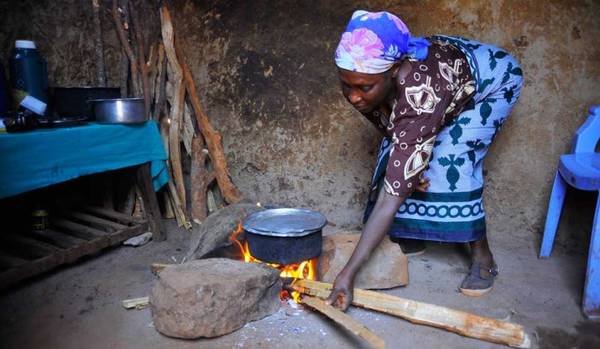
Household smoke may be the world’s deadliest environmental hazard
This article is excerpted from The Economist.
Imagine building a small pile of wood and kindling in the smallest room in your house and setting fire to it. You can keep the door open to let out some smoke, but cannot switch on an extractor fan. You must tend the fire for an hour. Repeat the process three times a day.
This is how Fatou N’Dour lives. Her kitchen, separate from her home and built of mud bricks, measures roughly two metres by two. She usually cooks indoors because of the winds that whip across Lambayene, the village where she lives in central Senegal. Wood-collecting may take four trips a week, each one of up to four hours.
Household smoke is thought to be the world’s most lethal environmental problem, killing 2.6 million people a year. Where wood and charcoal are burned trees often disappear. Africa loses some 0.5% of its forests every year, a higher rate of destruction than South America’s. Soot from domestic fires also warms the planet, particularly when it settles on snow. Black carbon like that from dirty cookstoves is thought to be the third most important cause of climate change after carbon dioxide and methane.
Brazil, Ecuador and Indonesia, among others, have all subsidized propane (LPG). Since 2016 the Indian government has made LPG available to 34 million households, giving them gas stoves and one cylinder free. Not only is propane much cleaner than solid fuel. It also feels like a step up in the world and is easier to use (the women say that even men can cook with it).
Subsidies make for poor policy tools. They are snaffled by wealthy, well-connected people. They create lobbies supporting them, and become hard to cut. Particularly in small countries, subsidized goods are likely to leak over borders. Subsidies may also vary from year to year with the government’s budget. That is a particular danger in the case of cooking fuel, because cooks prize reliability. If people cannot always obtain clean fuel, they will probably revert to dirty stuff, says Radha Muthiah, the departing head of the Global Alliance for Clean Cookstoves.

Why We Require You To Sign In Before You Can Post Comments
Before you can post a comment or question you must sign into our commenting partner, Disqus. This is helps make sure everyone hanging around the grill is civil. We do not tolerate nastiness, racism, porn, inappropriate language, or attacks on others. All comments are the property of AmazingRibs.com and we reserve the right to quote them, edit them, delete them, and block people from making future comments.
Please leave comments and questions on the page devoted to the same subject so others can see them and our answers when they are reading about that subject. You must enable JavaScript to use the comments section, and you must accept cookies to post comments. Note that the software that runs Disqus is different from the Pitmaster Club so members need to sign into that separately.
Moderators