

Just how hot is it?
Insert the tip of the thermometer into the thickest part of the meat and go past the center. Slowly pull it out. Read the coldest temp. Here's are two other tricks for taking the temp of a thick cut of meat.
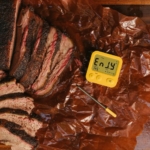
1) Line up the probe tip on the outside of the meat (that's a brisket below) until the point is past the middle. Then slide your finger tip until it touches the top of the meat (top photo). Now slide the probe into the meat until your finger touches the meat. The tip will be past the center (bottom photo). Now pull it back slowly and read the lowest temp. If any modeling agencies need a hand model my wife is available. Ain't that a purty finger?

2) Another option is to insert the probe from the side as in the porterhouse below. Use your finger to locate the center of the meat as above. Stay away from the bone which heats at a different rate than the muscle.

|
Is it done or is it ready?
There is a difference. Click here to learn when meat is ready.
Magic
Magic happens within the meat at different temps. Click here to learn some basic meat science.
Thermodynamics
Click here to learn the thermodynamics of cooking.
Use a cooking log
Click here for a cooking log that will make you a better cook.
|
Product Reviews and Meathead's Hot Stuff Awards
These are highly recommended products that I have tested personally or that have been tested by reliable sources. Awards are based on features, quality, and value. Rest assured that when I recommend a product, it is really because I like it, not because someone has paid me to say so or because the company is an advertiser or sponsor. I purchase most products I review although occasionally suppliers send me samples.
Manufacturers: Contact Meathead for permission to use this award medallion and to get a high resolution version.
|
Shopping tip
When a product is available on Amazon.com, I often provide a direct link. Amazon.com often has the best prices anywhere, even better than many manufacturers' websites. That's because manufacturers know that if they undercut retailers, these important resellers may drop their products. Please let me know if you find broken links, discrepancies in model numbers, specs, or prices.
Full disclosure: Amazon.com pays me a small commission, so purchasing from them helps underwrite the cost of operating AmazingRibs.com. But low prices, fast delivery, and good refund policies are the real reasons to buy from Amazon.com.
|
Thermometer Buying Guide
A radio host once interviewed me and asked "What is the single most important advice you can give a barbecue cook?" My answer, without hesitation, was "Get a good thermometer."
Now that I've had time to give it more thought, two good thermometers is ideal: One for the cooker, and one for the meat. Or one that does both.
Cooking with a bad thermometer is like driving at night without headlights. Spend the money for a good one. It will pay for itself by saving your meat and your face.
Without a good thermometer there's a good chance you'll be making lame excuses for overcooked meat, undercooked meat, or dinner at midnight.
Here's what the US Department of Agriculture (USDA) says: "The color of cooked meat and poultry is not always a sure sign of its degree of doneness. Only by using a food thermometer can one accurately determine that a meat has reached a safe temperature. Turkey, fresh pork, ground beef or veal can remain pink even after cooking to temperatures of 160F and higher. The meat of smoked turkey is always pink."
Finally, you absolutely positively cannot tell anything about the temp of a cooker is by holding your hand over it and counting until you have to pull your hand away. Anyone who says so is severely misinformed.
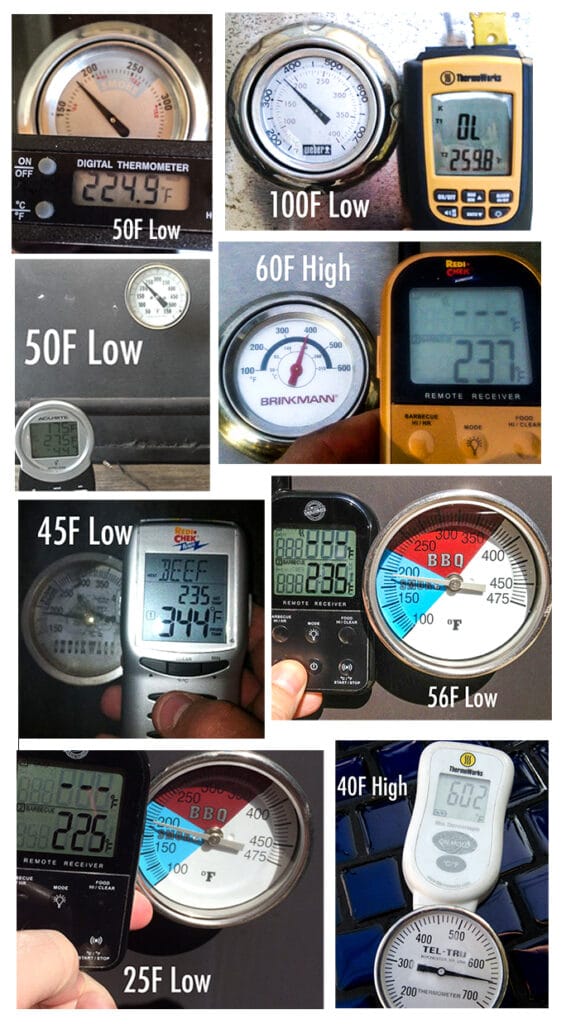
Oven thermometers. Can you imagine cooking in your kitchen if your oven did not have a thermometer? Then why do we try to cook outdoors without a good oven thermometer? And no, the thermometer built into your grill is not a good oven thermometer. In fact, it probably sucks. The bimetal thermometer that came with my gas grill tells me that the oven temp is 350F when a more accurate thermocouple reads 438F. Almost 100F off! If you hope to be king of the grill, you've got to got to got to know what the oven temp really is. Click here for a complete list of all oven thermometers available on Amazon.com
Meat thermometers. The best way to properly cook meat and protect against food poisoning is to take its temp. Some cooks can tell by look and feel. But that comes with years of experience and even then it is just not as reliable as a good thermometer. If you hate apologizing for overcooked meat or having to take bloody chicken off your guests' plates and sticking it in the microwave, then you've got to have a good meat thermometer. Click here for a complete list of all meat thermometers available on Amazon.com.
Checklist
Here is a checklist of things to look for when shopping for a good thermometer:
Accuracy. The difference between a medium rare and well-done steak is only a few degrees. Bad data is almost worse than no data, so it's important to know where the reading is coming from. For a meat thermometer, I want the sensitive part of the thermometer to be small and in the tip of the probe. This is important for measuring thin pieces of meat, like ribs. For an oven thermometer, I want the temperature next to where the meat is cooked. A thermometer in the dome of your Weber kettle will not tell you the temp that the meat is experiencing 6" below on the grate over the coals.
Speed to read. How long does it take to get a good reading? This is important for "instant read" thermometers, none of which are really instant. When you open the lid on your cooker to stick the meat you are letting out valuable heat and humidity. You want a device that gives you a quick read. Five seconds or less would be nice. Some work in two seconds.
Instant or continuous? Some probes are for pricking the meat and then must be removed. Some can be left in the meat and will provide continuous readouts throughout the cook. The ideal is one that can do both.
Range. If you're going to spend money on a thermometer, it would be nice if it could read the temperature of the meat, the oven, in your freezer, or in an ice bath, and in boiling oil.
Length of the probe. Meat thermometers need to be able to get the temp in the middle of big roasts such as hams and pork shoulders.
Thickness of the probe. A thin probe is easier to insert into the meat and leaves a smaller wound that seals faster. We don't need a gusher of valuable fluids following the probe out.
Adjustable. A good thermometer needs to be calibrated occasionally (see the info on calibration elsewhere of this page).
Easy to clean. We don't need barbecue sauce and soapy water in the inner works.
Ease of use. Is it easy to read? If it has lots of buttons and settings, can I remember how to use them?
Price. There are some decent units for under $20 and others can cost almost $200 with attachments.
Sturdy. I'm willing to make an investment in a good device. I want it to last. How's the warranty? And if it breaks, can I order parts? Will the manufacturer repair it promptly and for a reasonable price?
Timer. Although not necessary, some digital thermometers also have timers with alarms. Very handy.
Thermometer maintenance
Cleaning. After taking a reading you should wash the probe so you don't inoculate the meat later with microbes on the probe. Be careful not to get water into the electronics or other sensitive areas.
Calibration. You should check a thermometer's accuracy after you buy it, once every year, and if you drop it. You can check your thermometer's accuracy with boiling water and with ice water.
1) Boiling water. Bring a pot with about 3" of water to a boil and insert the probe. It should read about 212F. Notice the key word "about". The exact reading can vary slightly with air pressure (factory calibration is based on one atmosphere, about 30" of mercury). Minerals in tap water can cause minor variations, so use distilled water if you want to be absolutely precise. I just use tap water. Remember that water boils at lower temps at high altitudes. The ThermoWorks website has a nifty calculator that helps you determine what your boiling point is.
2) Ice water. Fill a tall glass with ice cubes, not crushed ice, add cold water, and let it sit a minute. Insert the probe and make sure it is not below the ice or touching the ice. The temp below the ice can be several degrees above 32F (0C) and the temp of the ice can be below 32F. The experts at ThermoWorks say "Make sure the probe is in the middle of the ice water mixture and then gently stir for best results." The ice water test does not vary with altitude.
Thermocouples: Best instant readers
Thermocouples are the best meat thermometers because they're fast. Some thermocouples can read accurately in fewer than two seconds, faster than any other sensor. Advantages? They're thin: They have two thin wires in the probe, so the probe can be very thin. They're easy to use: The sensitive area is very close to the tip so you know just what you're reading and they can be used to check the temp in several locations easily. They're accurate: They can be tested and calibrated. You can get thermocouples that are great for spot metering, or others that can be left deep inside a roast like a pork shoulder or a ham.
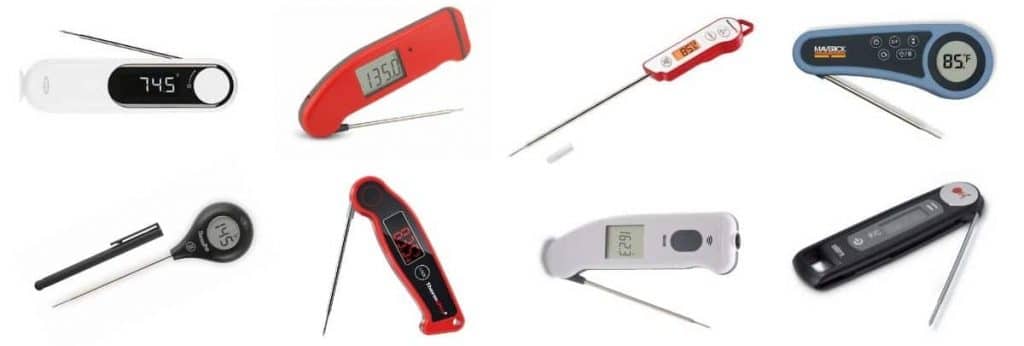
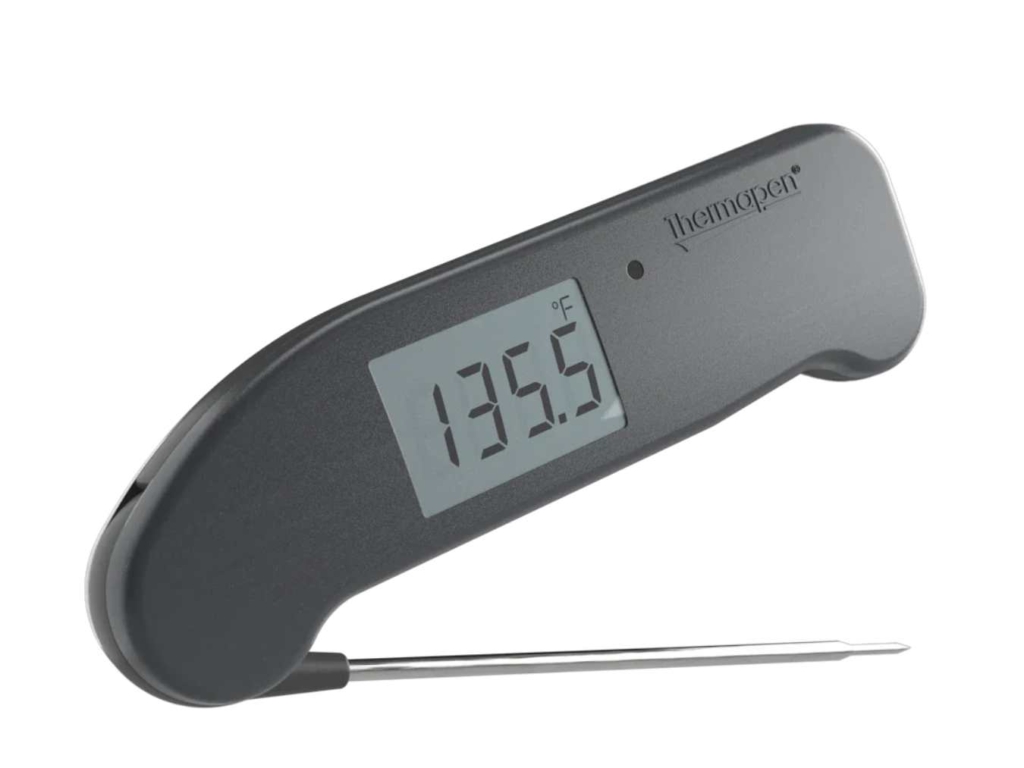
 ThermoWorks ThermaPen is a model I strongly recommend for anyone serious about cooking meat properly. It reads fast, has large easy-to-see numbers, and a long thin probe for getting into the center of a steak, a chicken breast, or even a large hunk of meat like a ham. The probe is thin so it will not open a gusher when you pull it out. It is on a pivot so it can reach into awkward places. The heat sensor is extremely small, so you know you are reading just where you put it and not a lot of the meat around it. For this last reason, it is the only probe I use for ribs. Another nice thing about the ThermaPen is that the company stands behind it. Mine began to malfunction after eight years. I called them, gave no indication that I was a writer, described my problem, and rather than hit me up for a nice repair bill, they told me how to fix it. For discount pricing and direct ordering from Amazon.com, click here
ThermoWorks MTC Mini Handheld Thermocouple is my new favorite. It is water resistant, accurate to within 0.1F, it reads really really fast, and the Fast Response Meat Probe (the left one of the three at right) is hypodermic thin. Best of all, the probe is easy to remove and you can plug in other probes. The Smoke House Penetration Probe (center) can be left in the meat and the braided stainless cord is heavy duty and will not fray. The Miniature Needle Probe (far right) is great for oven temp and has a cable thin enough to fit under lids or behind door gaskets. The thermometer is relatively cheap at about $43, but the probes are expensive, $30, $52, and $42 from left to right. Available from ThermoWorks. Now if they only had a remote readout unit like the Maverick (below).
Thermistors: Good for continuous readings
Thermistors are digital thermometers with a small resistor in the tip. They are not as quick as thermocouples and they tend to be thicker. Some have a probe on a wire that allows you to insert it into the meat and get the readout from outside the oven so you can monitor the meat temp continuously. Before you buy, make sure it can go higher than 350F so you can use it for reading the oven. The very popular Weber digital is meant for inserting into meat only and barely goes above 200F. Not good for reading the oven temp.
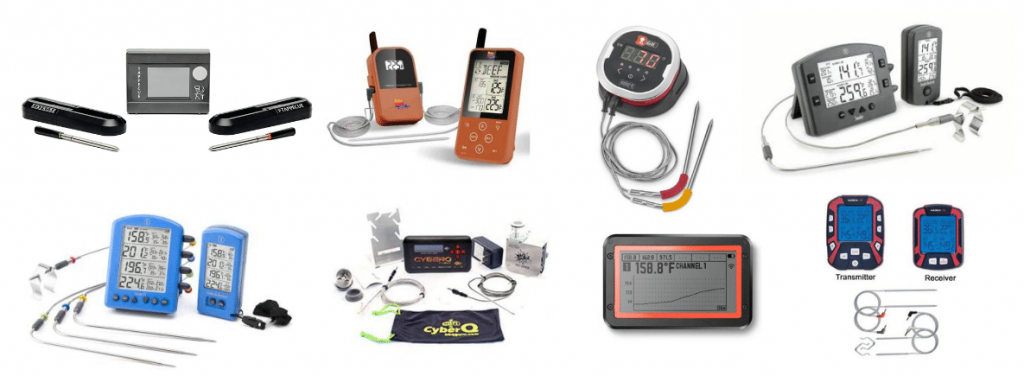
 Maverick ET-73 RediChek Remote Wireless Smoker Thermometer. This cool tool is a digital thermometer and timer combo. There are two probes and cables (I call them each a probe on a rope), one to insert into the meat, and another to leave in your smoker. Both probes plug into a sender module that transmits temperatures to a receiver that you can take into the living room with you and place on the couch next to the beer and chips. That's right, with the Maverick ET-73 you can monitor your smoker and your meat while you watch the game. You can also set the timer to remind you when to start the side dishes or wake you up if the game is really boring. If you can afford only one thermometer, this is the one since it is really two thermometers in one.
Maverick has good tech support. When my receiver began to malfunction, they told me the problem sounded like a bad backlight and told me to ship it back for a replacement. No question about when I bought it!
There is still room for improvement, however. You must turn on the receiver first or else it won't work, and turning on the sender is a pain because you have to remove the battery cover! Also, some of the programming is a bit tricky, so make sure to keep the instructions handy. Unfortunately, the instructions are not well written or organized. My final complaint: The range of the transmitter can be diminished by obstructions (like walls), so it may not reach you in the living room. But I still love mine. If you are handy, click here for instructions on how to extend your Maverick's range by beefing up the antenna.
It is important to know that the meat probe is designed to roasts and thick pieces of meat. You may not get accurate readings on steaks, chips, and thin cuts. For those, I prefer the faster, thinner Thermocouples. For discount pricing on the Maverick and direct ordering from Amazon.com, click here .
Weber Beeper Thermometer. This is a nice unit that has a single probe for the meat. It does not go high enough to read a hot grill/oven. But it does have a remote that you can take with you into the house. Click here for more info and pricing.
Taylor Commercial Waterproof Digital Thermometer, at right, can fit in your shirt pocket and will hardly dent your rear pocket. For discount pricing and direct ordering from Amazon.com, click here.
CDN Proaccurate. This stainless steel unit is said to be dishwasher safe, but I am reluctant to test that claim. Reads quickly and comes in a protective sheath. Recommended by Cook's Illustrated. For discount pricing and direct ordering from Amazon.com, click here .
Thermostats
The BBQ Guru and Rock's Stoker are incredible hi-tech solutions. They are thermostatically controlled blowers that regulate the airflow to the combustion chamber and thus control the temp extremely accurately. You still have to make sure you don't run out of fuel, but thermostats are where it's at, Jack.
Bi-metal coils: Good oven thermometers
These dial-and-needle readouts use two strips of metal bonded together and rolled into a coil. Each metal expands at a different rate and this provides the reading on a dial. They are fine oven thermometers, but they are slow and not very precise, so I don't recommend them for meat. Most thermometers built into grills and smokers are bi-metal, but they are often low quality. I recommend you replace them with a better model that is easier to read, more accurate, and can be calibrated. A popular model on high end smokers is the Tru Temp 814. It has a large 2.75" glow-in-the-dark dial. It ranges from 100-500F. It is well built with a 1.88" stem and it can be mounted onto the smoker wall. Remember to mount it near the cooking surface, not high above it. Another is the Tel-Tru, shown at right, with a wingnut, a range from 150-700F, 1.75" dial, and a 2.13" stem.
Some bi-metal thermometers are rated as oven-safe and can be left in the meat during cooking, but the sensitive area may be one inch or long, so they are useful only for meat thicker than 4", such as pork shoulders. They also can conduct heat into the meat so they can be used to speed cooking. Unfortunately the dial sometimes fills with smoke or water when being cleaned. They cannot be calibrated.
Here's a tip: If you notice condensation under the glass of a bi-metal thermometer, a common problem for those thermometers stuck into your grill, put it in a zipper bag with a couple of cups of rice or dried pasta and seal it up. In about a week they grain will have absorbed the moisture and your thermometer will work fine.
Other thermometers: Not recommended
Liquid filled. These old-fashioned devices (shown at right) cannot read a small area and are best for thick meats. They are not very accurate.
Pop-up thermometers. These single-use devices are often found in turkeys. They have a material in the tip that melts at a determined temp and releases a spring that pops the stem up. Although they can be accurate, they can also stick, they read only one part of the turkey, and they are usually set too high. First thing I do is throw them out.
This page was revised 1/6/2009
|