


No aspect of food is more misunderstood than fat. All mammals have it, and many vegetables do too. It is essential to human life. Cut it out of your diet and you die. Eat too much and you die.
There are many different kinds of fat: Saturated, monounsaturated, polyunsaturated, trans fat, vegetable oils, fish oils, nut oils, olive oils, omega 3, 6, 9, hike. This article will focus on solid animal fat, and what it does from a culinary standpoint, and try to settle the argument once and for all: Fat cap, on or off?
As far as the health apects, suffice it for me to say: I have digested authoritative research and learned that there is a huge amount of conflicting data, so much so that one might conclude that the only ones who really know the answers with any certainty are the food fascists who want you to eat like a horse: Only hay. The scientific community is still seeking facts. I am not qualified to form a conclusion other than to say that fat makes many foods taste better.
Fat serves many functions. Most importantly, it stores energy for the animal. It also insulates it and helps keep it warm. And because fat is a decent solvent, it dissolves and stores many of the flavor compounds in the foods the animal eats. That’s why corn-fed cattle taste different than grass fed. If a sheep has grazed on wild rosemary, you’ll taste it, and Spanish Iberico hogs fed acorns taste very different than any others. As animals age more of these flavors build up in the fat. That’s why mutton has a stronger taste than lamb.
Melting surface fat does not penetrate muscle
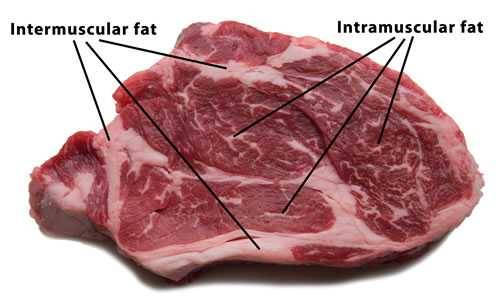
It is important to differentiate between different types of fat:
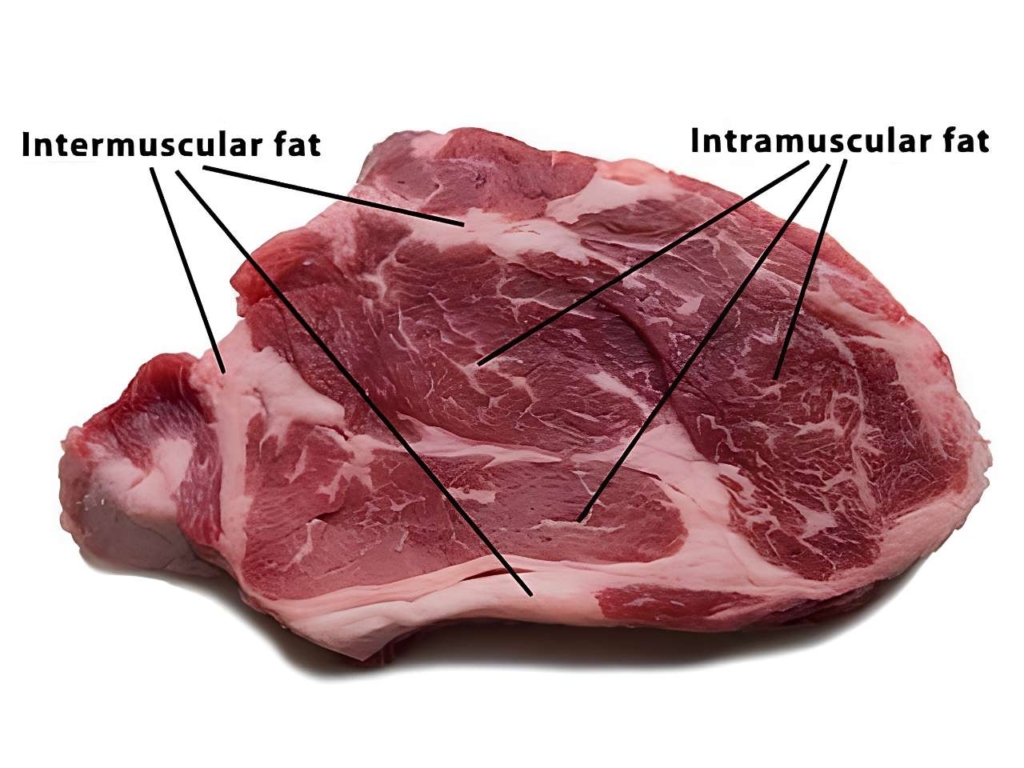
1) Subcutaneous fat, the thick hard fat layer right under the skin of many animals also called the fat cap. Most of the fat on steaks and chops are wrapped around the edge, called edge fat, and it can cause nasty flareups. It often covers silverskin, tough connective tissue that shrinks under heat and causes steaks and chops to cup. It should be removed.
2) Intermuscular fat, the fat that lays in thick layers on top of muscles as well as between muscle groups.
3) Intramuscular fat, the thin whisps of fat that thread their way between fibers within the muscle. Also called marbling, it is the fat that gives meat its rich texture and much of its flavor.
4) Intercostal fat that is found between ribs.
The penetration myth
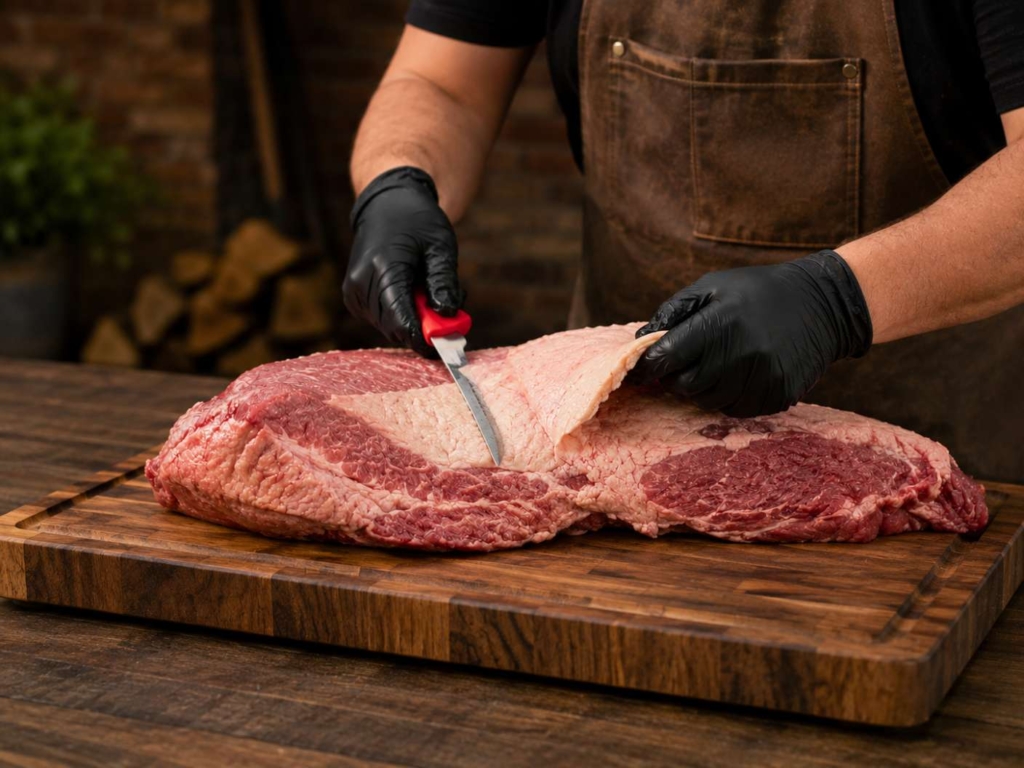
So let’s say that you have a hungry crowd of rowdies to feed and this big ole honkin’ pork shoulder, beef brisket, leg of lamb, or prime rib. It has a thick layer of fat on top. The question is, leave it on or trim it off? Most books, TV cooks, and websites say that you should leave it on because it will melt and percolate down into the meat making it juicier.
Nonsense.
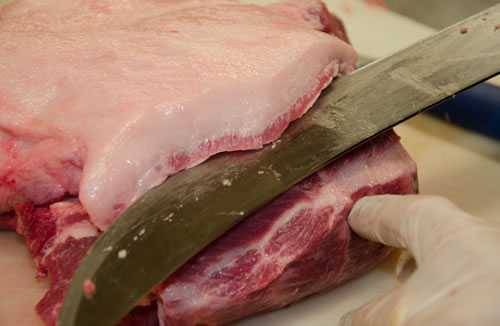
The fat cap is usually white, fairly hard, and can be as much as two inches thick. Meat scientist, Dr. Tony Mata, the AmazingRibs.com beef consultant, explains, “Fat will not migrate into the muscle as it is cooked. First of all, the molecules are too large to squeeze in. Second, fat is mostly oil. The red stuff in meat is muscle and it is mostly water. Oil and water don’t mix. Protein in muscle is also immiscible in fat because of its chemical configuration. Third, in most cases there is an anatomical barrier between muscle and fat cap, namely, a layer of connective tissue holding muscle groups together. It too is water based.”
The AmazingRibs.com science advisor Prof. Greg Blonder adds a fourth reason: “Raw meat is like a protein sponge. Before it is cooked it is fully saturated with water. There’s no room for the fat to go in. As the meat cooks, water-based juices are being expelled from the interior. No way fat can swim upstream.”
Although this is not the best example of my photography, you can see the point made clearly here. I dug a hole in a piece of beef and filled it with olive oil. As you can see, even after 3 hours plus, none of the oil penetrated the meat. BTW, there is an interesting additional phenomoenon on display here: The meat got pinker after the myoglobin combined with oxygen.
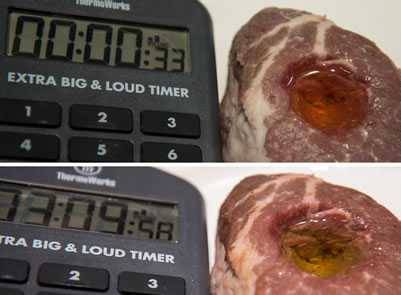
Consider this myth busted.
The basting myth
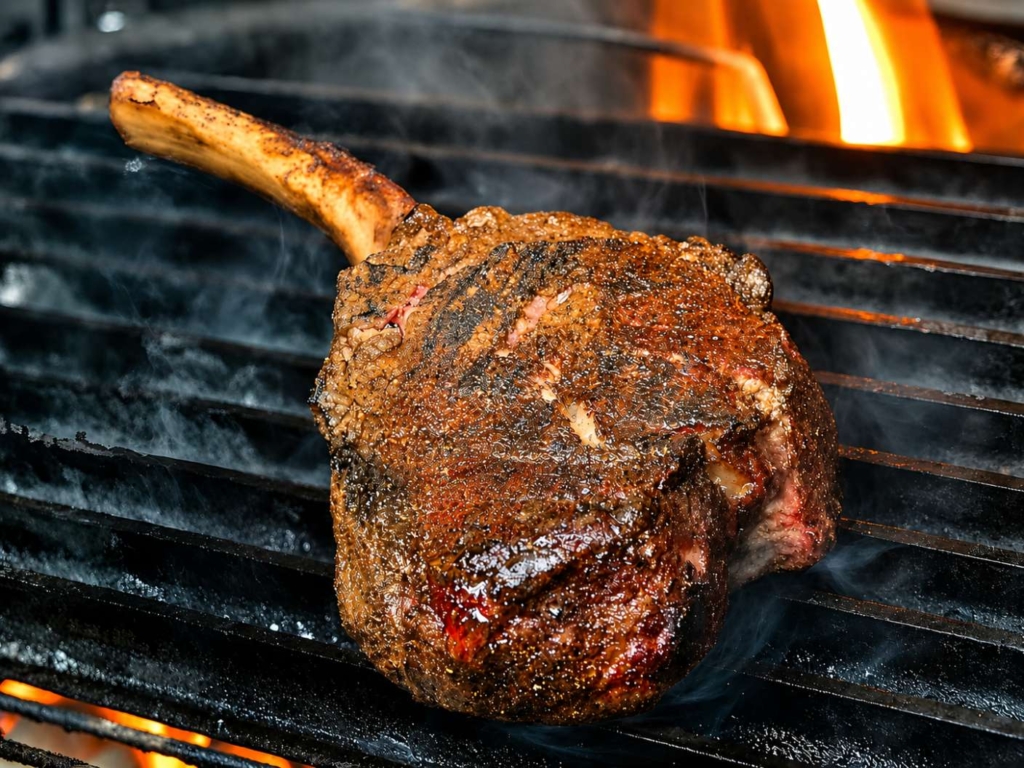
People who defend the fat cap claim that it bastes the meat. So let’s think about that for a second. What does melting fat do on the surface of protein? At high temps lipid’s molecular structure can be altered and create great flavors. That’s why I recommend painting a steak with beef fat during the sear phase. But at low or even medium temps, when the meat roasts, the fat just melts and drips off. It does not enhance the flavor of the meat like a paintbrush full of a flavorful basting liquid. Water based bastes cool the meat and slow the cooking which can improve tenderness. It can also to a small defgree replace water that evaporates. But oil? Not so much. There is one possible benefit: Dripping fat that hits hot coals or metal below can vaporize and impart flavor on the meat. How much depends on how long you cook.
Here is an article about the pros and cons of basting.
Fat cap on or off?
So if the fat does not penetrate the muscle, should you leave it on or off? Here are the pros and cons:
- When you cook meat with the fat cap on it softens, some of it browns, some melts and lightly coats exposed muscle groups below, and some of it drips off into the fire where it is vaporized and can settle on the meat adding flavor. Some of the fat will drip off and can be collected for use in making gravy or stored for use in frying later.
- If you leave the fat cap on, it can slow salt penetration and salt is very effective at helping the muscle retain moisture. Salt also burrows down into the muscle and amplifies its flavor. If you leave the fat cap on a brisket, you should consider injecting brine.
- Spices do not penetrate muscle more than a fraction of an inch, but they do flavor the surface and help form the crust. If you coated the meat with a wonderful spice rub, it will remain on top of the fat and not get onto the meat. Much of that flavor and expense will drip off.
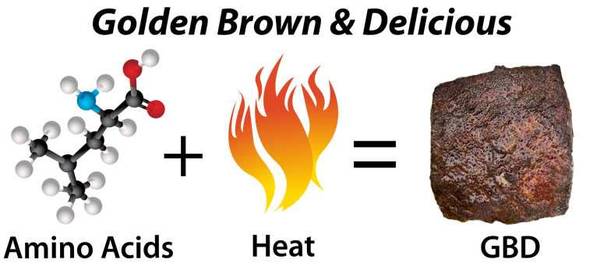
- If you leave on a thick fat cap, most people are going to trim it off at the dinner table. If you have used a spice rub, all your expensive spices will be removed along with the wonderful browning flavors created by the Maillard reaction and caramelization.
- Most of the flavor from smoke comes from microscopic particles and gases, and, although the gases can penetrate, they rarely penetrate more than 1/4″ so if there is 1/4″ of fat it will absorb much of the smoke flavor and block the formation of a smoke ring. Click the link above to learn more about smoke, and click here to learn more about the smoke ring.
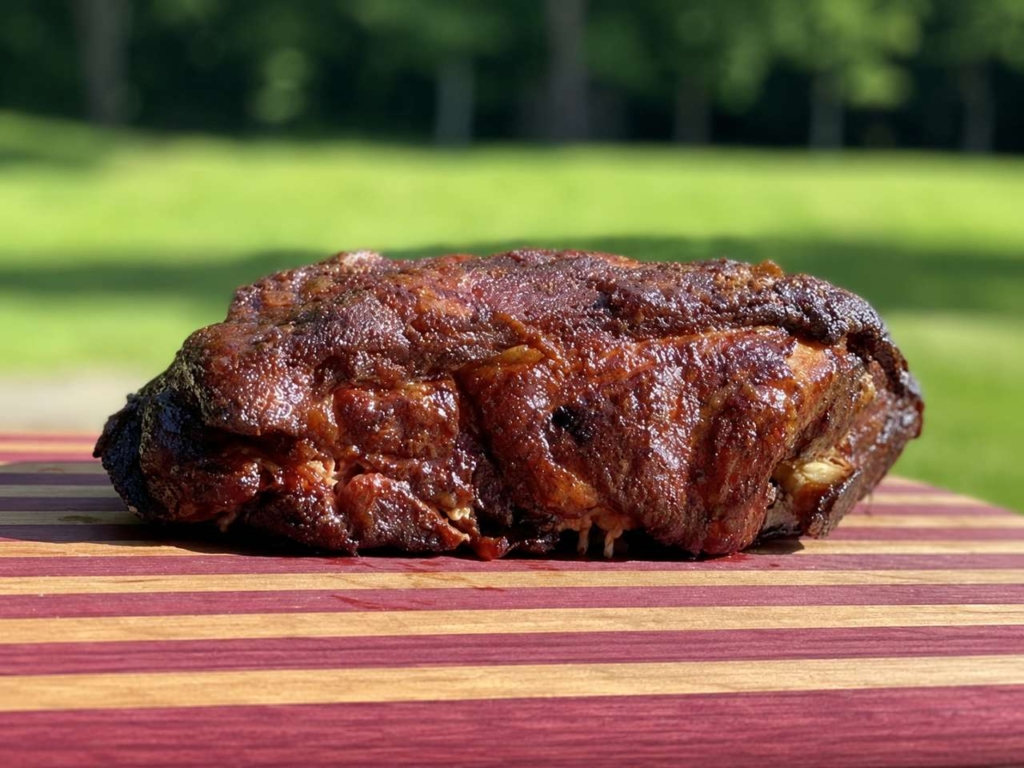
- But fat does help prevent water from evaporating. Evaporative cooling is what causes the stall, a consterning phenomenon where the meat, when cooked at a low temp like 225°F, stops rising in temperature for hours because moisture evaporates and cools the surface. Hypothetically, if the entire piece of meat was covered in a thick layer of fat, no water would evaporate, there would be no stall, and there would be more water in the final product. But water is just a part of the feeling of moisture in meat. Much of it comes from intramuscular fat and melting collagen from connective tissue. And the drying of the surface is part of the formation of the tasty crust called bark.
- Finally, fat is full of flavor, often tastier than the meat itself, and the best tasting meats are those with small fat deposits strewn throught the muscles, marbling.
When to leave a fat cap on
There are some good arguments for leaving on a fat cap.
- If your cooker has the meat sitting directly above the heat, putting the fat cap down creates a heat shield protecting the meat surface from drying heat.
- On the other hand, if you like a crunchy crust, a thin layer of fat coated with salt, spices, and herbs, can combine to create something that barbecue lovers lust for on pork butt for pulled pork, a jerky-like dried surface packed with flavor called bark.
- On the other hand dripping fat vaporizes and transmits flavor to food above.
- On the other hand dripping fat can flare up and if too much fat hits the flame it can produce nasty black soot.
- On the other hand,the fat layer will trap evaporating moisture and produce juicier meat, but not a hard bark. Also, after a long cook, such as the 12 hours or more a whole brisket needs, the meat dries a bit from evaporation, drip loss, and breakdown of collagen holding the muscle fibers together, leaving perhaps 5 to 10% airspace within the cut. It is a good practice to rest briskets for an hour or so in an insulated box, a faux cambro, so that liquid can fill the gaps. Dr. Blonder says he likes to rest the meat in a vacuum bag to maximize this.
Spaulding’s cut
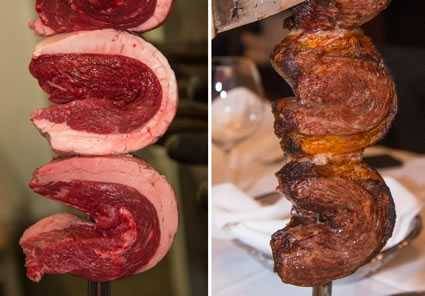
Now here’s a cut young Spaulding would love: Picanha.
In Brazil and Argentina, they relish this cut. In the US it is called coulotte or sirloin cap steak. There is a way of grilling this cut by impaling wedges on a large skewer. Mata says “A specific amount of fat cap is left attached on purpose. The skewers are placed above hot coals. When served, the wedges are sliced onto the plate directly from the skewers. The fat is consumed, not trimmed off. It is fantastic.”
You may have seen this presentation in Brazilian themed restaurants presented tableside with a flourish on the sword-sized skewers. The photo here is from the website of the Brazilian steakhouse chain, Fogo de Chão. Next time you go Brazilian, taste the fatcap on the Picanha.
Bottom line
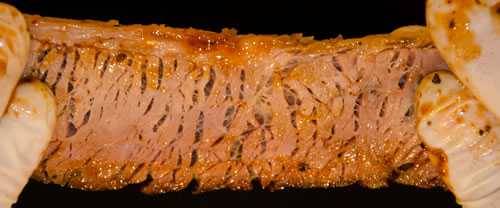
Conclusion? Remove all but a thin layer, 1/8″ or less, as on the top of the slice of brisket at right. Much of it will melt away, but if you leave a little people can eat mostly muscle and still get a taste of flavorful fat, as well as the spices and herbs you lovingly blended and rubbed all over.
I recommend removing all the fat except 1/4″ to 1/8″. Most of that will melt off and drop away leaving 1/8″ to 1/16″, and people will see that the spices are on that cap and most will eat it, significantly enhancing the dining experience.
And what about the fat dripping into the fire and being resurrected as flavorful droplets mixed in with smoke? I save the fat cap and put it on the grate over the fire and let it drip away.
Before you can post a comment or question you must sign into our commenting partner, Disqus. This helps make sure everyone hanging around the grill is civil. We do not tolerate nastiness, racism, porn, inappropriate language, or attacks on others. All comments are the property of AmazingRibs.com and we reserve the right to quote them, edit them, delete them, and block people from making future comments.
Please leave comments and questions on the same page that is devoted to that subject so others can see questions and our answers when they are reading about the subject. You must enable JavaScript to use the comments section, and you must accept cookies to post comments. Note: the software that runs Disqus is different from the Pitmaster Club, so members need to sign into the Pitmaster Club separately.