
If You Have A Weber Kettle You Absolutely Need A Smokenator
"Using your techniques, and cooking on nothing more than a pair of Weber One-Touch Silver Kettles equipped with Smokenators, our team finished 4th overall out of 44 at an International Barbeque Cookers Association (ICBA) sanctioned event!" Martin Alex Hambrick, House Divided BBQ Team
By Meathead
For less than $70 you can easily convert a standard Weber Kettle into a smoker capable of making restaurant quality smoked ribs, pork shoulder, brisket, turkey, or salmon. If you have a limited budget or limited deck space, there is no need to buy a standalone smoker.

First thing you need to know is that you should not rely on the manual. It gives bad advice. This page should be your new manual.

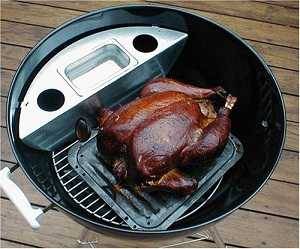
Here's how this deceptively simple gadget works: The Smokenator is a simple piece of bent 18 gauge stainless steel that inserts into the lower half of the kettle. You can place meat on the lower and the upper rack so it is possible you can get eight to 10 slabs on at once. Then you put some hot charcoal in the Smokenator, some wood chunks on top of them, and some water in the water cup. If you have something drippy like a pork butt, put a drip pan under it. Add water if you like.
Put the lid on, adjust the dampers, and go drink a beer. The Smokenator will pump out aromatic smoke and just the right low and slow temp for hours. I had no trouble keeping the temp under 250°F on a 100°F day. The thick steel plate blocks your meat from direct exposure to the flames becoming a large flat radiator providing indirect heat. The water bowl puts moisture in the oven which helps develop the smoke ring. Keep in mind that this is a "hot" smoker so it can't do cold smoking for things like lox or cheese. But it can do just about anything else the fancy-schmancy smokers do. A very clever, inexpensive gadget that actually works as advertised.
I use it for cooking thick steaks with the reverse sear. I start the meat in the indirect side, just a few pellets in the Smokenator with the coals, and I slowly warm the meat to about 115°F, getting the interior perfectly even colored. Then I take the steak off for a few moments, lift the grill grate, remove the smokenator, and place the steak right over the hot coals to sear the exterior. Click here to learn more about the reverse sear.
I have also left the Smokenator empty and put the coals against the other side and placed a steak above the empty Smokenator for a low slow roast before the sear in the rear.
Smokenator setup and tips
If you have a Weber Kettle grill, you need a Smokenator. The Smokenator may be the best accessory for the Weber Kettle ever. It turns an $89 grill into a $400 smoker for about $70.
Here are my tips for success:
Before you start cooking, calibrate your tool. Do some dry runs without meat so you know what it is actually doing and how it reacts to changing vent openings and when coals burn down. Start by reading my article on calibrating and seasoning your new grill or smoker.
The Smokenator manual says "Insert a Taylor candy thermometer or a bi-metal thermometer into one of the upper vent openings." Do not use a thermometer in the dome unless you plan to eat the dome. The side of the grill with the Smokenator will be hot, the side without will be much cooler. The temp in the dome will be a blend of the two. In addition, the temp on the bottom rack will be about 50°F lower than the temp on the top rack. You must always measure the air temp where the meat will be. It is the meat that you are cooking, after all.
Besides, bi-metal dial thermometers, especially the $10 variety are usually absolute pure junk. They are often off by 50°F or more. You absolutely must use a good digital oven thermometer to get this baby under control. Once you've done that you can smoke as well as any of the big units. Click here to read my buyer's guide to thermometers.
Drop the probe through the vent holes in the top, not under the lid. You want to control the airflow and snaking it under the lid will allow in air. Better still, drill a small hole in the side of your kettle just above the grate on the side opposite the Smokenator so you can slide the probe in there. While you're at it drill another hole just above the lower grate for when you cook down there.
If the temp drops below your target or about every 30 minutes, use the skewer they supply to stir the coals and knock off ash, add unlit charcoals to fill it back up, and top off the water pan. The unlit coals will create smoke so you may not need to add wood. And, no, unlit charcoal will not make your food taste bad unless you use the stuff that has accelerant in it like Match-Light. Read my article on The Zen of Charcoal.

Remove all ash before using the Smokenator.
A charcoal grill uses two fuels, charcoal and oxygen. You need to figure out how to control them to get the right temp, usually 225°F or 325°F depending on the food.
Open the top vent halfway and leave it there for your first dry run. Never close the top vent all the way. Start with the bottom vent open all the way. Control the oxygen with the bottom vent only since it feeds oxygen to the coals. Try not to close the bottom more than halfway. If your lid is bent, it is letting air in and you can't control temp. Get a new lid.
The air temp outside the grill, rain, and wind can drastically impact the internal temp. You cannot rely on the settings in the manual. It was written by people in San Jose, CA, where the weather is always beautiful. The colder the day, the more lit coals you need to use. On hot days use a mix of lit coals and unlit coals. You can put hot coals on top of unlit coals or visa versa, it doesn't make much of a difference. But beware, unlit coals produce more smoke, so you will need less wood.
Don't use lump charcoal. It varies from bag to bag and you need consistent heat. There is also too much dust in lump bags and dust impedes airflow in the Smokenator. Also, with briquest you can count them and this helps you control temp. Smokenators tend to run hot so I recommend Kingsford Blue Bag charcoal because it does not burn as hot as the Kingsford Competition (brown bag). Pick a charcoal and stick with it.
Put about 40 unlit briquets into the bottom of the smokenator. Put two wood chunks on top of the unlit coals, each about two to three ounces, one on either side. I recommend wood chunks not chips, as large as you can get through the holes. Mojobricks, which are made from compressed sawdust are great for this purpose. Read my article on the Zen of Wood.
On hot days put 12 briquets into a chimney, up to 24 on cold days. A Weber chimney holds about 80 briquets and the Smokenator holds about 60. Briquets shrink as they burn down. When the coals are covered with white ash, add them to the Smokenator, top it off with more unlit coals if there is room, close the lid, and start watching the temp. Adjust the lower vent and watch the temp. Read my article on controlling temps with vents. Take notes with my cooking log. If it runs too hot, next time use fewer hot coals and/or close the vents. But never close the top vent all the way. Learn your tool.
You can put food on both the food grate and the lower charcoal grate but beware that the temp down there is usually about 50°F cooler.
Cook on the upper grate most of the time, but if it is running hot, use the lower grate.
You can use rib racks, but don't crowd them. Ther must be airflow between the slabs of meat. Click here to read my article on Cooking More Than One.
The more cold food in the grill, the colder the air temp in the grill will be so you will need more fuel in the form of lit coals or air or both.
Fill the water cup with water, not beer, wine, juice, etc. Don't skip the water, it helps keep the temp from spiking and dipping. Click here to read more. They don't penetrate the meat. They just waste money. If the cup doesn't settle in all the way because coals are in the way, that's OK. Fill the water cup whenever it gets low.
When you lift the lid, lift it straight up and don't tilt it. That will trap much of the heat under the hood and recovery will be faster when you put it back on. Click here to read the debunking of "lookin you ain't cookin".
DonZ says he puts a loaf pan on top of the water pan and fills it with water so he doesn't have to refill the tiny Smokenator cup as often. Smart!
Keep the lid on tight. If you are having temp control problems, chances are you are leaking too much. Air flow control is vital. If you see a lot of leakage under the lid, go buy four or five 1.5" binder clips in your office supply store. They'll hold it tight.
Combine the Smokenator with a PartyQ thermostat and you have one helluva machine! Click the link to read more about the PartyQ and how to mount it to a Weber Kettle.
Join the Smokenator Forum. There is a message board with idea exchanges between Smokenator owners, more tips, and tricks.
Martin Alex Hambrick of House Divided BBQ Team in Texas wins money on the competition circuit with the Smokenator competing against teams with $10,000 smokers. He has a clever way of dealing with a common problem, when the temp starts to drop and there aren't many lit coals left. "For longer smokes I use the bottom grate. If you waited too long and there's not enough coal on the bottom, no worries. Just fill a chimney up with 10 to 15 coals, light it, and wait until they are gray.
"With heavy gloves I take out the Smokenator, flip it around, and tent the meat with the Smokenator. This keeps it warm while I fire up the new coals. This is why I use the bottom grate for the food, it makes it super easy just to flip the Smokenator around and rest it on the inside of the grill over the meat.
"Using a metal garden trowel or tongs, I scoop up all the lit coals and drop them in the chimney or in the lid to store them, which keeps the lid nice and warm. I give the ash scraper a few go-arounds to clear out all the ash, and then take the Smokenator off the meat and put it back in position. Now I treat it like an empty Smokenator: I fill it up with unlit coals and wood, and then using the trowel or tongs, I place the lit coals from the lid/chimney on top of all the unlit ones."
If you have a Smokenator, what advice do you offer? Tell us below:
This page was revised 4/27/2013
About this website
AmazingRibs.com is all about the science of barbecue, grilling, and outdoor cooking, with great BBQ recipes and tips on technique. Learn how to set up your grills and smokers properly, the thermodynamics of what happens when heat hits meat, as well as hundreds of excellent tested recipes including all the classics: Baby back ribs, spareribs, pulled pork, beef brisket, burgers, chicken, smoked turkey, lamb, steaks, barbecue sauces, rubs, and side dishes, with the world's best buying guide to barbecue smokers, grills, and accessories, all edited by Meathead.
Advertising on this site
AmazingRibs.com is far the most popular barbecue website in the world and one of the 50 most popular food websites in the US according to comScore and Quantcast. Visitors and pageviews increase rapidly every year. Click here for analytics and advertising info.
| Weights, Measures, Conversions | Tips & Techniques | Recipes | Equipment Reviews | BBQ Culture & History |
| My Ingredients | BBQ Joints | About Us | Blog | Links | Newsletter | BBQ Tunes |
| Privacy Promise, Code of Ethics, Other Legal Terms | Advertising & Sponsorship Opportunities |


GrillGrates amplify heat, eliminate hot spots, and block flareups. This is the concept behind the expensive new infrared grills. A must add-on for all gas grills.


Please please please read this before posting a comment or question:
1) Please use the table of contents or the search box at the top of every page before you ask for help.
2) Please click the "Follow Conversation" button or the "Email" button below your comment so you will be alerted when we reply.
3) Please don't ask any questions that involve temperature unless you tell us that you are using a digital thermometer! Dial thermometers are often off by as much as 50°F! If you are not using a good digital you have no idea what the temp really is so we can't help you. Please read this article about thermometers, then buy one of our recommendations, and then, if the problem persists (chances are it won't), hit us with your questions.
4) Please tell us everything we need to know to answer your question like the type of cooker you are using.
5) If you are shopping for a grill or smoker and need help, tell us your budget!