




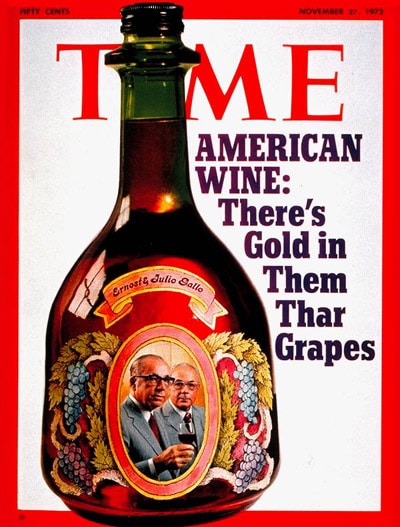
Ernest Gallo, foreground in the picture, died March 6 at age 97, but when I had dinner with him in 1978 he was at the height of his powers, running the largest wine selling machine in the world, and, after a long dinner, in one telling sentence, he demonstrated why he was such a conundrum, why he was both hallowed and hated.
Ernest co-founded, with his older brother Julio, the E&J Gallo Winery. The pair did more than anyone to popularize wine in a nation still recovering from Prohibition and bathtub gin. Shortly after the repeal of Prohibition 1933 they reportedly started with $5900 and a recipe they found in the library, built an empire, pioneered new methods of viticulture, winemaking, and marketing, but along the way they squashed rivals like grapes and nurtured allies like rare bottles. They taught their children the family business and passed it on to them, but they were so ruthless they sued their younger brother, Joseph, for using the Gallo name on a dairy.
Ernest ran the marketing and sales side of the team. Julio ran the production side. Julio was a year older than Ernest and 11 years older than Joseph. Julio died in 1993 at age 83 when a jeep he was driving on one of his ranches rolled off an embankment. Joseph died at age 87 on February 17, just a few weeks before his nemesis, brother Ernest.
When I came calling in the fall of 1978, Ernest and Julio were putting the final touches on a massive wine processing facility in Modesto in preparation for a huge harvest. The after-effects of a highly publicized boycott by the United Farm Workers for Gallo’s hardball labor practices were fading and sales were soaring. America was in a “wine boom” with per capita consumption growing rapidly spurred on by innovative television ads created under Ernest’s direction. A new generation of 20-something winemakers, fresh out of the University of California at Davis were breaking all the rules, and wineries were popping up in the coastal valleys like weeds after a rain.
I was teaching wine at Cornell and writing a weekly column about food and drink in the Chicago Tribune. I had just toured the cynosure of wine, Napa and Sonoma, where boisterous winemakers were challenging the establishment order with amazing wines and outrageous new wine styles. Just two years earlier two Napa Valley wineries bested the best of France in a blind tasting in Paris of all places, and the story was front-page news.
Not many connoisseurs were interested in what the Gallos were up to in the central valleys, mass-producing inexpensive table wines in the irrigated desserts surrounding Modesto. So when I came calling, they proudly showed me the huge vineyards stretching to the horizon with the massive mechanical harvesters replacing the rebellious migrants.
I wanted to interview Ernest, but instead of arranging a meeting in a conference room, he invited me to dinner at his home, with his winemaker, Charlie Crawford, and their wives.
It was a fabulous meal prepared by their personal chef. Multiple courses, each accompanied by Gallo wines. They were not special barrel samples, but off-the-shelf bottles that sold for about $5. I tried to ask him questions but he parried them with questions for me. What did I think of his wines? What did the public think of his wines? Where did I think the market was going? Did people care about their labor troubles? Who’s hot? Who’s not? Insatiable curiosity. No, ceaseless market research.
Finally, the dessert course. Mrs. Gallo called for a tray of macaroons flown in from Ernest’s hometown in northern Italy. He twisted the screwcap off a Ruby Port. I asked, a bit timidly, “May I share a bottle of something special I have on ice in my car?”
Two days earlier I had visited Chateau St. Jean in Sonoma Valley where a brilliant young winemaker, as yet relatively unknown, Richard Arrowood, handcrafted some of the finest vintage dated, vineyard designated wines in the world, each with unique personalities. His operation was the polar opposite of Gallo’s where the non-vintage wines were manufactured with the goal of consistency and affordability.
Late in the fall of 1976 Arrowood (now at Amapola Creek Winery) lead a team of pickers into the vineyards and they hand selected bunches of overripe Rieslings that had become infected with a mold, botrytis cinerea. Known as the noble rot in Europe, botrytis occurs only when the weather cooperates and dehydrates the grapes leaving behind a super sweet nectar that, when one gathers enough to fill a bathtub, might yield a half-bottle of luscious, syrupy wine that is the ultimate accompaniment for pastries.
Tiny amounts of botrytised wines had been made only two or three times in California previously. Arrowood had made enough to actually put it on the market, and I bought a half-bottle. The price was about $30. It was in a cooler in the car, and I thought it would accompany the macaroons beautifully. Certainly better than the cheap port Gallo wanted to serve. Gallo Ruby Port sold briskly in flat pint and half pint flasks, just the right size for the back pocket of a wino.
When I asked if I could bring in another winery’s product, Ernest hesitated for a moment, but Crawford nodded at him and he graciously accepted my offer. I retrieved it from my car under the supervision of Gallo’s bodyguard, brought it in, it was uncorked, and passed.
For the first time there was silence. Gallo liked to say that he strived to make wines that encouraged customers to have a second sip. Everyone sipped Arrowood’s wine a second time. Smiles broke out around the table at all seats but one. Gallo furrowed his brow. He lifted the viscous liquid to the light. He sniffed at it like a truffle hunting dog. He read the label. Every word. Finally, he passed it to Crawford and said, in a sentence that demonstrated what made him consecrated by friends and cursed by competitors, “Get another bottle of this, send it up to the lab, and figure out how they did it.”


Before you can post a comment or question you must sign into our commenting partner, Disqus. This helps make sure everyone hanging around the grill is civil. We do not tolerate nastiness, racism, porn, inappropriate language, or attacks on others. All comments are the property of AmazingRibs.com and we reserve the right to quote them, edit them, delete them, and block people from making future comments.
Please leave comments and questions on the same page that is devoted to that subject so others can see questions and our answers when they are reading about the subject. You must enable JavaScript to use the comments section, and you must accept cookies to post comments. Note: the software that runs Disqus is different from the Pitmaster Club, so members need to sign into the Pitmaster Club separately.