




These are great on the beach over a campfire and can be made with clams, too.
When I was a boy, I lost too many fishing days scraping too many baby mussels from the bottom of my Dad’s runabout. As much as I enjoyed using the boat for fishing, I enjoyed this job as much as weeding his beloved pineapple patch.
It was not until college that I discovered the better side of shellfish when my friend Kurt Westfall handed me a claw hammer and took me wading near his home in St. Petersburg. We wore old canvas Keds, canvas gloves, and carried canvas bags. We would gather driftwood, build a fire, wait til some of the logs burned down to embers, rake them into a pile, put a big pot right on the glowing coals, and make this dish. I have fond memories of beach bonfires with big bowls of bivalves and beer.
There are many recipes for cooking mussels, clams, and oysters on the grill, my favorite way of cooking almost everything, but most have one fatal flaw. They waste the liquor.
Liquor, in this case, is the incredibly rich briny broth in which the mussel meat floats and exudes when cooked. When you throw bivalves on the grill the shells pop open and spill much of their bodily fluids into the flames. As a barbecue evangelist, it is my sad duty to tell you that bivalves are better steamed in a pot. The outdoor cook can do this recipe in a pot on a campfire or on a grill, or on your side burner, but it is just as good indoors.
The cooler months are the best time for salt water mussels (smooth black shells), clams (rippling white shells), and oysters (bumpy lumpy, jagged shells). When the water is warm they are in the mood for love and they lose weight and flavor. They are best from October through April in the northern hemisphere, when they store fat. Fresh water mussels aren’t very good tasting.
Not surprisingly, the French created the best recipe for cooking mussels, called Moules Mariniere, and my wife and I have adapted it successfully with other seafood such as clams and oysters. It is great beach and football watching fare. At home we always prepare more moules than we need, and the leftovers make a rich, heady pasta sauce for later in the week.
Buying and storing mussels
Because they are widely farmed by planting their seed in ropes dangling from buoys, mussels are less expensive than clams and oysters, and they taste fine to me. In addition, farm raised mussels are easier to clean than wild, and rarely have sand in them. The green-lipped variety is becoming fairly widespread. People who dislike the idea of fish farms should have no compunctions over mussel farms. They are not fed anything artificial, there is no genetic engineering involved, and the waste is no problem.
Three pounds (1.4 kg) of mussels yields about 1 pound (453.6 g) of edible meat. I usually buy 24 per person, enough for discarding dead ones and for leftovers for pasta. Ask your store for the freshest bag of mussels. You want them alive. By law grocers must keep records of the date of harvest and location, so do not shy from asking for this info. Mussels usually are shipped in mesh bags, and should be stored in the refrigerator. Sniff them before you buy. They should smell like a handful of fresh seaweed. They should not smell fishy or, pardon the expression, poopy. If there are dead ones, they usually have a rotting or fecal smell. The nose knows.
Mussels are naturally high in protein and minerals, and have a rich flavor. Depending upon their origin, they can vary in brininess, fattiness, and taste.
If you cannot use a bag of mussels same day, wrap them in wet newspaper and put them in a bowl on top of ice in the refrigerator for up to 48 hours. Do not store them under water. They are salt water animals and might die if kept in fresh water for long.
Some mussels have beards. These hairy filaments are like tentacles that hold them in place in the wild. By the time they reach the store, many have had their beards clipped. In case they haven’t, or some fibers remain, cut them with a scissors just before cooking. Do not yank them off as soon as you get them home or you might kill the mussel.
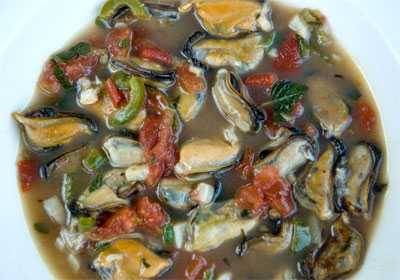

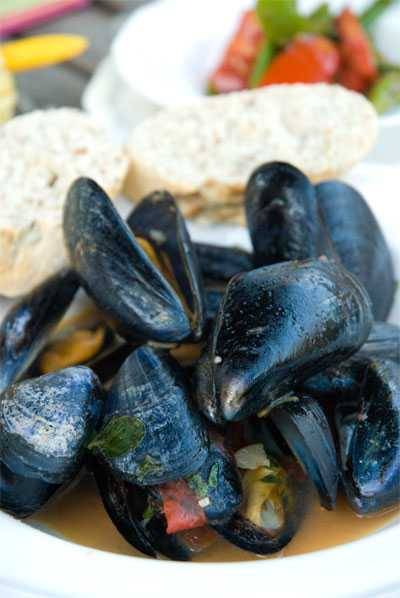
Mussels Mariniere Recipe
Ingredients
Method
- Triage. Just before you are ready to cook, you must do a little triage. This selection and cleaning process is critical because one dead mussel in the pot will stink up the kitchen and have you ordering out for pizza. Begin by rinsing them one at a time, washing off dirt and seaweed. Squeeze each mussel between your thumb and forefinger trying to slide the shells across each other. There should be resistance from the adductor muscle within the shell. If they slide easily, they are probably dead and must be discarded. If one is a lot heavier than the rest, it may be filled with mud or sand, so place it in the sink, crack it open, and check. Mussels with or broken shells should be discarded, too, because they are likely dead. It is often said that those with open shells should be discarded, but this is not true. Some live mussels open up after they have been out of water for a while and remain alive. If the shells hold firm, and they smell fresh and salty, you can keep them. The nose knows. When in doubt, throw it out.
- Soak and trim. Once you have culled the live from the questionable and rinsed them, submerge them for an hour or so with one tablespoon of salt per quart of water to get any stale water out of their systems. If the water gets cloudy, change it. Some people put in a few tablespoons of flour or cornmeal for the same purpose, and some say this fattens them up. My informal experiments are inconclusive. I don't see that this makes a diff. Just before cooking you should cut the beards off with a scissors or yank them.
- Optional tomatoes. If you are using them, cut the stem end off the tomatoes, about ½ inch (12.7 mm) from the top so you can see the gelatinous center, and hold them stem down over the garbage can. Squeeze out the seeds. Then coarsely chop them.
- Simmer. Mix all the ingredients except the mussels and tomatoes in a large, covered, non reactive pot, kettle, or wok. Crank the heat up and put the pot on until it is boiling, add the mussels and tomatoes, stir until the mussels are coated, and steam for 10 minutes, or until the shells have popped open and beg your indecent attentions. Do not overcook. Discard any that have not opened. Adjust seasoning to taste, but they should not need salt. You can add some fresh oregano, thyme, basil, parsley, or a drizzle of fresh olive oil at this stage if you wish.
- Get sloppy. Make sure plenty of napkins are on hand as well as an empty bowl for shells. After they are done cooking, and they cook in a scant 10 to 15 minutes, we ladle them, shells and all, into big shallow bowls with plenty of the liquor laden broth and serve with crusty bread or grilled bread.
- The bread is dipped into the broth, although I often like to tear off a hunk, scoop the meat from the shell, plop it on the bread, and then dunk it in the broth for a savory juicy little sandwich. If you are dainty you can pluck the mussels from the shells with an empty shell by using it like tongs.
- Although I love sourdough, I prefer this recipe with a baguette. Sometimes if I feel like indulging my wife or guests, I will scoop the meat from the shells with an empty shell before serving, but most of the time we prefer licking them clean. If you do remove the shells, make sure to scrape the adductor muscle that holds the meat to the shell. You don't want to lose this tasty chewy morsel of mussel! I cannot think of a better better finger food except maybe ribs.
- Leftovers. We always make more than we can eat and then save the meat and liquor. When you cannot eat another one, shell the remainder, and set them aside with the remaining liquid for a pasta sauce. They freeze well. But we usually just throw them in a plastic tub and later in the week we boil up some spaghetti and top it with the mussels and juice. No need to thicken it or flavor it or do anything else to it, although a little fresh chopped tomato and herbs do perk it up a bit.
Before you can post a comment or question you must sign into our commenting partner, Disqus. This helps make sure everyone hanging around the grill is civil. We do not tolerate nastiness, racism, porn, inappropriate language, or attacks on others. All comments are the property of AmazingRibs.com and we reserve the right to quote them, edit them, delete them, and block people from making future comments.
Please leave comments and questions on the same page that is devoted to that subject so others can see questions and our answers when they are reading about the subject. You must enable JavaScript to use the comments section, and you must accept cookies to post comments. Note: the software that runs Disqus is different from the Pitmaster Club, so members need to sign into the Pitmaster Club separately.