Sponsor
AmazingRibs.com Barbecue masthead


Anatomy of a baby backRib science: Speed kills

To achieve Amazing Ribs, we need to know what goes on inside the cooker and inside the slab.

Anatomy of a slab

A slab is usually between 1/2" to 1" thick. Within you find a complex system of muscle fibers, fat, and connective tissues.

The muscle cells are about the thickness of a human hair and are surrounded by diaphanous connective tissue that attaches the muscle fibers to each other. These fibers are found in bundles surrounded by more connective tissue. This connective tissue is mostly a protein called collagen. More connective tissue creates ligaments and cements the bundles to the bones. It is mostly elastin. As the animal ages, grows, and exercises, muscle fibers get thicker and tougher. So does the connective tissue. When you cook, collagen begins to melt at about 160F and turns to a rich liquid, gelatin. This gives meat a lot of flavor and a wonderful silky texture. When cooking it is important to liquefy collagen.

Cut to the chase

If you just want to know what to do and not why, here's the basics: Cook at 225F without sauce about 3.5 hours for baby backs and about 4.5 hours for St. Louis cut ribs. Add sauce and cook for another 30 minutes. If you sizzle on the sauce at high heat as I recommend in my article on saucing strategies, knock 30 minutes off the cooking time.

If you want to know why you should follow this regimen, read the rest of this page. And get a good thermometer.

Don't boil ribs!

A lot of people boil ribs. Don't do it! When you boil meat and bones, you get a flavorful soup. That's because water is a solvent and it pulls much of the flavor out of the meat and bones. You wouldn't boil a steak would you?

Ribs are best when roasted slow at low temps in the presence of smoke and humidity. If you are in a hurry, you are better off steaming or microwaving ribs and then finishing them on the grill or under the broiler.

White meat or dark meat?

Meat is muscle fiber mixed with fat for storing energy and connective tissues made of collagens. Red meat gets its color from proteins such as myoglobin. It is made up of "slow-twitch" muscles designed for slow steady movement and endurance. Red meat holds moisture better and is more flavorful than white meat.

White meat is mostly "slow-twitch" muscle, designed for brief bursts of energy. This meat contains less myoglobin and fat, and it dries out more easily when cooking. Farm raised chickens and turkeys spend most of their lives on the ground or in coops, and their breasts are mostly fast-twitch muscles. Modern chickens and turkeys have been bred for large breasts because white meat is more popular in this country (and I for one, can't understand why). The legs and thighs of chickens and turkeys get more exercise standing, walking, and running, so they have lots of slow-twitch muscles, more pigment, more fat, and more flavor. They are slightly more forgiving when being cooked.

Ducks and geese are designed for flying and swimming and they get more exercise, so they have mostly slow-twitch muscles and red meat.

Small fish swim with quick darting motions have mostly fast-twitch muscles and white meat, but tuna swim long distances with slow steady tail movements are so they are mostly red meat.

Modern domestic pigs have been bred to have less intra-muscular fat for a health conscious society, and they don't get much exercise, so they have become "the other white meat".

Sous-vide:
Low & slow gone wild

Low and slow retains moisture and concentrates flavor, so that's why shee-shee chefs are cooking with a new method called sous-vide. That's French for "under vacuum" and it means putting the meat in a vacuum sealed plastic bag and immersing it in water at about 140F for as many as 24 hours! The process also prevents liquids from escaping, and some chefs add butter or sauce to the bag to build more flavor. Sous-vide is tricky, and if you do it wrong you die of botulism. So don't try this at home.

Temperatures
that matter

These temps are approximate. Other variables come into play such as salt content, type of heat, etc.

95–110F Rib fats start to melt.

120F Some fluids get milky.

140F Collagens begin to contract and squeeze juice from muscle fibers. Juices begin to bead on the surface.

140F Target temp for lean pork such as chops. Take it off now and it will rise to 145F.

145F Most microbes killed.

160F Collagen begins to melt.

180F Holding temp we target to melt remaining collagen. 30 minutes at this temp any you're ready.

212F Water boils, meat begins to brown.

225F Ideal cooking temp.

250F Pork fat begins to smoke.

300F Maillard reaction (browning) accelerates.

Scattered among the fibers are fat cells which store energy for the muscles. Meat with lots of fat amongst the muscle is called marbled because it has a striated look similar to marble. Lean meat, such as loin meat from the back of the pig, is typically about 75% water, 20% protein, and only 3% fat. Rib meat, depending on what part of the rib cage it comes from, the age of the pig, the size of the pig, the gender of the pig, and how it is trimmed, is more like 65% water, 20% protein, and 15% fat. Click here for definitions of the different rib cuts (baby back, spare ribs, country ribs, St. Louis cuts).

Fat is crucial to meat texture. Waxy when it is cold, fat does not evaporate when you are cooking as does water. It melts and lubricates the fibers as they are getting tougher under the heat.

Fat is also the source of much of the flavor in meat. It absorbs and stores the aromatic compounds in the animal's food. As the animal ages the flavor compounds build up and get stronger. After the animal is slaughtered, the fat can turn rancid if stored improperly or too long. So we have a tradeoff. The muscle fibers and connective tissues get tougher as the animal ages and exercises, while the fat builds flavor. Because we have become health conscious fat haters, modern pigs have much less fat than pigs bred prior to 1980.

The thermodynamics of cooking

The goal is to get the meat to about 180F and hold it there for about 30 minutes while the collagens melt. The best way to do it is low 'n' slow. Here's why:

There are three ways heat cooks food: Conduction, convection, and radiance. Barbecue aficionado Jim Prather describes it this way: When your lover’s body is pressed against yours, that’s conduction. Radiance is when you feel the heat of your lover’s body under the covers without touching. Convection is when your lover blows in your ear.

In other words, conduction is when there is direct contact between the heat source and the food. Cooking a burger in a hot pan is conduction. Grilling burgers over coals is radiation. Cooking burgers in your kitchen oven is convection.

When meat sits directly above the heat, called direct heat cooking, it cooks by radiation. When the meat is off to the side or a barrier is between the heat and the meat, warm air passes across cool meat, the meat absorbs heat and cooks by convection. That's called indirect cooking. As the surface of the meat gets hotter than the interior and the heat transfers to the center through the moisture and fats, that's conduction. One of the best ways to cook ribs is with indirect heat, by using convection and conduction.

Rib bonesAs the meat begins to heat, it undergoes physical and chemical changes. At about 120F, some of the fluids begin to get milky. As the meat gets approaches 140F, cell walls begin to break open and release liquids. This is what makes meat juicy. Raw meat isn't very juicy because the cell walls are all intact. After the fibers break down the juices release more easily as you chew. That's why a rare steak is juicier than raw steak.

It is important to understand that the reddish color in meat and its juices is not blood. That was pretty much all drained out in the slaughter house. The ruddiness comes from a pigment called myoglobin, and at about 140F red meat begins to turn pink as the myoglobin begins to change. As the temperature rises and the myoglobin changes, the juices go from pink to clear, and the meat turns tan.

Also at about 140F, the heat causes the sheaths around the muscle cells to shrink rapidly and squeeze out moisture much like wringing out a wet wash cloth. It can happen suddenly, and the meat will rapidly shrink, stiffen, and become chewier. Juices will bead and pool on the surface. That's why medium rare steak cooked to about 130F is much juicier than well-done steak cooked to 160F. This drying process even happens when meat is boiled. You would think that boiling meat would keep it moist, but boiled meat can get as dry as cardboard. Poaching or braising meat by submerging it in liquid below 212F, the boiling point, will not drive off the moisture as rapidly.

As the hot air circulates in an oven (and all covered grills, smokers and outdoor cookers are ovens), the moisture on the surface runs off and evaporates. The lower the oven temp, the less evaporation, and the juicier the ribs. Evaporation is not a problem with a big roast like a pork butt. If the exterior is a bit dry and crusty on a pork butt or brisket, no sweat. The interior is so far away that the moisture cannot escape. But when it comes to ribs, the secret to moist meat is to cook it low and slow. But low and slow has benefits for even thick cuts. It seems to allow more flavor to develop.

Further cooking transforms more of the compounds in the meat. Some of them begin to escape as enticing aromas. This is no great loss. We smell powerful scents even if some aromatic compounds are as low as a few parts per billion. These aromas can cause a problem however. It will attract the neighbors. Ladies, if you want to catch a man, forget the expensive implants and get a smoker!

The melting of collagen really starts to accelerate as the meat hits 160F and it continues rapidly on up to 180F. By now lean meat like steak or pork loin is well done and beginning to dry out. On collagen and fat laden cuts such as ribs, pork shoulder, or brisket, although the muscle fibers are drying and toughening, the collagen that held them together as bundles begins to turn to liquefy; the meat gets easier to chew and the gelatinous collagens makes the texture more pleasing.

Meanwhile the fat is softening, rendering, spreading through the meat to lubricate it, and dripping out. As it softens, fat absorbs the aromas and flavors from spices in the rub, marinade, or brine if you used them. Most important, the fat absorbs the smoke flavor if you are using a smoker. If the meat gets too hot, all the fat will render out and rob the meat of much of their flavor and texture. That's why, if you use a paprika based rub, you've probably noticed that the drippings are bright orange. They're loaded with the rub.

As the surface of meat heats above the 212F boiling point, it starts to brown, a process called the Maillard reaction, and it develops a richness and depth of flavor, not to mention crunchy texture, called "Mr. Brown" or "bark" in barbecue speak. If you are cooking ribs for a stew, as in my Mexican Ribs recipe, browning them in the beginning adds flavor, as it does for any stewed meat.

The moisture thing

As moisture evaporates, the meat begins to shrink. A slab can lose 20% or more of its weight in cooking due to shrinkage. So we are faced with a problem. To liquefy the collagen we need to cook the meat to 180F and hold it there for about 30 minutes. But by then it is well past well-done and the muscle fibers are drying out. As a result, we need to add moisture.

Injecting. One method is to pump up the meat with moisture prior to cooking. You could use a hypodermic with flavorful marinade, but you would have to inject it between all the ribs. A bit tedious, and the result doesn't taste like pork.

Marinating. You could marinate the meat. That helps a wee bit, but the fact is that most marinades do not get very far into the meat, even overnight. You could marinate for several days, but that will also remove much of the pork flavor. The secret to marinating is to have the right balance of flavor, acidity, and time.

Brining. Brining adds a significant amount of moisture, it helps retain moisture during cooking, contributes noticeable flavor enhancements, and it's relatively quick: One hour for ribs. Max. For more on the subject, click here.

Mopping or basting. A popular method is to mop the meat with flavored water, oil, beer, marinade, vinegar, or fruit juices frequently while cooking. This helps cool the exterior, and it is essential on an open grill that is running higher than 240F because it can replace evaporated moisture, but it really doesn't help a lot on closed ovens, and the problems it causes can outweigh the benefits. Muscle fiber and fat do not absorb a lot of liquid, especially when they are partially cooked. But the real problem is caused by opening and closing a cooker. This just pours oxygen onto the coals. So you dump heat out of the smoker when you lift the lid, the temp dives, and then the coals get excited when they see daylight. When you close the lid, the chamber warms up quickly, and then zooms way beyond the target temperature. So you close the dampers to starve the fire and the chamber cools and begins to die. So you open a damper to get it back up, and finally, about the time it is stable, you need to add more coals or mop again. The result is a constant yo-yoing of temperature. Mops were invented by cooks working over an open pit where the fire is hot and the meat needs to be cooled. But they are a bad idea on a closed smoker, especially a charcoal or wood smoker. The die-hard traditionalists love the game of fiddling with the vents and the meat. They call it the essence of barbecue. They love barbecue, the verb. But I love barbecue the noun more, so I skip the mop. Put the meat on, bone side down, close the lid, and go drink a beer. Just go away.

Spritzing. Some folks use a spray bottle filled with with beer, apple juice, or some other secret concoction. Others use liquid margarine or cooking oil. Spritzing is just a variation of mopping, and a waste of time and temp.

Braising or poaching. Notice I said braising, not boiling. Braising is a method of cooking by submerging the meat in hot liquid, but not hot enough to boil. Same idea as poaching, simmering, or stewing. If you boil it, you just get the proteins knotted in a bunch, all the juice gets squeezed out, and the texture gets all dry and mushy at the same time. On the other hand, braising can give you juicy, tender, and flavorful meat, especially if you use a flavorful braising liquid. But it tends to pull all the collagen out and rob the meat of its natural flavor. Flavor the liquid (water with pickling spices is a nice simple start), completely submerge the slab, keep the lid off, keep the temp down to about 160-180F for about 30 minutes, and let the meat cool in the liquid for 20-30 minutes so it will absorb some of the water before putting it on the grill. A great recipe for braised ribs is here.

Steaming. Another method of adding moisture is to cook the meat in very high humidity by wrapping it in foil with a little water or juice. This keeps moisture from escaping and some vapors penetrate the meat. This method is called the Texas Crutch, and you can read about it here. Do it right, and it works great. A lot of competition cooks use the Texas Crutch.

Saucing. Another method to get moist meat is to serve it with a sauce. But you knew that. This site has for all the important regional barbecue sauces with which you can experiment. Just click here. Thin sauces penetrate the meat more easily than thick sauces.

Ideal TempThe temp thing

Remember, the goal is to get the meat to 180F and hold it there for about 30 minutes while the collagens melt. To do that, the ideal cooking temp is about 225F, hot enough to brown the surface and get a bit of a bark, but not so hot that a lot of moisture evaporates.

You can cook at a lower temp, but it will take longer for the meat to hit 180F and you risk drying out the meat.

At 225F temp it takes about four hours to cook a slab of baby backs and about five hours to cook a slab of St. Louis cut ribs. The precise time is hard to gauge because each slab is different. Another problem is that it is very hard to measure the temp of a slab or ribs, especially since the temp can vary from edge to middle, surface to center. So I rely on the clock and some doneness tests. When I think it is done, I try to back down on the temperature to about 180F and hold it for 30 minutes. This is tricky on some cookers.

Pink is beautiful

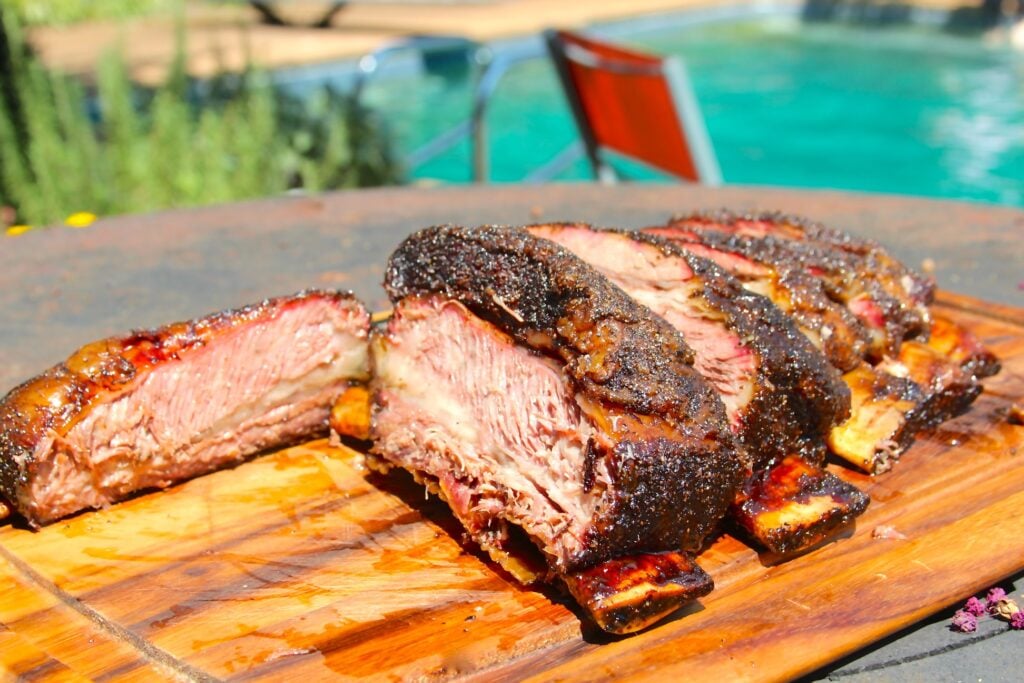
Many smoked meats develop a smoke ring, a bright pink color just under the surface. Some people think the pink color means the meat is raw, but nothing could be further from the truth. There is a picture of a pork rib with a smoke ring at the top of this page.

Nitrogen dioxide (NO2) is among the compounds formed in the high heat combustion of wood, charcoal, and even propane. As these compounds land on the surface of meat, especially cool moist meat from the fridge, some, including nitrogen dioxide, are moved deeper into the meat as cells lower in the smoke compounds pull them in with a diffusion and absorption process. The cells are simply seeking equilibrium. The process is the same as when someone lights a cigar in a room. All the smoke starts out near the cigar, but eventually it spreads throughout the room as it achieves equilibrium. After a while it penetrates clothes, furniture, and even food. Because it is water soluble, cigar smoke will get into wet things first, like your wife's eyes. Before long you and your cigar will be seeking equilibrium in the garage.

The smoke ring in meat is caused by four things: (1) low temperature cooking, (2) combustion of the wood at high temperatures to form nitrogen dioxide, (3) nitrogen dioxide, and (4) moisture on the surface of the meat to help move the water soluble nitrogen dioxide into the meat. When these conditions are met, nitrogen dioxide in wood smoke reacts with the pigment myoglobin in meat to form nitrites and nitrates. These are the same compounds added to hot dogs and other cured meats to preserve them and they also give them their pink color.

When cooking ribs, the moist meat absorbs smoke. Less smoke is absorbed as the cooking continues because the surface of the meat begins to seal and becomes saturated with smoke. For this reason putting a pan of water in a smoker helps create a smoke ring. In fact some smokers, called water smokers, have water pans built in.

Most of the smoke flavoring occurs in the first hour or two of cooking so adding wood to the fire late in the cook doesn't create as much flavor. It also allows moisture to escape. It's better to just leave the door closed.

A faux smoke ring can also develop without smoke if you cook low 'n slow. When meat is cooked fast, the proteins in the muscle and myoglobin denature at the same time and combine to turn brown. When cooked slowly, the muscle proteins finish denaturing before the naturally pink myoglobin denatures and so the meat remains pink. You can occasionally see this phenomenon in braised meat like a beef stew. It may have been cooked for hours in a liquid at low temps, yet the meat will still be slightly pink inside.

On the other hand, some meats cooked low and slow in a smoky environment in an electric smoker will not develop a smoke ring. That is partially because the wood smolders at a low temp in electrics. Experts at cooking in electric smokers will add a charcoal briquette as well as wood chunks to create the correct atmospheric conditions for a smoke ring.

No Trichinosis

Once upon a time it was easy to get trichinosis (trick-a-NO-sis) from undercooked pork. Today trichinosis has been all but eradicated in developed countries. Trichinosis is caused by eating raw or undercooked pork and some wild game infected with the larvae of a species of the parasitic worm, trichinella. The annual average is now fewer than 40 cases per year in the US, most associated with eating undercooked wild game such as bear. Trichinosis from pork is about 5 cases per year, mostly from eating uninspected home grown hogs. The number of cases in pork has decreased because of improved farming and processing methods as well as public awareness of the importance of proper cooking. Trichinosis may be a thing of the past, but all meats carry microbes, like salmonella, and they can give you a pretty bad tummy ache, the runs, organ damage, and even kill. Children and elderly are especially at risk. Most microbes are killed at 140F, so instead of cooking lean and tender pork roasts or chops to 160F, as most cookbooks say, you can take it off at 135-140F and let the internal temp rise to 140-145F while the meat rests for 10-20 minutes.

Is it ready yet?

Cooking pork to an internal temperature of 140F will kill the bugs, but to liquefy collagens in tough cuts such as ribs and shoulders, we take them up to 180F for 30 minutes. If you don't have a good thermometer (and why not?), there are a few other ways experienced cooks have to tell if their slabs are done. Click here to know when your ribs are ready.

Get a good thermometer

The only way to know for sure if meat is cooked properly is with a meat thermometer. The problem with ribs is that it is hard to get an accurate meat thermometer reading because the meat is thin, it curves, and touching the bone with the thermometer can give you a false reading. I highly recommend the Maverick ET-73, a Meathead Hot Stuff Award winner. The Thermoworks Thermapen is another winner. Click here to read more about thermometers.

Charcoal typesHeat sources

Some purists cook with hardwood only, but more often than not, that produces meat that is too smoky, pungent, bitter, and reminiscent of an ashtray. Gas, electricity, wood pellets, and charcoal are better fuels for the backyard chef, and you can get the smoke flavor with wood chips, chunks, pellets, or sawdust. Charcoal comes in two flavors: briquets and lump. Lump charcoal produces a bit more smoke, but it burns hot and fast. I love it for steaks and lamb, but for ribs, I prefer briquets.

Enough is enough

One of the biggest mistakes we frequently make is using too much smoke. Too much smoke can make your meat bitter or taste like an ash tray. Smoke is like salt. You can always add more but you can't take it out. Do not try to cook with wood. It is too hard to control the temp and the amount of smoke. When you become an expert, you may be able to cook with wood only, but at the outset stick to charcoal, propane, or electricity. I cannot give you a precise amount because each cooker is different and the amount of wood to get the right flavor will depend on the volume of the cooking chamber, the airflow, leaks, how often you peak, the kind of wood you use, and of course, your preferences. You will need to experiment, but a good rule of thumb is start experimenting with about two ounces of wood, regardless of the cut or weight. For dense, thick cuts of meat such as pork butts for pulled pork or beef brisket, you can double or triple the amount of smoke. If the results are not smoky enough, you can add more wood on your next cook.

Smoke cold meat

There is some evidence that meat right out of the fridge absorbs smoke more readily than warm meat, so add you wood when the cooker gets up to the target temp. Try to get all your wood on in the first hour.

Keep your lid on

Some folks like to baste the meat and others like to spritz it with apple juice or beer or wine. Fogeddaboudit. All this does is let hot air and moisture out of the oven and cool down the surface of the meat. Bad idea. If you're burning charcoal or wood, the rush of oxygen is like pouring gas on the fire. Worse idea. Keep the lid on your grill until the meat is ready. Remember, if you're lookin', you ain't cookin'.

Sauce late

Sweet sauces can burn if you add them too early in the process and they can prevent the smoke from penetrating the meat. For the best saucing strategies, click here.

Seek balance

The secret to Amazing Ribs is to achieve balance between flavors. For barbecued ribs, there should be a distinct pork flavor, a smoke flavor, and a seasoning flavor from a rub or sauce. Balance is the key in cooking ribs.

Bottom line

Take your time and have the following on hand: a cooker with good heat control, a good thermometer, a comfy chair, a good book, and a great beer.

This page revised 7/3/08


Unless noted, all text, photos, and recipes are Copyright (c) 2008 by Craig "Meathead" Goldwyn. You need my written permission to publish or distribute anything on this website.
But I'm easy. To contact me, click here.


Meathead the Barbecue Lover Cartoon
New tips and recipes: Get "Smoke Signals," Meathead's free eletter. No spam. Guaranteed.


Barbecue Award

If you have a Weber grill, you need the amazing Smokenator. It really works! List is $55, but it's less at Amazon.com.

Weber Barbecue Smokenator


Shop at Grills Direct

Grills from The Grill Store

Support
AmazingRibs.com
by shopping at Amazon.com


IACP Logo
MEMBER:
INTERNATIONAL ASSOCIATION OF CULINARY PROFESSIONALS