


Pork chops and steaks are blank canvases. They love to be painted with herbs, spices, smoke, and sauces. But they can transmogrify from juicy to jerky in just two minutes, so temperature control is especially crucial. There are several different cuts you need to know, but my favorite cooking method works equally well on all cuts.
This is Kermit the Frog’s Second Favorite Pork Chop. For Kermit’s all time favorite pork chop, just watch the ending of the movie The Muppets Take Manhattan, below.
The different pork chop cuts
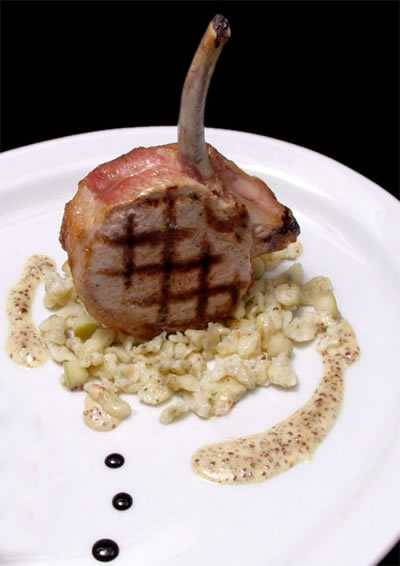
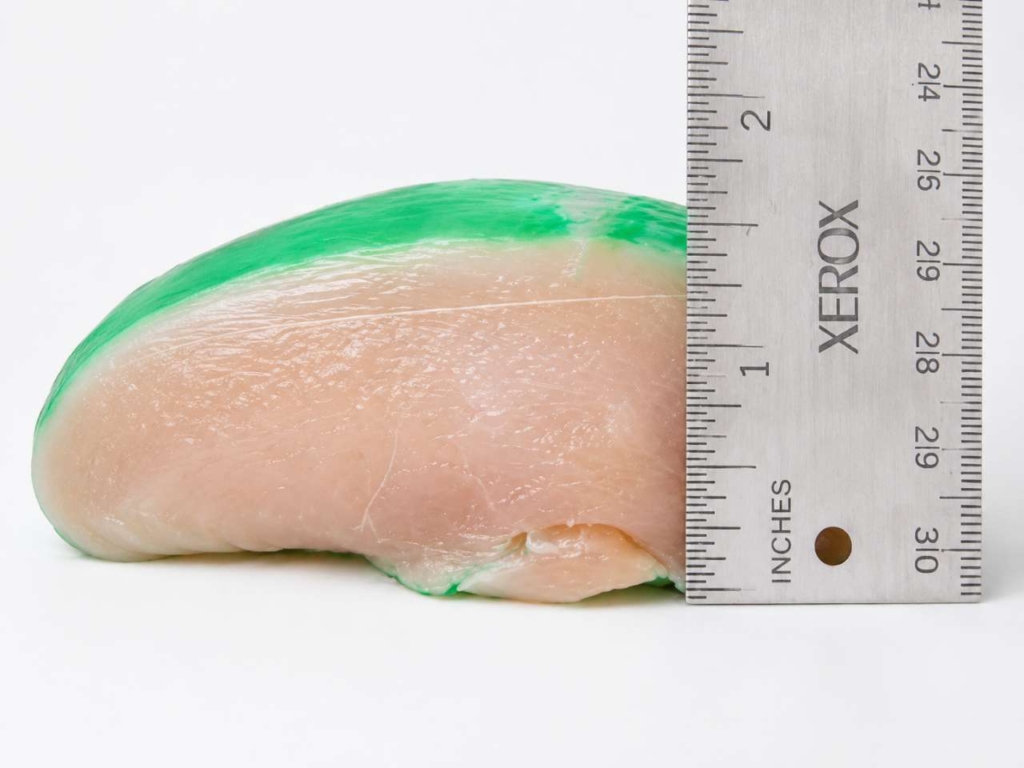
The bone-in loin chop. This comes from the loin muscle that runs along the backbone. The meat is very lean. It usually has a thin belt of fat on one side, and a rib bone attached to another side. This is the “other white meat” you’ve heard of, mild and tender because the loin muscle does not get a lot of work. It is usually about 4″/10.2 cm diameter. In the picture here, we see a bone-in loin chop with a bone that has been cut partially loose of the meat to make a cutesy lollichop. Usually this bone is attached and the meat is more oblong shaped.
Contrary to popular belief, the bone does not add flavor to the meat. It does not somehow dissolve or send out flavor compounds across 4″/10.2 cm of solid protein. Besides, the bone is mostly calcium on the outside. Bones add flavor to stews and other wet cooking methods, but not in grilling or roasting methods. The bone does impede heat transfer slightly, so meat next to the bone tends to be a bit less cooked. But the bone is also fun to gnaw on.
In the picture at right, we see a bone-in loin chop that has been cut partially loose of the meat to make a cutesy lollichop. Usually this bone is attached and the meat is more oblong shaped.
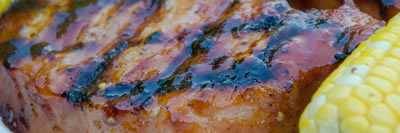
The boneless loin chop. This is the same cut as above, but the rib bones have been removed before it is cut into chops. Think of these chops as a chicken breast. Simple, lean, tender, unless you overcook it, and a blank canvas. Sometimes it is slit along the side and folded open like a book making a butterflied loin chop.
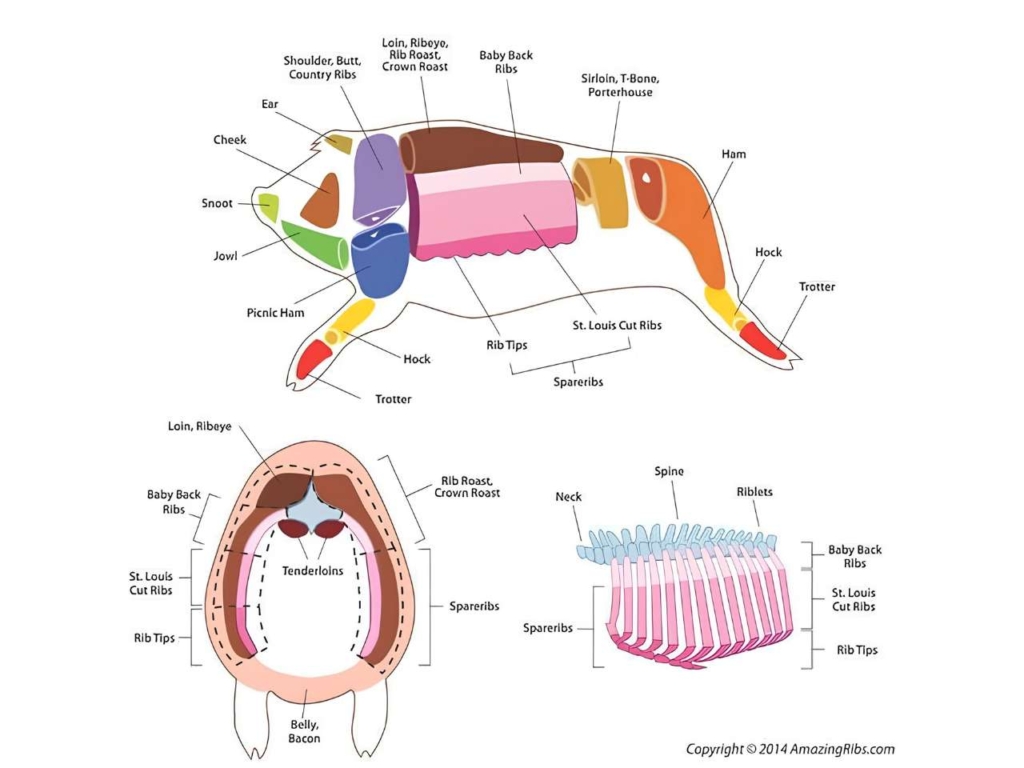
The T-bone or porterhouse. Cut from behind the rib cage, there is a T-shaped bone with a large hunk of loin meat on one side, and on the other side of the bone there is a smaller round, section of the tenderloin. This is also a lean cut and care must be taken not to overcook.
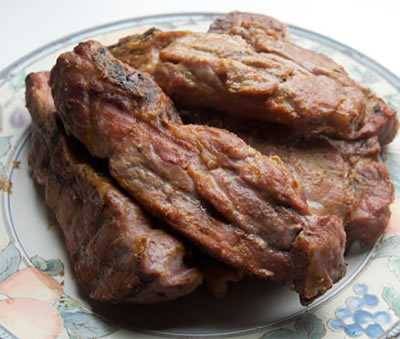
Country-style ribs (a.k.a. country ribs, a.k.a. blade steaks, a.k.a. blade chops). Country-style ribs are not really ribs. They are really pork chops, more meaty and less fatty than real ribs, and should be cooked like chops, not ribs. That means they should not go beyond 140°F/60°C while ribs often are cooked way up to 200°F/93.3°C. That mistake will result in a call for carryout. They are cut from the front end of the baby backs near the shoulder and a tray of country-style ribs in the grocery store might contain a rib or two but more than likely they there will be a section of shoulder blade. Because they vary in size and thickness, they are hard to cook to an even doneness. Depending on how they are cut, a serving will be one or two country ribs. For big hungry men, perhaps three. They respond well to brining before low and slow cooking.
Click here for more on the different cuts of pork.
Technique
Loin chops and T-bones are best when cut thick, at least 1″/25.4 mm, when wet brined for about an hour, then gently cooked with a little smoke, and flavored with herbs and/or a sauce. This is one of the rare occasions where I prefer a wet brine because a bit of water is drawn into the meat and this cut needs all the water it can get. Thin chops are easy to overcook and there is less room for error. You can ask your butcher to cut them thicker than those on display if you wish. Most butchers are happy to do this for you at no extra charge.
To make sure you get it right, I recommend you cook low and slow with indirect heat at about 225°F/107.2°C. Low and slow is especially important for shoulder chops which have a lot more connective tissue.
Shoot for meat that is 135 to 140°F/57.2 to 60°C in the thickest part. Make sure you don’t overshoot the target by using a good digital thermometer. You may see a little pale pink in the meat, but don’t worry about trichinosis. Trich is extinct in USDA inspected pork. When there is a hint of pink, it is at its peak tenderness and juiciness. Resist the temptation to cook pork chops over high heat. We like to sear beef steaks, but dark colored pork is not as flavorful as dark colored beef, so don’t worry if you don’t get the outside brown. It is far more important to get the insides right.
To knock them outta the park, add smoke. To knock them outta the state, top them with caramelized onions. For more on how to add smoke, read my article on the Science of Wood. To knock them outta the state, top them with caramelized onions.
Don’t stuff ’em
I’m sorry to say it, but I don’t recommend that you stuff porkchops. Stuffed chops are made by cutting a slit into a thick chop and working a knife around to create a pocket. The process makes a thicker entity, and by the time the center of the stuffing is warm, the meat, which you have now, for practical purposes, reduced to two thin chops sandwiching the stuffing, is overcooked as the heat works its way toward the center. If you must stuff a chop, precook the stuffing so you can get them off the heat sooner, and cook at 225°F/107.2C and no more.
Video: Kermit and Miss Piggy’s Wedding
Find out which pork chop is Kermit’s FAVORITE.

Juicy Smoked Pork Chop Recipe, a.k.a. Kermit’s Second Favorite Pork Chop
Ingredients
Method
- Prep. Trim excess fat. If you have loin chops, there is a band of fat around the perimeter. Beneath the fat is a thin layer of connective tissue called silverskin. You need to remove it because as it cooks it shrinks and causes the meat to form a cup. The fat will not penetrate the meat so there is no reason to leave it on unless you like eating the fat. In that case, cut at least two slits through the fat and the silverskin right down to the meat.
- Fill a 1 gallon (3.9 L) plastic zipper bag with the brine, add the chops, place the bag in a bowl to catch any leaks, and refrigerate for 1 to 2 hours. Thinner chops will take half that time. While they are brining, setup your grill for 2-zone or indirect cooking or fire up the smoker, and shoot for 225°F (107.2°C) in the indirect zone.
- Season the chops with black pepper, but no salt (they have enough from the brine). Don’t bother with your favorite barbecue rub. Not needed.
- Fire up. Prepare a grill for 2-zone cooking, and shoot for 225°F (107.2°C) in the indirect zone.
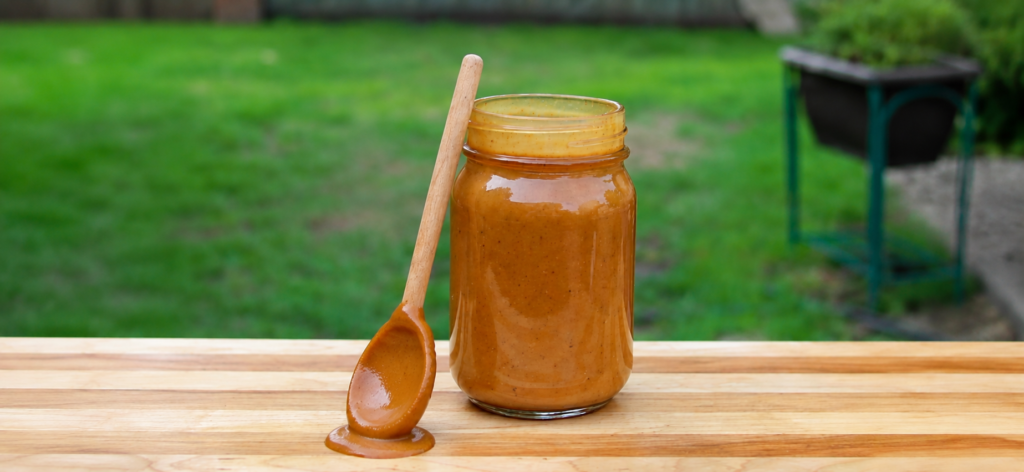
- Cook. Put them on the indirect side of the grill, paint both sides with sauce, and let them cook with the lid down. Flip them after about 20 minutes and paint them again. After another 20 minutes or so, you're ready to eat. If your indirect side is about 225°F (107.2°C), cooking time will be about 45 to 60 minutes for 1" (25.4 mm) chops. Please use a good digital thermometer to get them cooked properly, 145°F (62.8°C) in the center, max. If you are cooking over direct heat, don't add the sauce until just before the chops are ready or else it will burn.
- If you want to get fancy and add grill marks, when the meat hits about 125°F (51.7°C), paint on the sauce, and then move them to direct heat and remove the lid. After 3 minutes rotate them 45 degrees to get cross hatching. 3 minutes more and flip, paint, 3 minutes more and rotate. You've got to be careful here, this is a great way to incinerate the sauce and overcook the meat. You want the lid off so the meat is cooking only on the bottom side. Remove them when the centers are 140 to 145°F (60 to 62.8°C).
- Serve. Plate and serve with grilled asparagus, spätzle, and a dry riesling.
Before you can post a comment or question you must sign into our commenting partner, Disqus. This helps make sure everyone hanging around the grill is civil. We do not tolerate nastiness, racism, porn, inappropriate language, or attacks on others. All comments are the property of AmazingRibs.com and we reserve the right to quote them, edit them, delete them, and block people from making future comments.
Please leave comments and questions on the same page that is devoted to that subject so others can see questions and our answers when they are reading about the subject. You must enable JavaScript to use the comments section, and you must accept cookies to post comments. Note: the software that runs Disqus is different from the Pitmaster Club, so members need to sign into the Pitmaster Club separately.