Shopping for BBQ Gear? Start Here!

2,000+ Free Pages

2,000+ Free Pages

YOU ARE HERE >> AmazingRibs » Education » Paella Recipe: The National Dish Of Spain Began Outdoors And You Can Cook It Outdoors

Share On:

Paella Recipe: The National Dish Of Spain Began Outdoors And You Can Cook It Outdoors

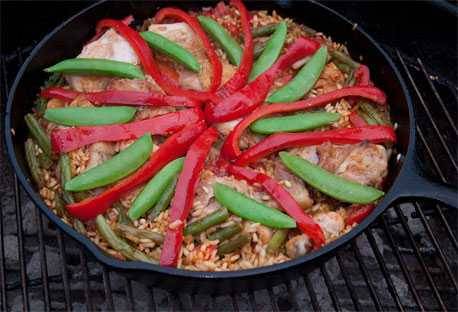
Paella cooking on the grill

Forget what you think you know about paella. Paella (pronounced pah-YAY-ya) is the national dish of Spain, and although it may seem intimidating, it is actually not too hard to do at home on the grill.

If you’ve ever had paella, then you have experienced the fanfare and flourish with which it is presented, offering up a virtual pinwheel of colors and shapes. A real showstopper. And while seafood is the most common type of paella, there are countless variations.

When it comes to making authentic paella at home, the first thing you will recognize is the fact that the traditional paella pan is ill-suited for stovetops because, in most cases, it is much wider than your stove’s burners thereby making it impossible to create even heat across the bottom. That makes it perfect for your grill. Also, the first steps involve frying and spattering. Cook outdoors and you won’t have to clean the stovetop.

Paella was first cooked in a field over a wood fire near Valencia, a magnificent Mediterranean seaport about 200 miles southwest of Barcelona. Valencia is the third largest city in Spain (after Madrid and Barcelona), and is famous for its food, especially paella and Valencia oranges, as well as its ancient Roman buildings, modern architecture, soaring cathedrals, tomato fights and other festivals. Today, most families prepare paella at least once a week, usually cooked by the man of the family, often outdoors, and then they eat it from a communal pan. Paella is tricky, but worth the effort, and it is actually easier grilling outdoors than cooking it indoors.

It’s all about the rice

Paella is primarily a fabulously flavorful rice dish, with all manner of tropezones, tasty bits and pieces of meats, fish, fruits, nuts, and vegetables. But its soul is the rice (arroz).

Just outside the city limits of Valencia are vast rice fields. Rice is to Spanish cuisine as pasta is to Italy, and it was probably brought to Spain by the Moors, African Muslims who conquered and occupied the Iberian peninsula for 800 years beginning in 711 CE. The rice that is commonly used is a short grain rice called bomba that can absorb 4 to 5 times its volume in liquid. When cooked with bomba, if you don’t use too much liquid, the rice has a firm texture, and is not mushy.

I had a dickens of a time finding real Spanish bomba rice, and as I was testing this recipe I learned that it was crucial to the formation of the soccarat. So I ordered some from La Tienda, an importer of high end Spanish products. They also sell saffron, paella pans, Spanish chorizo, squid ink, cheese, and all kinds of other goodies.

About the socarrat

Socarrat is the dark crunchy, scorched bits of crispy rice that fry on the bottom of the pan near the end of the cooking as the liquid evaporates. In fact the word comes from the Spanish word for “scorched” because it is slightly burned. Sometimes you get it, sometimes you don’t. To get it you need plenty of oil, and you’ve gotta keep a close eye on the final minutes. Just don’t let the rice burn.

Socarrat

Socarrat is prized among Valencians much the way the crusty rice in the bottom of Bibimbap is prized among Koreans and the golden tahdig is beloved by Iranians in their rice dishes.

Don’t skip the saffron

Moors probably also introduced saffron to Spain, an essential ingredient in many paella recipes. Real saffron is probably the most expensive food in the world at about $14 per gram. You can make a sort of paella without saffron but it’s just not the same. Try not to leave it out. It is a traditional part of paella, and it adds important yellow color and flavor. A pinch is all you need for paella for four.

Saffron is the stigma from the inside of the flower of a crocus that blooms in fall on the stony plains of La Mancha in central Spain. There are only three stigmas per flower and they must be picked by hand. An acre will produce only about 5-7 pounds. My favorite spice merchant, Penzeys, says there are about 450 stigmas (a.k.a. threads, strings, strands, filaments, or pieces) per gram and a gram is about 2 teaspoons of whole saffron threads, 1 teaspoon crumbled, or 1/2 teaspoon powdered. They warn against buying pre-powdered saffron because it loses flavor quickly and is often cut with turmeric or something else.

Faux and Real Saffron

Real saffron, the threads on the right, is the most expensive food in the world. The best grades are dark rusty red and have no yellow in them. Just beware of cheap imitations. The stuff on the left was bought in a grocery store in for 99¢ for about 4 tablespoons. I have no idea what it is, but it was tasteless. Here are some options for the real thing on Amazon.

The sofrito

In Spain and in a Spanish restaurant, paella often includes a paste of onions, garlic, and tomatoes called sofrito. A typical Spanish household may have a jar of sofrito on hand at all times. Rather than add the extra step of making a sofrito, my recipe stays true to its heritage by adding the ingredients individually.

About the pan

Paella is practically a daily staple in Valencia, and paella culture in Spain has become so ritualistic that there is even a special pan used. In fact, the word paella comes from the Latin word patella for pan. It is essentially a wide round frying pan called a paellera, made from carbon steel or stainless steel, with low sloped sides and two ear-like handles.

Paella pan

They can be small enough for one or two servings, or wider than you are tall for a party after a roof-raising ceremony. Here are some of the options available on Amazon. But you don’t need one. Any frying pan or flat bottomed baking pan will do as long as it has an oven safe handle. It should be wide so the rice will cook properly. The reason you can’t use non-stick is because a fun part of the dish is the socarrat, crunchy bits of caramelized slightly burned rice that fry and darken on the bottom at the end of the cooking process. Socarrat, which comes from the verb socarrar which means to scorch, adds texture, but also a nutty flavor. How? You need bare metal for this magic to happen.

If you are feeding a lot of people, paella is better when cooked on a grill than on the stovetop because most stovetop burners are narrow and concentrate the heat in the center of the pan. Paella needs even heat across the bottom of the whole pan. In addition, the first step is frying, and in a shallow pan that can mean spattering, so cooking outdoors means less cleanup. Don’t try to cook over a wood fire, it is too hard to control the heat. Use your charcoal or gas grill. Add some wood chips or dried herbs onto the fire to add a whisp of smoke, just like the original.

Variations

There are scores of paella recipes depending on the local ingredients found all over Spain’s varied topography, climate, and seasons. On the Mediterranean, seafoods are common. In the mountains, goat, rabbit, lamb, and snails are common. There are vegetarian paellas, sausage paellas, spicy paellas, mild paellas, and mixed paellas, with chicken, seafood, and sausage. Although most restaurants in the US serve seafood paella with shrimp, clams, and mussels, the original Paella Valenciana probably had things like rabbit, chicken, duck, pork, or snails prepared by farmhands near Valencia over an open fire. So that’s what we’re going to do.

seafood paella

Veggies: Artichoke hearts, peas, all manner of peppers, squash, eggplant, Swiss chard, mushrooms, potatoes, lentils, olives, spinach, seaweed, leeks, and chickpeas.

Meats: Rabbit, pork, lamb, beef, duck, quail, Spanish chorizo and other course ground sausage, serrano ham, and marinated chicken.

Seafood: Squid, shrimp, lobster, crab, firm fin fish, clams, mussels, scallops, and salt cod.

Seasonings: Cumin, bay leaf, thyme, squid ink, lemon juice, and peppercorns.

Liquids: Water, white wine, tomato juice, sherry, tomato sauce, fish stock, clam juice.

Toppings: Chopped boiled eggs, green onions, dried figs, raisins, pine nuts, almonds, walnuts, and lemon slices.

paella book by casas

Now that you have the concepts down, you can play with the ingredients. Penelope Casas’ book Paella!ir?t=amazingribs 20&l=as2&o=1&a=0805056238 is the definitive reference and contains plenty of recipes. Or you could experiment…

Cooking paella indoors

If necessary, you can cook paella indoors. The problem is that you need even heat across the bottom and small burners can burn the center of the pan’s contents. Be sure to use a pan that distributes the heat well. The stainless pan above has a copper clad bottom to distribute heat.

Indoor paella

Start on the stovetop, and after you add the stock and water, move it to a 450°F oven. If the rice is done and there is still liquid, move it back to the stovetop to finish.

flames line2
Paella in a paella pan

Grilled Paella Valenciana Recipe

3.99 from 61 votes
Rate this Recipe
Paella is a traditional Spanish rice dish. It is tricky to cook but worth the effort. For this recipe, the paella is cooked outdoors in order to ensure that even heat across the entire pan.
Prep Time 30 minutes
Cook Time 30 minutes
Servings: 4 servings
Course: Dinner, Lunch, Main Course
Cuisine: Spanish
Difficulty: Difficult

Ingredients


  • 1 14.5-ounce can diced tomatoes
  • 2 cups chicken broth, low sodium or no sodium
  • 1 small pinch saffron threads
  • 4 boneless, skinless chicken thighs
  • 1 teaspoon Morton Coarse Kosher Salt
  • 1/2 teaspoon ground black pepper
  • 1/4 cup olive oil
  • 6 ounces Mexican chorizo sausage, casing removed
  • 1 medium sized red, yellow, or orange bell pepper
  • 1/4 pound green beans
  • 1 medium onion
  • 1 tablespoon sweet paprika
  • 3 cloves of garlic
  • 1/2 teaspoon fresh rosemary leaves (1/4 teaspoon dried)
  • 1/2 teaspoon fresh thyme leaves (1/4 teaspoon dried)
  • 1 cup arroz bomba or arborio rice (Spanish rice)

Method
 

  1. Prep. Paella assembly moves quickly so make sure you have all your ingredients measured and cut in advance (mise en place). Begin by cutting the boneless, skinless chicken thighs into bite sized chunks or strips.
  2. Remove the stem, core, and seeds from the bell pepper then slice into strips.
  3. Remove the ends and skin from the onion and then coarsely chop.
  4. Press or mince the garlic.
  5. Fire up. Preheat a gas grill to medium high. If you are using charcoal, you'll need enough coals for about 90 minutes of cooking. Prepare enough coals to cover the lower grate with only one layer, shoulder to shoulder. If you are cooking indoors, preheat the oven to 400°F (204°C) and put a rack in the lowest position.
  6. Cook. Put the broth and tomatoes in a pan with the saffron and heat it on the grill until it is simmering. Don't let it boil because you need all the liquid. This step helps extract the saffron's flavor, and we don't want to add cold broth to the paella.
  7. Sprinkle the chicken generously with salt and pepper.
  8. Put a 12- 14-inch (30 to 35 cm) pan over the hot part of the grill, let it heat for a minute, and add the oil. There should be enough to cover the bottom about 1/8-inch (3.2 mm) deep. If not, add more. You don't want to skimp on the oil because it is necessary to form the socarrat. Make sure the grill is level so the oil covers the entire pan evenly. If you are cooking indoors, turn the burner on high. It will cool off soon after you add the meat. After a minute or so, when the oil is hot and shimmering, place the chicken parts in the oil, and cook. Don't touch the meat for about 5 minutes so it has a chance to turn golden while in contact with the hot pan. Stirring too frequently will prevent browning. When it is golden on one side, stir, scraping the crunchy stuff the French call fond off the bottom, and turn the chunks over to brown on the other side. If the pan is not hot enough to fry, then you need more heat.
  9. When the second side of the chicken chunks are golden add the chorizo, green beans, onions, and half the pepper strips. The veggies will give up some water so cook until it evaporates as steam and you can hear the oil hissing and frying. Add the paprika, garlic, and rice, and cook for 1 minute, stirring to make sure the rice is coated with oil. If you are using dried rosemary and thyme, add it now. If you are using fresh, it goes in later. Gently add the broth/tomato/saffron mix. Do not stir because you want the rice under the liquid. Rice on top will not cook properly. Don't worry if a few grains float. If you stir you will get risotto, which is a thick pasty mass. Cook for about 10 minutes or more with the lid of the grill closed and do not stir. If you are cooking indoors, place it in the 400°F (204°C) oven on the bottom rack now.
  10. After 10 minutes, sprinkle ther fresh rosemary and thyme on top and lay the remaining pepper strips on the surface in a pinwheel and cook another 10 minutes until the rice has absorbed the liquid and is no longer runny. Taste a small forkful. The rice should have some chew, buy not be hard, called al dente. Nor should it be mushy or gummy. If it is still hard and the liquid is gone, add water or more broth, 1/4 cup (60 mL) at a time.
  11. When the rice is done, push a fork in and look at the bottom of the pan to see if the rice crispies, the socarrat, are forming. If not, and this is optional, put it over direct heat or on a burner on medium high heat for about 3 to 5 minutes. Rotate the pan every minute or so to prevent hot spots. You should hear the rice on the bottom crackle. This part is crucial: You have to watch so it does not burn badly, a little black is OK, but not a lot. Remove the pan a minute or two after the rice begins to stick, especially if you are using a cast iron pan or a pan with a heavy bottom. Do not wait for it to turn brown. Cast iron will hold heat and continue to cook long after you remove it from the heat. A little blackening is OK, but don’t let it get a lot of blackening. It is better to not have any scorched rice than to have a burned tasting meal.
  12. If you are going to garnish with chopped parsley, sprinkle it on now. Remove the pan from the heat and put the cover on or drape a towel over the pan and let it rest for at least 5 minutes. If you don't have a cover, use aluminum foil or a plate.
  13. Serve. To serve, place it on a trivet or a very thick stack of pot holders or placemats or even towels so it does not scorch or crack your table. In Spain many families eat right from the pan!

Notes

Scaling up. If you double or triple the recipe you must use a wider pan. Try to keep the ingredients 1″ deep or less. I recommend you do a single recipe exactly as I have described below the first time.
About the broth. The secret to great paella is to have just the right amount of liquid to complete the cooking of the rice so it is firm, but not crunchy, but not too much liquid that it gets mushy. Use a good rich broth that’s not too salty. If it is salty, cut the salt in the recipe in half. For some complexity, substitute 1/2 cup broth with dry white wine. After I bone and skin the chicken, I simmer the bones and skins, and use the broth if the dish needs more liquid.
About the saffron. Do not not leave it out and do not buy cheap imitations. It is a traditional part of paella, and it adds important aroma, flavor, and yellow color.
About the chicken. White meat (breast meat) is not well suited for this kind of prep. It just overcooks and gets dry. Use thighs and remove the skin. It just gets rubbery. You’ll notice that there is only one thigh per person. You can add more if you wish, but this is primarily a rice dish, not a meat dish.
About the salt. Remember, kosher salt is half the concentration of table salt so if you use table salt, use half as much. Click here to read more about salt and how it works.
About the oil. You need enough to cover the bottom of the pan about 1/8″ deep in order to form the socarrat, so the exact amount will vary depending on the size of your pan.
About the sausage. OK, classic Paella Valenciana doesn’t usually have sausage. But I think it really tastes great this way. You can leave it out if you want. In Spain, chorizo is a slicing sausage, spicy, and very flavorful. If you can’t find it, Andouille is close enough. If you can’t find that, Mexican chorizo is commonly available in American groceries, but it is mushy and can’t be sliced. Just add it to the pan and it will cook and become crumbly.
About the paprika. I often substitute smoked paprika, which adds nice flavor, as well as a bit of heat. If you wish, you can add 1/2 teaspoon chipotle powder for some heat.
About the rice. Look for bomba or Valencia rice. Bomba can absorb 4 times its volume in liquid. Bomba is hard to find, so you can use other rice if necessary, but you might need to adjust the amount of liquid. Arborio rice works well. In this recipe, the canned tomatoes contribute about 1 1/2 cups of liquid. 1 cup of regular short grain rice and arborio rice can absorb only about 2 to 2 1/2 cups of liquid, so use less broth. Do not rinse, wash, or soak the rice. Click here for more about rice.
Snails. The original version probably contained land snails, so feel free.
Optional garnish. Toss 1 tablespoon chopped fresh parsley on the top when you are done cooking, just before you let it rest, just before you serve it.
Serve with. Paella is a meal in itself, but you can serve it with lemon wedges, a salad, and Spanish wine. Try an albarino with this recipe or Torres Vina Sol from the nearby Penedes region.

Tried this recipe?

Let us know how it was!
Here's everything you need to know about cooking with cast iron on your grill, in a campfire, and in your
Read everything a good cook needs to know about buying, storing, cooking and serving white rice, brown rice, wild rice,
Chile, chili, chilli, chilies, bell pepper, black pepper, paprika, aji, capsicum, chiles pasado, pimento, pimiento...what's the difference? Let's straighten this
Garlic makes it good! Here's what a cook needs to know about forms of garlic, including fresh garlic, elephant garlic,
Want to be a better cook? Learn mise en place. This French term means, roughly, 'everything in its place.' It
In northeast Spain, Catalonia is a land of culinary riches and the heart of the Mediterranean diet. For centuries, Catalans
Published On: November 25, 2014
Last Modified On: November 25, 2014

On This Page

Up Your BBQ IQ By Joining The Pitmaster Club

Get a free trial of the AmazingRibs.com Pitmaster Club and experience everything that the world’s largest membership-based BBQ and grilling community has to offer. No credit card required!

New Recipes, Reviews, and Science Sent To Your Inbox!

Subscribe to receive our FREE weekly newsletter, Smoke Signals, and never miss a new recipe!

Jump To Top