



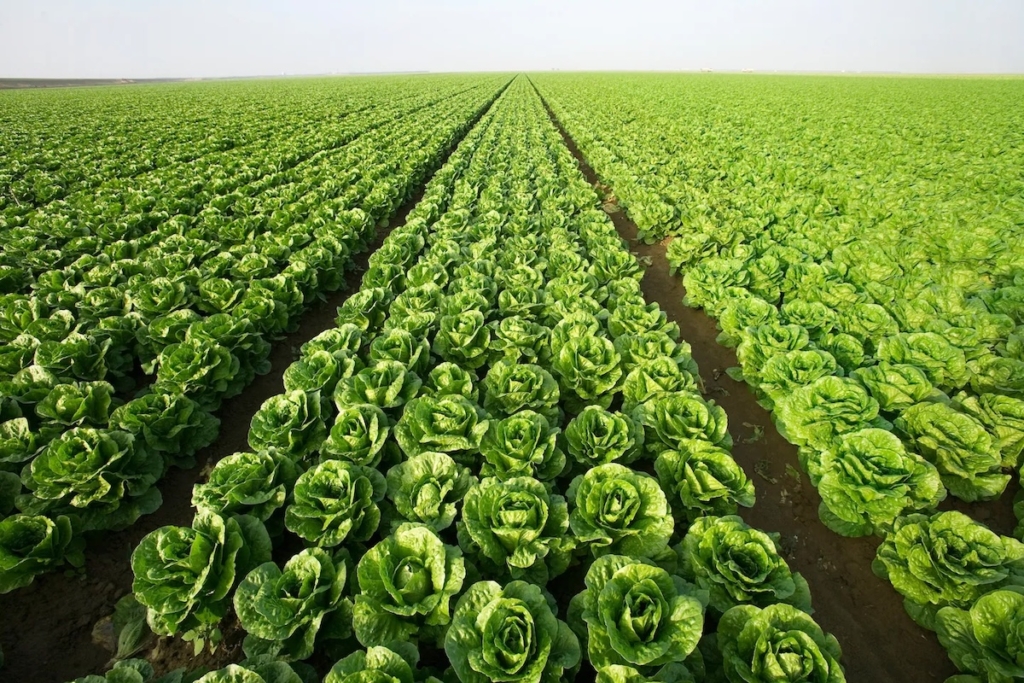
Lettuce makes us sick, wastes resources and has minimal nutritional value. Why are we still consuming it?
In the summer of 2026, Cyclospora illness in America reached historic levels with 18,445 laboratory-confirmed Cyclospora cases, according to the Centers for Disease Control and Prevention. Author and James Beard Award winner, Tamar Haspel has been researching and reporting on food safety and nutrition issues for many years. Below, she makes the case for giving up on lettuce altogether. This article originally appeared in the Washington Post and is reprinted with permission from the author. (Photo credit: Ed Young/Design Pics Editorial/Universal Images Group/Getty Images)
Explosive diarrhea is in the news.
Cyclospora, a parasite spread through human feces, is the culprit. And it probably arrived on your table via lettuce. We don’t know all the details of the outbreak, the largest ever tracked in the United States, but “the odds are very high that the now-recalled Taylor Farms iceberg lettuce from Mexico is the source for many of the illnesses,” says journalist Helena Bottemiller Evich, founder and editor in chief of Food Fix, a popular newsletter about food policy.
This isn’t surprising. Leafy greens are responsible for more illnesses than any other food category, according to the Centers for Disease Control and Prevention. A 2024 analysis found that lettuce was the source of something like 1.7 million cases of foodborne illnesses per year, and the economic cost was $3.7 billion. Lettuce and other vegetables that are generally eaten raw top the charts here primarily because most pathogens that make us sick don’t survive cooking. It’s certainly possible that your collard greens are contaminated, too, but once you braise them with a smoked ham hock and a little vinegar, you’ll never know.
Aiding and abetting foodborne illness may be lettuce’s biggest offense. But it doesn’t have much else going for it, either, and there’s a reasonably strong case that we would be better off without it.
As you probably surmised by now, I’m going to make that case.
Let’s start with nutrition. Americans eat about 14 grams of lettuce per day. The good news is, that’s only a few calories. But it’s not much else, either, mostly because lettuce is about 95 percent water.
Think about that for a second. Only 5 percent of your lettuce is what you think of as lettuce. Every time a head gets picked, trimmed, packed, stocked on a shelf or put in your grocery cart, only one-twentieth of that weight is actual food. Lettuce is just a vehicle for transferring refrigerated water from farm to table.
If you’re thinking that all vegetables are mostly water, you’re right! And some other salad vegetables aren’t that much different from lettuce. Cucumbers, celery and radishes are right up there. (And if you’re eating them for hydration, that stuff out of the tap is way less resource-intensive.) But look at broccoli, for example. It’s 90 percent water, which doesn’t sound all that different from 95 percent, but it means there’s twice as much vegetable in that vegetable.
All that water doesn’t leave much room for nutrition. Your daily 14 grams of lettuce has one-quarter of a gram of fiber, a bit of your daily potassium, and a few smidgens of other minerals and vitamins. The biggest win is probably 9 percent of vitamin A, something most Americans get plenty of in their meals. (I used nutrition numbers for romaine, and the Dietary Reference Intake values for women.)
This doesn’t mean it’s impossible for lettuce to provide a meaningful amount of some nutrients — you just have to eat a lot of it. While 14 grams is the average consumption, some people obviously eat much more. Even so, I’m going to go out on a limb and predict that if we stopped eating lettuce altogether, there would be no public health crisis. There might even be a benefit, because, if we’re going to talk about nutrition, we have to talk about what goes along with your lettuce. Croutons? Deep-fried halloumi? Those dried crunchy noodle things?
When the name of the dish has “salad” in it, you’re likely to consider it healthful no matter how much not-so-healthful stuff it has in it. If the lettuce gives you carte blanche to eat high-calorie, low-nutrient accoutrement, that has to factor into the math. (Of course, some salads have beans, tomatoes, beets, carrots, broccoli and other nutrient-dense components. In which case, just make the salad without the lettuce.)
And that’s just the lettuce that gets eaten. The Agriculture Department estimates that we waste as much lettuce as we eat. Roughly, we eat 3 billion pounds and we toss 3 billion pounds every year.
So, on one side of the ledger we have 1.7 million annual cases of food poisoning, $3.7 billion and 3 billion pounds of rotting lettuce. On the other we have, basically, an excuse to kid yourself into eating blue cheese dressing.
But wait, there’s more! Growing, storing and shipping lettuce is a greenhouse-gas-emitting enterprise. Although it’s hard to pin it down with precision, CarbonCloud estimates that lettuce’s carbon cost is 0.56 kilograms of carbon dioxide equivalent per kilogram of lettuce, a number that’s right in line with Our World in Data’s estimate of the “other vegetables” category. That means our 6 billion pounds of lettuce generate 3 billion pounds of carbon dioxide. That’s 2.7 million metric tons, more than half a million cars’ worth.
The U.S. generates all that carbon dioxide by growing lettuce on 375,000 acres. (We also import lettuce.) That’s an area bigger than Cape Cod, where I live (although I have to report that my efforts to grow lettuce there have been only moderately successful).
What can we do with 375,000 acres, besides grow a distinctly suboptimal food? Well, we could grow an optimal food! That would be a pound and a half of lentils for nearly every American adult who isn’t on the carnivore diet. But, as the world’s leading lentil evangelist, I know that’s a tough sell. Besides, lentils don’t thrive where lettuce farms do, so I have a better idea, especially considering that water use is a big issue in some lettuce-growing areas. How ’bout we use that land to generate electricity instead?
An acre of solar in a sunny place (and you grow lettuce in sunny places) can deliver something like 400 megawatt-hours per year. Since an average American home uses about 11 megawatt-hours per year, those 375,000 acres could power nearly 14 million homes.
Which would you rather have, a solar-powered home or explosive diarrhea?
Okay, okay, this isn’t literally my plan, because there are some obvious stumbling blocks. Farmers may want to keep using that land for food. I have no idea how transmission would work. Getting permits would be an uphill battle. Besides, people like lettuce! I do, and there’s often a lettuce-based salad on my table — partly because I like it, partly because I’m hoping it’ll distract me from a second helping of the pasta with vodka cream sauce. In an overfed society, a food with few calories and a bit of bulk is a boon.
But if we’re going to try to craft a better food supply — one conducive to limiting environmental impact and improving human health — we need to give lettuce a good, hard look.
Meantime, if you find yourself having second thoughts about your salad, I feel compelled to remind you that lentils are right there.




Before you can post a comment or question you must sign into our commenting partner, Disqus. This helps make sure everyone hanging around the grill is civil. We do not tolerate nastiness, racism, porn, inappropriate language, or attacks on others. All comments are the property of AmazingRibs.com and we reserve the right to quote them, edit them, delete them, and block people from making future comments.
Please leave comments and questions on the same page that is devoted to that subject so others can see questions and our answers when they are reading about the subject. You must enable JavaScript to use the comments section, and you must accept cookies to post comments. Note: the software that runs Disqus is different from the Pitmaster Club, so members need to sign into the Pitmaster Club separately.