
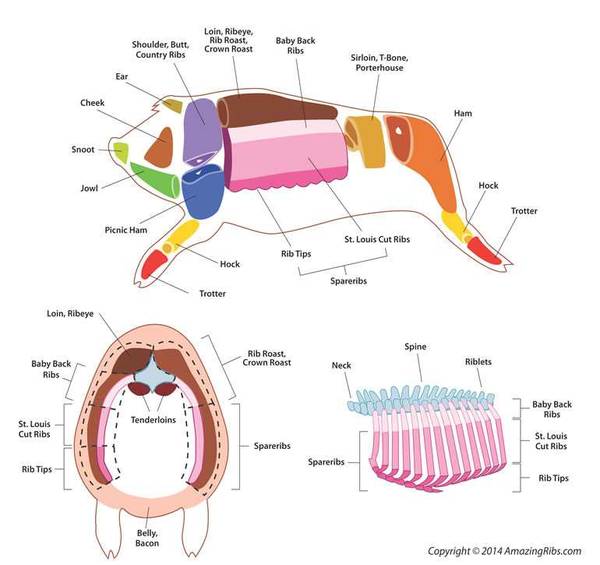
Pork is a blank canvas upon which you can paint your masterpiece. Steaks have more innate flavor and need absolutely no adornment, but pork is milder, calling for the creative touch of a culinary artist wielding a brush laden with sauce, a cooker swathed in smoke, or a smattering of seasonings massaged into its flesh. Here are the different pork cuts explained.
It would be nice if the nomenclature for meat cuts were the same from animal to animal, and from country to country. Alas, they are not. A standing rib roast (beef) is the same as a rack of lamb is the same as a bone-in pork roast or pork crown roast. Beef short ribs are pretty much the same as pork spare ribs, but don’t ask for beef spare ribs because there is no such thing.
In April 2013 The Beef Checkoff Program, the National Pork Board, and the United States Department of Agriculture (USDA) agreed to new labeling standards in an attempt to “make things easier on the consumer”. I have updated the list below to include new names, list ing them first. Click here to see a pdf of all the new pork names and the old ones side by side. I have highlighted some of the more interesting changes.
Regardless, traditional, regional, and even local names will be on your store shelves. There is a standard guidebook for butchers, the North American Meat Processors Association Meat Buyers Guide,
According to the National Pork Board, with a market weight of 265 pounds the typical hog will produce a 200 pound carcass that will yield about 150 pounds of retail cuts of pork. Everything but the squeal is used, however. The bristly hair is often used for brushes, pig’s feet are pickled, pork skins are fried and sold as snacks, rendered fat and lard are used for baking and frying. Even the snouts are cooked sometimes. Here are the average weights of popular cuts from a typical hog.
Hams (hind legs). 37 pounds of retail meat.
Bacon (side and belly). 15 pounds of cured bacon.
Spareribs (side ribs). 8 pounds.
Baby back ribs. 4 pounds.
Boneless loins. 16 pounds.
Sirloins. 6 pounds.
Tenderloins. 2 pounds.
Boston butt roasts (shoulders). 11 pounds.
Blade steaks from the Boston butts. 6 pounds.
Picnic hams (shoulder to elbow). 16 pounds boneless.
Jowls, feet, tail, neckbones. 13 pounds.
Trim for sausage. 25 pounds
Skin, fat, bones, shrink, loss. 49 pounds
Pork is not graded like beef
Interestingly, pork is not graded by the USDA as is beef. Beef gets its grades (Prime, Choice, Select, etc.) depending on the amount of fat “marbled” in with the meat (click here for more on beef grades). Pork is not graded this way. Pork grading involves two basic factors. Size and gender of the animal. Some of the terms that are used are:
Pig, Swine, or Hog. Any porcine animal from the family Suidae.
Market Hog or Butcher Hog. Male or female raised strictly for meat. Typically weighs 195 to 320 pounds.
Barrow. Male butcher hog, castrated before puberty.
Gilt. Female butcher hog who has not given birth yet.
Sow. Female breeding hog. Weighs 300 to 700 pounds. Typically births 10 piglets at a time, she averages 2 litters per year, and they take about 21 days to wean.
Stag. A male hog castrated after puberty. Darker meat. Weighs up to 700 pounds.
Boar. An uncastrated male used for breeding purposes. Darker meat. Weighs up to 1,000 pounds.
Piglet. A young pig that has not been weaned yet.
Fresh pork is available all year, but more hogs are slaughtered from October to February, so prices are a bit lower then. This is a holdover from the days before refrigeration when hogs were slaughtered in cool weather so the meat could be cured and stored in cool weather. Hogs are also more expensive to feed in winter when grain is not growing. Most pork today is slaughtered at between six to nine months old. Ribs often go on sale for Father’s Day and the Fourth of July.
But beware, some unscrupulous butchers will, illegally, repackage and relabel older meat, so look at the stuff before you put it in your cart. Look for meat that is pale pink with white fat. Brown meat or yellow fat usually means the meat is oxidizing and not fresh.
Large hog farms, called Concentrated Animal Feeding Operations (CAFOs), have been widely criticized for predatory pricing, overcrowding and inhumane handling of the animals, overuse of antibiotics fostering antibiotic resistant bacteria that can jump to humans, improper handling of waste, as well as air and water pollution. This is a system that is broken and in need of reform. On the plus side, they deliver quality fresh meat at low prices.
When buying pork, shop for cuts that are darker red in color. They have more flavor.
More than you need to know about pigs
Kingdom. Animalia
Phylum. Chordata
Subphylum. Vertebrata
Class. Mammalia
Order. Artiodactyla
Family. Suidae
Subfamily. Suinae
Genus. Sus
Species. Scrofa
The family Suidae is made up of 16 species, and the common pork hog in your grocery case is Suidae Sus Scrofa. Suids first appeared in southern Europe and Asia and were found on Africa and the Phillipines. They are omnivores and, according to the University of Michigan Museum of Zoology (UMMZ), in the wild they eat, fungi, leaves, roots, bulbs, tubers, fruit, snails, earthworms, small vertebrates, eggs, and carrion. They have a flexible, muscular snout, and in concert with their forefeet, they root and scratch for food.
Wild boars are hunted for sport around the world, and in parts of the US and Europe, their population is soaring and they are becoming a major problem for farmers, pets, and humans. They can be downright ornery and their tusks are potentially lethal.
Hog stomachs have two chambers, but they do not ruminate like cattle. They have many different skin colors, tail lengths, and snout shapes. Their eyesight is not good because their eyes are on the sides of their heads limiting their forward vision, and their sense of taste is very advanced. Males often have long tusks, and fight violently for the attention of females. Dominant males can often service as many as eight sows. They are pregnant for 115 days, and litters of 5 to 6 are typical.
Recently some types of pig have become more popular as pets. According to UMMZ, domestic pigs are considered to be more intelligent than dogs and circus trainers have characterized Sus scrofa individuals as quick learners with substantial memories. It is also believed that pigs speak a rudimentary language composed of calls, snorts, sniffs, and whistles. Among the most famous pet pigs is Max, owned and beloved by George Clooney.
New old hog breeds
A few decades ago, farmers decided that they wanted to sell pork as a healthy competitor to chicken, whose sales were booming. So they settled on breeds like the American Yorkshire that have less fat woven in with the muscle and they cooked up the “other white meat” marketing campaign (which was discontinued in early 2011). Jim Compart of Compart Family Farms in Nicollet, MN, and caretaker of a large herd of Red Duroc hogs, calls the standard grocery store pork “The other dry meat.”
In recent years some farmers have been bringing back herds of “heritage hogs” and other exotic breeds including Berkshire, Chester, Duroc, Gloucestershire Old Spot, Guinea Hog, Large Black, Mule Foot, Kurobota, Mangalitsa, Ossabaw Island, Red Wattle, Hereford, and Tamworth. Most have more fat, darker meat, and more flavor than Yorkshire. Because they are not common yet, the meat is more expensive, but you can expect to see these and other specialty breeds in the market soon. I’ve seen Berkshire in several groceries already. Click here for more info about these heritage and other hogs. They are worth pursuing.
The different cuts of pork and a pork glossary
Below are some of the most popular cuts of pork. Click here to watch an excellent video of my friend Stephen Gerike butchering a hog shoulder. For a precise technical list visit the University of Nebraska Porcine Myology website.
3 & down, 4 & over, etc. This is butcher talk for the weight of a slab of spareribs. A “3 & down” weighs 3 pounds or less untrimmed, with the tips attached. Most chefs prefer theirs 3 1/2 and down, from younger hogs.
Applebee’s Riblets. See button ribs.
Arm roast. See picnic.
Arm steak. Cut from the picnic.
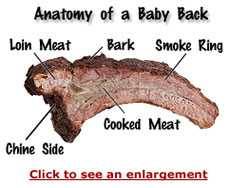
Baby back ribs (a.k.a. back ribs, a.k.a. baby backs, a.k.a. loin back ribs, a.k.a. loin ribs, a.k.a. Canadian back ribs). Connected to the backbone, nestled beneath the loin muscle, are the most tender and leanest ribs, baby backs. No, they do not come from baby pigs. They are called “babies” because they are shorter than spareribs. A typical full slab has 11 to 13 bones. The slab is tapered at one end, with the shortest bones only about 3″ and the longest about 6″.
They are usually curved like a hockey stick at the end where they meet the spine. Depending on how the butcher removes the loin meat that is on the humped side of the bones, some can have up to 1/2″ of delicate, lean loin meat on the top. Usually about 2 pounds per slab, about half of which is bone, many hungry adults can eat a whole slab of baby backs. Because they weigh less than spareribs, they cook faster. In 2013 I began to hear about “boneless” baby back ribs. They are discussed below.

Baby front ribs. See photo of Meathead at right pointing out the baby front ribs at a seminar he gave on April 1.
Baby spareribs. These are not the same as baby back ribs. Nor do they necessarily come from young tender pigs. These are spareribs made smaller by removing the rib tips. These are more properly called St. Louis cut ribs (see below), but some butchers call them baby spareribs to capitalize on the popularity of baby back ribs.
Back bacon. See Canadian bacon.
Bacon (a.k.a. side bacon, streaky bacon). In the US, bacon is the term used to describe salt, spice, and smoke cured slices of belly high in fat and streaked with muscle. It is best made by taking slabs of belly, rubbing them with salt, pepper, sugar, and other spices, letting it age for days to weeks, then smoked over low temps, and sliced. Cheaper bacons are cured by injecting with a seasoned salt solution. Canadian bacon is a name for cured loin meat in the US.
Bacon bits. Chopped bacon. Buyer beware, there are fake bacon bits made from whatever.
Bacon fat. Fat rendered from cured, soked bacon. High in saturated fat, it is very flavorful and is superb for sautéing and frying.
Barbecue cut. See St. Louis cut ribs.
BBQ tenders. See flap meat.
Belly. Includes the skin, fat layer, and some thin muscle streaks from the sides and belly of the hog. Not to be confused with the stomach. It can be rendered for lard, roasted and sliced thin on vegetables, potatoes, or pastas, but it is most often used to make bacon. Many restaurants also serve roasted belly as a decadent treat.
Blade chops. See blade steaks.
Blade roast. See butt.
Blade steaks. Cut from the butt these slices are typically less than 1″ thick and often have a section of shoulder blade in the center. They have several distinct muscle groups and a significant bit of fat and connective tissue between the muscles, but when cooked gently, they make tasty eating.
Bone-in loin roast or bone-in loin rib roast. See rib roast.
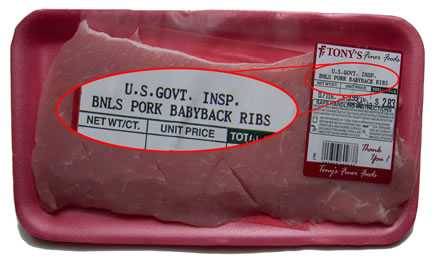
Boneless Baby Back Ribs. Baby back ribs are attached to the loin muscle. In the old days loin meat sold for more than ribs, but the demand for baby backs has changed this. So lately butchers have been leaving more loin meat on the ribs. Now they have taken it ever further by labeling loin meat as “boneless baby back ribs”.
Boston butt. See butt.
Brisket. In beef, there are two large clods of tough, boneless meet on the chest called brisket. They are used to make corned beef, pastrami, many pot roasts, and great barbecue. But beef brisket is very different than the brisket in pork. In pork, the brisket is the same as rib tips.
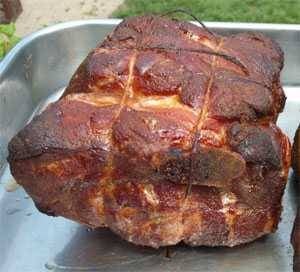
Butt (a.k.a. Boston roast a.k.a. Boston butt a.k.a. pork butt a.k.a. shoulder butt a.k.a. shoulder roast a.k.a. country roast a.k.a. shoulder blade roast). The top of the shoulder from the shoulder socket up to the spine excluding the picnic. This is the cut that is best for pulled pork but it can also be cut into steaks, stew meat, roasts, and ground for patties and sausage.
It is a complex weave of muscles, fat, sinew, connective tissue, and bone. Butts can weigh from 4 to 14 pounds and they usually have shoulder blade bones in them although some butchers remove the bones and sell “boneless butts”. Butts are often are tied with string because they fall apart easily. Butts are the most popular cut for pulled pork because they are best when roasted low and slow. They are also good for braising and in slow cookers.
It is not unusual to find partial butts in the 4 to 5 pound range. These small cuts are especially nice because they cook quicker and, if smoke roasted, there is a lot of the crispy, crusty surface, called bark, or Mrs. Brown by aficionados. This cut also produces blade steaks.
Why is it called a butt? Some say that because, when trimmed, the butt is barrel shaped, and barrels were often called butts by English wine merchants. Others say that they are called butts because they were shipped in barrels. A reader has suggested that a butt is a name for a joint in woodworking, and the shoulder is a joint area. One can only speculate why it is called the Boston butt, but my friends in New York have offered some unkind suggestions. No ifs ands or butts, it makes the best sandwich meat on the hog and it has the added benefit of being inexpensive.
Butterfly chops. Thick sections of boneless lean loin meat sliced most of the way through the center and then opened up to make a thick wide chop. Usually has a strap of back fat around it that should be slit or removed because it often shrinks during cooking and can make the meat cup. Fine for grilling, roasting, even stuffing.
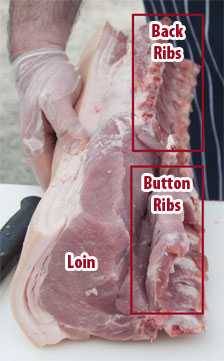
Canadian back ribs. Another name for baby back ribs, they are called Canadian because Canadian bacon is made from the loin meat that was connected to the ribs before butchering.
Canadian bacon. A term used in the US to designate cured, smoked loin meat. Although it is popular in Canada, side bacon is also popular.
Center cut rib roast. The 6 to 8 bone center section of the rib roast is the most desirable and expensive portion.
Cheater rack. A nine-bone rack of ribs, less than the usual 10-13.
Cheeks. Tender balls of meat from the cheeks of the head. Prized by chefs.
Chef’s Bonus. These are the trimmins that, when thrown on the smoker, finish fast and keep the barbecue cook from dieing of starvation during long cooks. See flap and tips.
Chine. The backbone or spine. Sometimes refers to a split backbone, and sometimes refers to backbone still attached to baby back rib slabs and rib roasts. Many people think the chine is the breastbone, but they are on the wrong side of the animal. The confusion is probably because the keel of a boat is often called the chine, and the breast is often called the keel of an animal. But the keel of a boat is analagous to the backbone in that all the ribs are attached to it. In any case, the chine is the spine and not the breast.
Country-style ribs (a.k.a. Country Ribs). Country-style ribs are not really ribs. They are really pork chops, more meaty and less fatty than real ribs, and should be cooked like chops, not ribs. They are cut from the front end of the baby backs near the shoulder and a tray of country-style ribs in the grocery store might contain a rib or two but more than likely they there will be a section of shoulder blade. Depending on how they are cut, a serving will be one or two country ribs. For big hungry men, perhaps three. They respond well to brining before low and slow cooking.
Cracklins (a.k.a. chicharrons). Made by frying chunks of skin and the subcutaneous fat layer, and occasionally a thin layer of meat. Liberally salted, they are sinfully tasty and make a killer snack or can be used as a garnish on vegetables or in soups. The skin is usually hard, and the fat spongy and juicy. Clcik here for my recipe for killer cracklins.
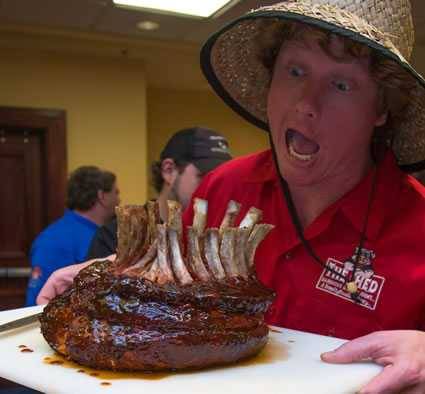
Crown roast (a.k.a. crown rib roast a.k.a. standing rib roast). There are several ways to make this festive meal for a crowd. The traditional method is to take a whole bone in pork rib roast and bend it into a circle with the loin meat in the center and the bones facing out and tie it with string. When the meat between the bones is trimmed off it is called Frenching. The cavity this creates is often filled with a bread stuffing or even pork sausage meat. You can season the meat with spices and herbs (my preference), or a sauce, as Brad Orrison of The Shed in Mississippi has done, above.
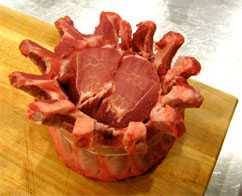
A more recent variation on the theme is made with a slab of baby back ribs wrapped around a hunk of loin meat (shown here).
Depending on how it is trimmed, there’s usually enough meat for at least 10 people in a standing rib roast of pork.
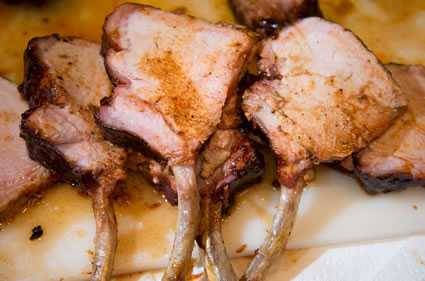
Below are the chops cut from the roast Orrison cooked.
Danish ribs. Small slabs of baby backs usually from Denmark, but not always. One guy I know says “I think they’re possum ribs. They look like baby backs, only smaller, thinner, and meatless!” Never heard a good word about them.
Double wide rib chop. A rib chop that is cut extra manly thick by including two bones. One is usually broken off or cut out. A serving is one chop.
Ears. Pig ears are found in the pet stores as dog treats, but they are also good people treats. They are high in cartilage, which, boiled, then fied, grilled, smoked or roasted, can make humans wag their tails and roll over for tummy scritches.
Fatback. Slabs of fat from the back (doh!). Often used in making sausage and burgers. It is not as highly prized as leaf lard because it is higher in water content and when burgers made with fatback are cooked, they can shrink significantly.
Feet (a.k.a. trotters). From the ankles to the toes. There is little meat and a lot of skin, fat and bone. Best used in soups and stews for body when the gelatin is extracted, and flavor from the fat and skin. Feet are often cured or smoked, and in the south they are often seen in big jars on bars, pickled.
Finger meat. The meat between the ribs.
Flap (a.k.a. skirt, a.k.a. Chef’s Bonus). There is a flap of chewy meat from the diaphragm on the concave side of the spareribs and St. Louis cuts from the head end of the slab. Many cooks remove it and cook it as a snack, toss it in with the tips, or grind it into sausage.
Flat-bone ribs. See button ribs.
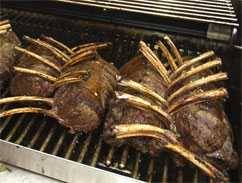
Frenching. Getcher mind outta the gutter. Frenching is the trimming butchers do to rib roasts in order to make them look pretty by bearing the rib bones. In the process they will often cut out the wonderful meat between the bones and toss it in the scrap pile for sausage! Arrrrggghhhh! I like to leave the meat on and just cover it with a few layers of heavy foil to keep the bone tips from burning.
Gristle. Tough connective tissue, but some folks use the term to describe rib tips which have a lought of gristle.
Ground pork. Used for pork sausage, burgers, and McRibs.
Half slab. A slab of ribs cut in half containing 4-6 bones. See slab.
Ham. The hind legs of a hog. The picnic, the top of the forelegs, is sometimes called a picnic ham, but the true hams are the rear legs from the hip to knee. There are many different kinds of hams sold, from raw ham to brined hams to cured hams to precooked hams. Click here for a whole article devoted to the different types of ham.
Ham steak. This large steak of uncooked ham has a round section of the leg bone in the center. It is fine for grilling.
Head and headcheese. Often used to make headcheese, which has no cheese in it by the way. Headcheese is a loaf that is typically made by simmering the head (sans eyes and brains) in water, vinegar, herbs, spices, and onion, then chopping the meat and mixing it in the liquid, and pouring it into a loaf pan, where the liquid hardens into aspic, an intense marvelously flavorful gelatin, with the meat parts encased. It is typically sliced and seerved with bread. See also ears, cheeks, and jowls.
Heart. Can be roasted, but the flavor is not for everyone. More commonly it is used in sausage, paté, and terrines.
Hocks. The shin, calf, and other muscles, bones, fat, and skin from just above the knee to the ankle. There are shoulder hocks from the front legs, and ham hocks from the rear legs. They are often sold smoked and are great when added to soups and stews where they give up flavor, texture from marrow, and richness from skin and the skin fat. Take the skin off and they are called shanks.
Jowls. From the rear of the head. There’s some very good meat there. In Italy the jowl meat is used to make guanciale, a cured meat.
Kansas City cut. Not a commonly accepted term, it is usually used to refer to what is otherwise known as a St. Louis cut. Sounds like a little Missouri rivalry to me.
Kassler rib. Smoked bone-in rib roast.
Lard. Fat rendered from the hog. The most prized is called leaf lard and it comes from the around the kidneys and is regarded by pie experts as the best shortening for crusts. High in saturated fat, it is not as popular for table use as it once was, but in Italy, lardo, a blend of lard and herbs, especially rosemary, is an exquisite treat spread on crusty bread and washed down by a big red wine.
Leg (a.k.a. fresh ham). Can be bone-in or boneless, skin on or skinless, or short shank by cutting off part of the thigh bone above the knee. Sometimes the outside muscles are offered separately. Ditto for the inside muscles. It can be roasted, skin on or off, and it is especially good with the skin removed and smoke roasted with Danny Gaulden’s Glaze. If you wish, you can brine it. That brings more moisture and flavor to the party. Use the brine and method described in my recipe for the Ultimate Smoked Turkey. Also, read my article on the faux Cambro so you can make sure you don’t keep people waiting. For more on the subject, read my article on The Science of Hams.
Leg cutlet. A steak like muscle that is fine grilled or panfried.
Leg tip or pocket roast. A muscle grouf from the top of the leg can be cut off to make a ball-shaped roast a bit larger than a softball.
Light Sparerib. Comes from smaller and younger pig, 3 pounds and down with breast bone (rib tips) on.
Liver. A strong distinctive flavor that is not for everyone. It is well used in a stew popular in South Carolina called hash. Hash is made with trimmings, onions, seasonings and more. It is also used in pates and terrines.
Loin a.k.a. loin roast a.k.a. chef’s prime roast. The loin of the pig is the long strip of tender, lean meat that runs on either side of the hog’s spine almost the entire length of the animal on top of the ribs. It is not the groin area as in “gird ye loins for the battle men.” The loin and tenderloin are two entirely different muscles and they are often confused. They shouldn’t be. The tenderloin is more tender (DOH!). But the loin is not far behind because both are muscles that doesn’t do much work.
The loin can be up to 3′ long and weigh 16 pounds. The tenderloin is about 10″ long and about two pounds. There is a good picture of the two here. Because the loin is the top of the back of the pig, the expression “living high on the hog” came to mean living the lux life. Poor people, serfs, servants, and slaves ate the tougher cuts, the muscles that worked hard, from lower on the hog, such as the ribs. Pork loin can be sold boneless or bone-in, in which case it is called a rib roast. Boneless loins can be cured and smoked to make Canadian bacon. Click here for my recipe for stuffed pork loin.
Loin chops (a.k.a. porterhouse chops a.k.a. T-bone chops). From the rear part of the loin, these chops have a T-bone in them and are analogous to beef T-bones and porterhouses. One side of the bone is firm loin meat and the other side is soft tenderloin. The texture and taste is distinctly different between the two pieces of meat.
Loin back ribs or loin ribs. See baby back ribs.
Long end ribs. See short end ribs.
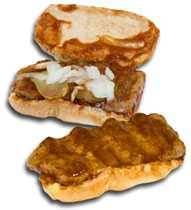
McRib sandwich. Introduced in the early 1980s, the McDonald’s McRib sandwich is an oblong ground pork patty smothered with a ketchupy barbecue sauce, topped with pickle slices and onion slices, served on a kaiser-type roll. The patty is pressed on the top to look as if it has bones in it. I’ll never know why they put in the ridges because, with all the sauce, pickles, and onions, even if you took the bun off you’d never notice the corrugations.
Of course McRib probably contains no rib meat. It is too expensive. When I complained to a friend that the name is misleading and it should be changed, he said “Yeah and they oughta change the name of Girl Scout cookies for the same reason.” McRib is not always on the menu under the Golden Arches, a marketing move that creates demand for the sandwich. A friend calls their occasional appearance “McDonald’s answer to soft-shell crabs.” The fact is that it is not the meat that brings ’em in. It is the sticky sweet sauce. If you try a McRib sandwich, get lots of napkins. Click here for more on the story of McRib, and for a recipe for a really great rib sandwich.
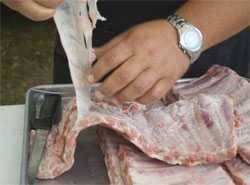
Membrane. Each slab has a meat side and a bone side. The meat side is convex (curving towards you), and the bone side is concave (curving away from you). The bone side has a membrane called the pleura covering it. It can be leathery and almost unchewable when cooked, and it can prevent flavorings and smoke from penetrating. Many butchers remove the skin. If the membrane has not been removed when you bring home a slab, you should remove it yourself. Click here to see how to skin ‘n trim.
Middlings. Early American cookbooks refered to spareribs as middlings, presumably because they came from the middle of the hog.
Oink. This is the only part that is inedible.
Picnic (a.k.a. picnic ham). The picnic is the upper part of the foreleg and it runs from the shoulder socket through to the elbow. A picnic ham is not a true ham. Hams come from the rear legs only. The picnic usually weighs from 4 to 12 pounds and it is usually used for pulled pork, braising, stew meat, or grinding.
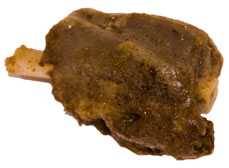
Pig wings. The fanciful trademarked name for rear leg shanks is the clever creation of Pioneer Meats, a meat wholesaler. Pig wings are a small hunk of meat, 2 to 5 ounces, taken from the narrow end of the ham near the knee with a small handle of fibula bone sticking out. They are mini pork chops on a stick, perfect bar food.
Pork steak. Pork shoulder can be cut in thick slices that can be grilled like steaks.
Rack. When referring to pork ribs, a rack is the same as a slab. When referring to lamb ribs, a rack also includes the loin meat and is essentially the same as a rib roast.
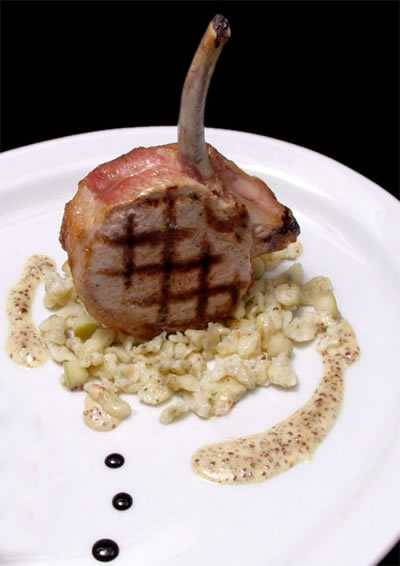
Rib chops. A rib chop is a pork chop cut from the rib roast. They are typically about 3/4″ thick, lean, and each can be sold boneless or with a baby back rib attached. Because they are so lean, they benefit from brining. A normal serving will be one chop. Hungry people might eat two. The one above has been “Frenched” which means it has been trimmed so the bone is exposed like a handle. I like to eat these like lillipops.
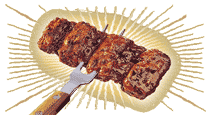
Riblets. Riblets are made by taking a full length slab or ribs and cutting them with a cleaver or a band saw so the bones are only half as long as normal, perhaps 2-4″. This is done to make smaller portions or to remove part of the curve of baby backs and produce a flatter slab. Usually served as appetizers, for a main course a normal serving would be 10-12 riblets. Some people refer to pork rib tips as riblets. This is incorrect. Applebee’s restaurants have a menu item called “riblets” that are technically not riblets. Technically they are button ribs. or “transverse processes of lumbar vertebrae byproduct from the boning of pork loins”.
In veal and lamb, riblets can refer to the ends of the ribs. Then there are the riblets by Gardenburger (at right) described thusly on their website: “Juicy and tender veggie riblets with a slow-cooked, hickory-smoked flavor. And don’t forget the smoky BBQ sauce. Cowboys never ate this good.” If they did, they would be called soyboys.
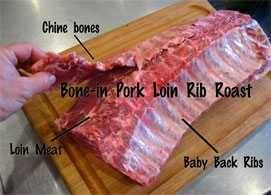
Rib roast (a.k.a. bone-in pork loin rib roast, a.k.a. bone-in loin rib roast, a.k.a. center cut rib roast, a.k.a. prime rib of pork). This is the whole pork loin muscle, up to 2′ long and 6″ thick, with the baby back ribs attached. You can buy the whole roast or sections. Sections of 5-8 bones are typical. The loin meat is lean and tender, so it should be not cooked to the high internal temps as rib slabs. Most books and websites say the internal temp should be 160°F but that’s a recipe for cardboard.
You can take it off at 135 to 140°F. Trichinosis is killed at 140°F, but not to worry, there are only about five cases of trichinosis a year from pork in the US and most of them come from uninspected homegrown hogs. There will be a hint of pink, and the meat will be moist and juicy. Rib roasts are always bone in. Without the bone they are called loin roasts. The center cut rib roast, with 6 to 8 bones, is the most desirable and expensive portion. A rib roast can be cut into rib chops with a bone in each and these are great grilled, especially if brined for about an hour first.
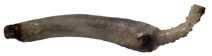
Rib tips (a.k.a. brisket, a.k.a. costal cartilages, a.k.a. breaks). Rib tips are strips that have been cut from the lower ends of the spareribs when making St. Louis cut ribs. They typically run 8 to 12″ long and 1 to 3″ wide.
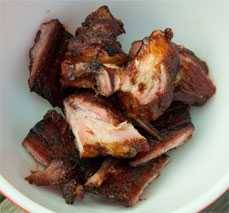
Eating rib tips takes a bit more gnawing than other cuts because they are chewy and the small tubes of cartilage in them go every which way. In some regions, tips are a delicacy and preferred over other cuts, and in some regions nobody wants them. Many butchers just remove them and chop them for stir-fry or grind them for sausage. Go figure.
When served, they are usually chopped with a cleaver into chunks about 2″ square. Two full strips trimmed from a slab of spares, will fill a normal person. Many people think rib tips and riblets are the same thing. In fact, many websites will tell you they are. They are not. The picture here shows a spare rib and the cartilage from the tips attached. When butchered, the tips are cut at this junction.
Rind. See skin.
Sausage. There are scores of sausages made from ground pork ranging from hot dogs, to loose meat breakfast patties to raw sausages like Italian sausage to cured and cooked sausages such as mortadella.
Shanks. Hocks without the skin, best in stews and braises.
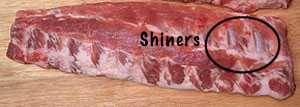
Shiners. Rib bones showing through the meat on top of the slab after the slab has been butchered. More common on baby back (loin) ribs than on spareribs. In the photo at right, the baby backs on the top have been cut generously with extra loin meat left on. The slab below has been cut too close to the bone, leaving two shiners showing on the right.
Short end ribs and long end ribs. In many rib joints you can order a half slab, and you never know which end you’ll get. In restaurants in Kansas City you can usually specify the end you want. On a slab of spareribs, the bones on one end are longer than on the other. The first six ribs from the shoulder back are the long end ribs. The short end has the last seven or eight bones. The short end is slightly meatier and slightly more tender. The short end typically costs $1 more there.
Short ribs. Short ribs are sections of beef ribs, not pork. They are described in detail in my article, the Science of Beef Ribs.
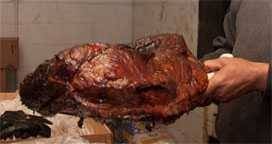
Shoulder. The pork shoulder is a complex weave of muscles, connective tissues, sinew, and fat and it runs from the spine down to the elbow of the front leg including the shoulder blade, forward to the neck, and back to the ribs and may include the first two or three small rib bones. It can be used for pork steaks, country ribs, shoulder roast, and pulled pork. It is generally best when cooked low and slow. Southern style smoke roasting and braising are good techniques. At high temps it tends to get tough. A full shoulder can weigh 8 to 20 pounds and has two halves, the picnic and the butt.
Shoulder roast. See butt.
Side ribs. See spareribs.
Sirloin chops. Chops from the back of the loin, behind the ribs, near the hip. The sirloin has a group of several muscles and makes very good braised meat.
Skin (a.k.a. rind). There are two uses for the word. (1) the exterior of the hog after the hair is removed. It can be thick and leathery. Fried and sorted pork skins are light and puffy, like Cheetos, a fine accompaniment to beer and football. Sections of skin and the subcutaneous fat layer are also fried to make crunchy heavenly unhealthy (but who cares) cracklins. Click here for my recipe for cracklins. The difference between cracklins and skins is that cracklins have the fat included and the skin is hard. (2) Skin is also another name for the membrane on the curved, interior side of the rib cage, properly named the pleura. See membrane.
Skirt meat. See flap.
Slab. A slab is a row or ribs held together by muscle meat, fat, and cartilage. The meat is both between the bones and on top of them. A slab is usually 10-13 bones, depending on how it is trimmed. A half slab is a slab cut in half. Doh! A cheater rack is only nine bones.
Snout or snoot. A particularly greasy and gelatinous cut with a particularly distinctive flavor for particular people. Popular in St. Louis.
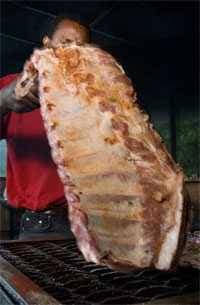
Spareribs (a.k.a. spares, a.k.a. side ribs). Spareribs are not like spare tires. They are not extras, leftovers, or an inferior cut. Nor are they so named because the meat is scanty. They contain excellent meat, usually richer and more flavorful than baby backs. Many chefs prefer spares to baby back ribs.
Spares are cut from the ends of baby backs, further down the side of the hog, they run all the way down to the breast bone, and that’s why they are also called side ribs sometimes. Look at a slab of spareribs and you will notice that along one edge the ends of bones are showing and you can see marrow. This is where they were cut from the baby backs. The other end, with no bones sticking out, is from the chest. It is flap of meat, small bones, cartilage, and gristle called rib tips. The bone side of spareribs usually has a meaty flap that is part of the diaphragm called the flap meat.
USDA says a slab must have at least 11 bones and there is usually more bone than meat in a slab of spares with more meat between the bones and less on top of them than baby backs. The bones are straighter and flatter than baby backs, and the meat has more fat between muscle fibers, called marbling. The bones, connective tissue, and the fat make the meat very flavorful. Spareribs generally run 2.5 to 3.5 pounds, half of which is bone and cartilage, and can usually feed two people.
Spares are a little less expensive than baby back ribs because they have more bone and because demand for baby backs has grown significantly since a certain restaurant chain began promoting them with a catchy jingle (sing along with me now: “I want my baby back baby back baby back ribs”).
So how did spareribs get their name? According to Charles Perry of the Los Angeles Times, “In 17th century England, spareribs were also called spear-ribs or even ribspare, a clear tipoff that this wasn’t a native English word. It was borrowed from the German rippespeer, which is smoked pork loin.”
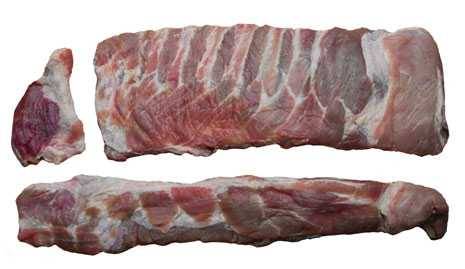
St. Louis cut ribs (a.k.a. SLC a.k.a. barbecue cut, a.k.a. Kansas City cut). Take a slab of spareribs, lop off the gristly rib tips (in the picture above, they are along the bottom), and what remains is a flat rectangular slab called the St. Louis cut (in the picture above, the SLC is at the top) and a flap of meat that is usually removed and set aside for grinding. Because the 10 to 13 rib bones are straight and flat, they are the best cut for recipes that require the ribs to be browned in a frying pan on the stovetop. Some butchers call SLC spareribs, but because the tips have been removed, technically they are no longer spares. They are also sometimes called barbecue cut, or Kansas City cut.
If your butcher doesn’t know what St. Louis cut means, get a new butcher or simply ask for spareribs with the tips removed. Then again, you may want to remove them yourself and cook them too. A standard 2 to 3 pound slab can serve two people or one really hungry big man. When smoke roasted at about 225°F, they take five to six hours to reach perfection. Don’t ask me how SLC got it’s name. I’ve heard several stories and I don’t think anyone knows for sure. Probably invented by some butcher in St. Louis where it became popular.
Suckling pig. A small whole hog that has only be fed milk, usually between 4 and 6 weeks old.
Tail. Best used in braises.
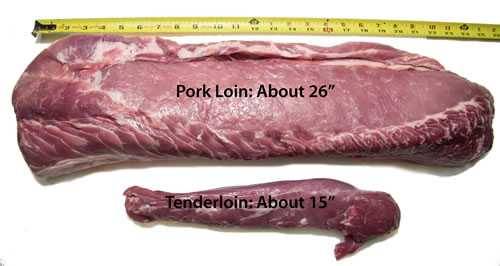
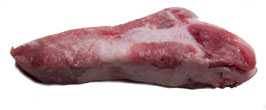
Tenderloin. The tenderloin is a long narrow, tapered muscle that lies just below the loin starting just behind the last rib, about the size of the forearm of a 10 year old human and weighing about two pounds. It is the tenderest and most expensive cut on the hog. Mild in flavor, it can be grilled quickly over direct heat, and it is often cut crosswise into disks called medallions and which are ideal for quick pan searing. It is not to be confused with the loin, shown above it here. The loin is a large log of meat up to 16 pounds. Click here for more about the loin.
Tips. Another name for rib tips.
Top leg (a.k.a. inside roast). A large bundle of muscles from the leg that make a fine roast.
Trotters. See feet.
Whole hog. One can order a whole hog ranging from suckling pigs at under 50 pounds to north of 200 pounds. Here is an article on cooking whole hog.
More info
Click here to view a site from the University of Nebraska Lincoln that has some really helpful pix and a really cool 3D visualization of a hog carcass and from where the different cuts come.Click here to see Title 9, Volume 2 of the Code of Federal Regulations. It contains the official government definitions for all cuts of meat.
Click here to see the US Department of Agriculture’s (USDA) Institutional Meat Purchasing Specifications (IMPS). This 40 page brochure in pdf format is the official source.
Click here for other glossary terms important to the barbecue cook.
Kosher, halal, and other pork free diets
Before you plan a big rib party, check with your guests. Many observant Jews, Muslims, and Seventh Day Adventists will not eat pork.
Any Part of Piggy By Noel Coward
Any part of the piggy
Is quite alright with me.
Ham from Westphalia, ham from Parma
Ham as lean as the Dalai Lama
Ham from Virginia, ham from York,
Trotters, sausages, hot roast pork.
Crackling crisp for my teeth to grind on
Bacon with or without the rind on
Though humanitarian
I’m not a vegetarian.
I’m neither a crank nor prude nor prig
And though it may sound infra dig
Any part of the darling pig
Is perfectly fine by me.
The Pig Got Up and Slowly Walked Away by Benjimine H. Burt
One evening in October when I was far from sober,
To keep my feet from wandering, I tried.
My poor legs were all aflutter so I lay down in the gutter,
And a pig came up and lay down by my side.
We sang, “Never mind the weather just as long as we’re together,”
Till a lady passing by was heard to say,
“All his self-respect he looses when such company he chooses,”
And the pig got up and slowly walked away.
Zoology
A man was driving down the road in the country. He looked over and saw a baby pig in the road. He stopped, picked up the pig, and drove around stopping at farmhouses ringing doorbells looking for the owner.
One house is owned by the Chief of Police who tells him “Just take him to the zoo.” The driver agrees and drives off.
The next day the Chief sees the guy driving around town with the pig riding shotgun. He pulls them over. ñWhat are you doing? I thought I told you to take that pig to the zoo!î
The driver replies, “I did! We had such a good time we’re going to the ball game now.”
Pig!
A man was driving up a steep and narrow mountain road. A woman was driving down the same road. As they pass each other, the woman leans out the window and yells ñPig!î
The man immediately leans out his window and replied, “Hag!”
They continue on their way and as the man rounds the next corner, he crashes into a pig in the middle of the road.
Three little pigs
A pig walks into a bar and asks for three glasses of beer, he drinks and drinks and drinks and when he’s finished he asks the bartender where the bathroom is. The bartender tells him it’s down there on the left and the pig sets out in that direction.
A second little pig walks in and asks for ten glasses of beer, he drinks and drinks and drinks and when he’s finished he asks the bartender where the bathroom is. The bartender tells him it’s down there on the left and the pig goes off to the bathroom.
Another little pig comes in and asks for 100 glasses of beer, he drinks and drinks and drinks and drinks and drinks. The bartender says “Aren’t you going to ask where the bathroom is?”
The pig says “No, I’m the little pig that goes wee wee wee all the way home.”
Pearls before swine
At his Sermon on the Mount, Jesus said “Do not give what is holy to dogs, they will only turn and attack you. Do not throw your pearls in front of swine, they will only trample them underfoot.”
Many, many years later, someone opened the door, stepped aside, swept an arm gesturing for the glamorous American writer and critic Dorothy Parker (1893 -1967) to enter before him. As she stepped through he muttered loud enough for those nearby to hear “age before beauty.” Without hesitation she replied “pearls before swine.”
How Wall Street got its name
Manhattan was once farm land and there were thousands of pigs being raised in lower Manhattan. They frequently escaped and wreaked havoc on the grain fields, so the colonists built a long wall to confine them. The street that ran along this wall became known as Wall Street.
A pig in the poke?
In England in the 1600s butchers apparently enjoyed the practical joke of putting a cat in the sack (poke) of a customer who bought a young suckling pig. When the bag was opened, he “let the cat out of the bag,” and found “a pig in the poke.”
Pigs and whistles
The phrase “pigs and whistles” was first used in 1681 and means “to be ruined.” Many British pubs are named “The Pig and Whistle” because a man going to a pub is going to his ruin.
Pork barrel politics
Before the Civil War slaves were often given pork preserved with salt in barrels. After the War, when politicians fought for the interests of their constituents, especially for harbor and river improvements, their opponents came to call the practice as dipping into the pork barrel. “pork Barrel Politics” has since come to mean the practice of politicians fighting to obtain funds for popular projects in home districts.
Year of the Pig
On the Chinese lunar calendar, these are the Years of the Pig: 1887, 1899, 1911, 1923, 1935, 1947, 1959, 1971, 1983, 1995, 2007, and next up 2019.
Bay of Pigs and more
Everyone has heard of the Bay of Pigs in Cuba, but did you know that there is a Hog Island in Florida, Grenada, Guyana, Michigan, Virginia? That there is a Boarhills in Scotland? A Hog Point in Virginia? Hog Head in Ireland? A Pig Point in Virginia? Or a Sow River in England?
Brush your teeth
The slightly stringy texture of ribs can easily wedge between your teeth. If you’re gonna eat ribs, you gotta floss, especially if you accompany it with corn on the cob. As my dentist says, “you don’t have to floss all your teeth, only the ones you want to keep.” And when you brush your teeth, think of this: The first toothbrushes had bristles made of pig hair.
Blame the pig
An farmer and his wife were leaning against the edge of their pig pen when the old woman wistfully recalled that the next week would mark their golden wedding anniversary. “Let’s have a BBQ, Willard,” she suggested. “Let’s kill a pig.”
The farmer scratched his head and said “Geez, Ethel, I don’t see why the pig should take the blame for something that happened 50 years ago.”
This little piggy went to market
This little piggy went to market,
This little piggy stayed home.
This little piggy had spareribs,
This little piggy sucked on the bones.
And this little piggy went “yum, yum, yum, yum” all the way home.
Sweating like a pig
Pigs are the only mammal that do not have sweat glands.
George W. Bush’s Economic Plan
On January 22, 2004 at about 11:30 a.m., after delivering a speech, President George W. Bush unexpectedly told his motorcade to pull up to the “Nothin’ Fancy Cafe” in Roswell, NM. The press pool followed. The President shook a few hands and then went behind the counter and this exchange ensued:
David Gregory of NBC (called “Stretch” by the President). Sir, on homeland security, critics would say you simply haven’t spent enough to keep the country secure.
Bush. My job is to secure the homeland and that’s exactly what we’re going to do. But I’m here to take somebody’s order. That would be you, Stretch, what would you like? Put some of your high-priced money right here to try to help the local economy. You get paid a lot of money, you ought to be buying some food here. It’s part of how the economy grows. You’ve got plenty of money in your pocket, and when you spend it, it drives the economy forward. So what would you like to eat?
Gregory. Right behind you, whatever you order.
Bush. I’m ordering ribs. David, do you need a rib?
Gregory. But Mr. President…
Bush. Stretch, thank you, this is not a press conference. This is my chance to help this lady put some money in her pocket. Let me explain how the economy works. When you spend money to buy food it helps this lady’s business. It makes it more likely somebody is going to find work. So instead of asking questions, answer mine: Are you going to buy some food?
Gregory. Yes.
Bush. Okay, good. What would you like?
Gregory. Ribs.
Bush. Ribs? Good. Let’s order up some ribs.
Terry Moran of ABC. What do you think of the democratic field, sir?
Bush (to the owner). See, his job is to ask questions, he thinks my job is to answer every question he asks. I’m here to help this restaurant by buying some food. Terry, would you like something?
Moran. An answer.
Gregory. Can we buy some questions?
Bush. Obviously these people, they make a lot of money and they’re not going to spend much. I’m not saying they’re overpaid, they’re just not spending any money.
The food was prepared in the kitchen and boxed for carryout. The President paid for his order with $39.30 in cash and took the ribs onto Air Force One. He left no tip. Cafe owner Edward Zabala said a tip was not expected. “Most people don’t tip for carryout.”
When Pigs Fly, From Through the Looking-Glass By Lewis Carroll (1832 – 1898)
“The time has come,” the Walrus said,
“To talk of many things:
Of shoes and ships and sealing wax,
Of cabbages and kings,
And why the sea is boiling hot,
And whether pigs have wings.”
Porcine politics
“If pigs could vote, the man with the slop bucket would be elected swineherd every time, no matter how much slaughtering he did on the side.” Orson Scott Card (1951 – ) American writer.
A pig fetishist
Zuni fetish carver Stanton Hannaweeke carves only pigs.
Butchering a rib section
Pigs have 14 rib bones. They are attached to the spine and are usually divided into four popular cuts: Baby back ribs, spareribs, St. Louis cut ribs, and rib tips. Starting at the top are the baby backs, closest to the backbone, nestled beneath the loin muscle. They are curved, round bones, close together, and most of the meat is on top of the bones, cut from the underside of loin muscle.As you move further from the spine, the bones get larger, flatter, straighter, and wider apart with more meat between them. There is more fat marbling in the meat as you go further from the spine and closer to the belly. The front ribs are connected to the breast bone with a number of small bones and cartilage known as the rib tips. There are a number of other cuts, and they are all described below.
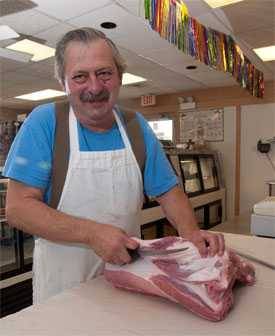
Morini’s Meat Market was my neighborhood butcher. That’s Dennis Morini below. Sadly he went out of business. He is my third artisan butcher to go out of business in the past 10 years. Old fashioned local butchers are a vanishing breed. They just can’t compete with the big box stores who have their meats pre-cut at huge central warehouses.
I asked him to order a rib section for me and then break it down while I took pictures. He is a patient man.
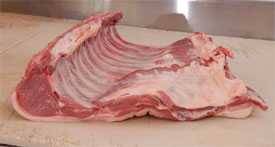
Below is the middle part of a rib section from a small pig that he ordered for me. It weighs about 16 pounds. That’s the tender, lean loin meat on the left with the skin still on the outside and the rib bones on the inside. On the right is belly meat that can be used for rib tips and bacon.
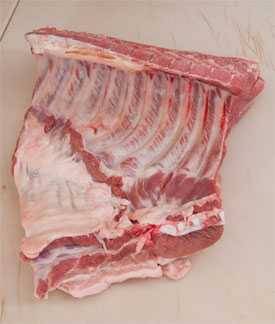
Below is the same section, top view. The right side is the front of the animal, and the shoulder or butt was attached to the top right part. There are only 9 1/2 bones, fewer than a normal rib section. The triangular white section on the lower left is the diaphragm.
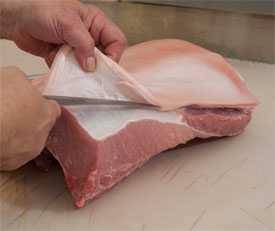
Dennis begins by removing the skin. I save it to make cracklins.
Below Dennis separates the ribs, at top, from the loin and belly meat.
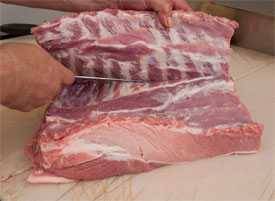
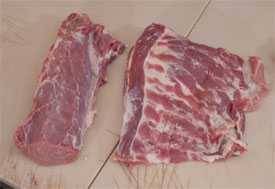
On the left is the long lean boneless loin muscle cut from on top of the baby back ribs. On the right is the belly meat that is often used for bacon or ground for sausage or meat loaf. It can also be cooked in dishes.
Next the rib section goes to the band saw where the chine, the section of spine attached to the top of the rib bones is removed. I use it in making spaghetti sauce.
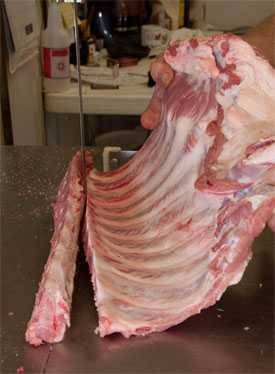
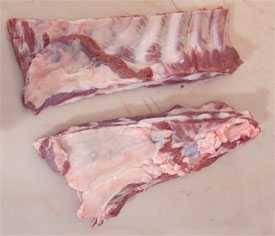
Below the band saw separates the curved back ribs from the straighter spare ribs.
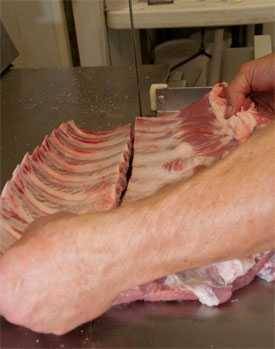
The spare ribs can be separated into two sections. At top is the squared off section called St. Louis Cut (SLC). You can see the section of diaphragm on the lower left of the SLC. The bottom section is the rib tips.
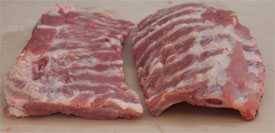
On the left, below, are the nice, squared off, flat SLC, and on the right, the curved baby backs right at the point at which they were separated.

High quality websites are expensive to run. If you help us, we’ll pay you back bigtime with an ad-free experience and a lot of freebies!
Millions come to AmazingRibs.com every month for high quality tested recipes, tips on technique, science, mythbusting, product reviews, and inspiration. But it is expensive to run a website with more than 2,000 pages and we don’t have a big corporate partner to subsidize us.
Our most important source of sustenance is people who join our Pitmaster Club. But please don’t think of it as a donation. Members get MANY great benefits. We block all third-party ads, we give members free ebooks, magazines, interviews, webinars, more recipes, a monthly sweepstakes with prizes worth up to $2,000, discounts on products, and best of all a community of like-minded cooks free of flame wars. Click below to see all the benefits, take a free 30 day trial, and help keep this site alive.
Post comments and questions below
1) Please try the search box at the top of every page before you ask for help.
2) Try to post your question to the appropriate page.
3) Tell us everything we need to know to help such as the type of cooker and thermometer. Dial thermometers are often off by as much as 50°F so if you are not using a good digital thermometer we probably can’t help you with time and temp questions. Please read this article about thermometers.
4) If you are a member of the Pitmaster Club, your comments login is probably different.
5) Posts with links in them may not appear immediately.
Moderators