

Historians think the first sausages of any kind were made about 5,000 years ago in what is now Iraq, and they are mentioned in Homer’s Odyssey, written around 800 B.C. Every nation and culture has its own special sausage so today there are hundreds of sausages in the world. Heck, there are hundreds in Italy alone! And sausage recipes often vary from butcher to butcher. I have tasted scores of sausages labeled Polish Sausage and no two are alike.
Although sausage can be made in patties, the typical sausage is called a forcemeat or a link — long and slender because it is forced into a transparent casing. The meat is most often ground beef or pork, but it is also made from lamb, duck, chicken, and everything from alligator to zebra. The casing is usually made from pork, lamb, or beef intestines. Sausages can be seasoned with spices, herbs, onion, garlic, and other flavorings. Some sausages are sold raw, and others are cooked, smoked, or in some fashion cured with salt or preservatives before being sold so they can be eaten without cooking.
If you think about it, the word sausage is very broad and it gives you a lot of leeway in making it. It is simply ground meat with spices and/or herbs. It can be encased in links, made into a patty, a a ball, or a loaf. In it’s broadest definition it can include burgers, meatballs, meatloaves, kofta, paté, and terrines.
There are several tricks that apply to almost all sausages. Here’s a good overview with pictures that you should look over before attempting to make sausages from scratch.
Safety first
Almost all meat is exposed to some level of contamination in the slaughterhouse. It is almost impossible to avoid. No matter how sanitary, invisible pathogens come in with the animals, float in the air, get on the floors, tables, knives, aprons, and gloves. The good news is that if the chain from the farm to slaughterhouse to packer to trucker to grocer to you is well managed, the amount of contamination can be insignificant. But if somebody slips up, if the meat sits on a loading dock and warms up, or if it sits too long on your kitchen counter, pathogens double in population rapidly, often in 20 minutes, and before long you have a problem. The good news is that proper cooking kills them, but it is still important to follow best practices when making ground meat products because ground meats are a special problem.
Most pathogens are strictly on the surface of the meat so they die almost instantly when cooked. But when you grind meat, the outside becomes the inside, and the insides take much longer to reach safe temperature. So there are a few things you must do to insure safety: Buy fresh meat, keep it chilled, keep your tools and work surfaces very clean, and cook it properly (160°F).
In the old days before refrigeration, sausages were made with preservatives and smoked to kill bacteria and extend shelf life. A common additive was Prague Powder, a salt with nitrites and/or nitrates added to fight bacteria. Nowadays this isn’t necessary if you are careful, but there are some notable exception: Frankfurters, and Andouille, the Bayou classic found throughout Louisiana. The additive not only preserves, it flavors.
About the meat and fat
In general, the best cut is the shoulder of the animal. It has a nice mix of fat and muscle. A good sausage needs 25 to 30% fat or it will taste dry. You may need to get extra fat. Your butcher should be willing to give you some trimmings for free. When I trim brisket and pork butts I often freeze fat just for this purpose, but beware, fat oxidizes and goes rancid faster than muscle. Pork fat gets funky faster than beef fat. I throw out pork fat older than a month, and beef fat, two months.
Here’s a nifty calculator we built to help you decide how much fat to add to your blend (thanks for help from Justin Wetherbee, Pitmaster Club member “Chief1232”):
Ground Meat Calculator
| Enter the amounts in yellow (works for pounds or kilos) | |
| Total weight of meat (enter fractions as decimals) | |
| Estimated % of fat in the meat | |
| % of fat you want in the meat (we recommend 30%) | |
| Weight of fat to be added | |
| Calculations in case you’re curious | |
| Weight of fat in meat (marbeling) | |
| Weight of meat minus the marbling | |
| Total weight of fat including marbling and added fat | |
| TOTAL weight of meat after added fat | |
About the casings
Natural casings are usually made from hog or lamb intestines are not hard to get. As they cook they get a desirable snap to them. They are neutral tasting and won’t make salmon taste like pork or lamb but you can get collagen casings made from beef protein, not intestines.
Hog casings are the best for most sausages and probably the easiest to find. We guestimate that you will get 2 links at 6″ each weighing 5 ounces each per foot of casing. So a pound of sausage mix will give you 3 links and require 18″ of pork casings. Play it safe and buy 2′ per pound to allow for blowouts, tears, and other mishaps. If you run out, make patties. Of course this depends on how you make them and how full you stuff them.
Lamb casings, which are smaller in diameter, are also common. As a rule of thumb, they are usually 4″ long and weigh about 3 ounces, again depending on how you stuff them and twist them. So plan on getting 3 links per foot of casing, or 5 links per pound of sausage mix, so you’ll need about 2′ of casing per pound. Play it safe and buy 3′.
Collagen casings are manufactured from beef protein in a variety of diameters.
You can ask the meat department at your local grocery or butcher store and if they don’t have them they should be able to order some. There are places online where you can order them too. When you get them ask if they have been washed and if they have been in a salt brine or dry packed. If they have been washed and are clean, you are good to go. If they have been in a salt brine or packed in salt, you will need to soak them for at least 30 minutes in tepid water, or as long as two days. They will keep in the refrigerator in a salt brine for about a month and if dry packed will last refrigerated for a year. They can also be frozen.
Sausages come in different sizes, so these definitions are not set in concrete. Most of our recipes are for standard 6″ links made with hog casings.
Cocktail. 2″ long and 1/2 to 1 ounce, lamb or collagen casings.
Small links. 4″, about 2 ounces, lamb or collagen.
Standard links. 5 to 6″, 4 to 5 ounces, pork.
Jumbo. 7 to 8″, 6 to 7 ounces, pork.
Tools
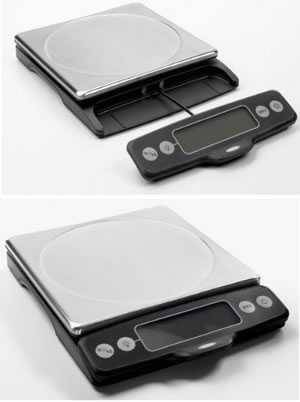
You need a scale, a grinder, and a stuffer. I use the OXO Good Grips Stainless Steel Food Scale with Pull-Out Display to get my fat to muscle ratio right.
Many people use KitchenAid Professional 5-Quart Stand Mixer


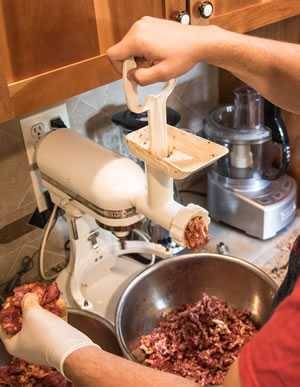
Pushing ground meat through the Kitchen Aid for stuffing is a pain. I broke down and splurged on a high quality crank and piston stuffer, the VIVO Sausage Stuffer (below). My only complaint is that when the piston hits bottom, there is enough meat left in the elbow and nipple for another two links. I recommend a bar clamp to hold it to the table. I don’t know why, but our webmaster says this picture reminds him of his last visit to the doctor.

Let’s make sausage!
1) Assemble all your ingredients and tools and read the recipe carefully.
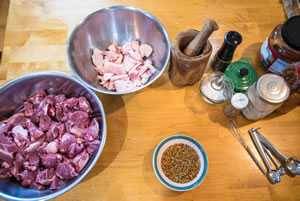
2) You can buy pre-ground meats, but they are usually not blended with enough fat. You want 25 to 30% fat for most sausages. You can chop or grind extra fat if you wish, but nothing beats the quality and freshness of grinding your own meats. Trim the fat, gristle, sinew, and bone off and discard them. Gristle will just clog the grinder. Cut the muscle and fat into 1/2 to 1″ cubes. I like to separate the muscle and fat and weigh them separately to get the ratios right, but you don’t have to do this if you think you can guess well.
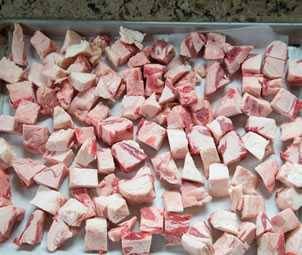
3) Place the cubes on a cookie sheet one layer deep. You want to work with cold meat because room temp meat is bacterial playground and room temp meat gets sticky and hard to work with. So put the tray in the freezer until the meat is stiff but not frozen, perhaps 20 minutes. If you freeze it solid, ice crystals form and puncture the muscle fibers and valuable juice is lost. Put the metal grinder parts in the freezer to chill them too, and if you can, chill the bowl the ground meat will fall into as well.
4) When meat and fat are ready, attach the die, a metal plate with holes, to the end of the grinder and attach the grinder to the mixer. I usually go for large holes, 3/8″ or larger. Smaller holes tend to clog more easily. Load the feed tube with cold meat a little at a time, and press it through with the plunger. You can grind the fat and muscle meat separately or mix them together before grinding, your choice.
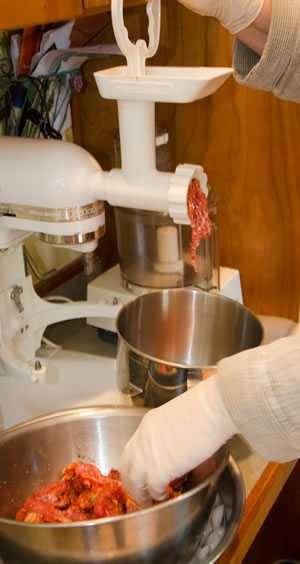
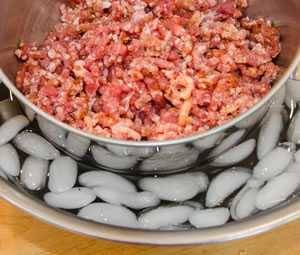
5) If you wish, float the bowl in a larger one with ice and water. Don’t fill the outer bowl to the top so there is room for the inner bowl to sink and displace water as the meat weighs it down.
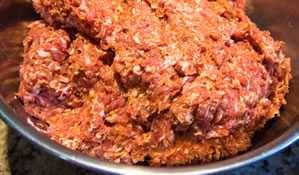
6) When the meat is ground, add the other ingredients. Don’t forget the water. Most recipes call for about 3 tablespoons of water per pound of ground meat and fat. You can mix by hand, with a wooden spoon, or with the paddle attachment on your mixer, about 1 minute on medium speed, until the liquid is incorporated and the mixture has a uniform, sticky appearance. If you can, age the ingredients in the refrigerator overnight, covered, so the dry ingredients can moisturize and the flavors can marry.
7) Make a small patty and fry it in a non-stick pan and taste it to see if the flavor is right and if it holds together. Keep in mind, if you have not aged the mix at least overnight, the flavor will be slightly different after a day or two. But the salt should be the same so pay close attention to the salt. You can now make patties, meatballs, or loaves. You can then grill or smoke it to 160°F, or store it in the fridge for a few days or in the freezer for about a month. Pork fat does not age gracefully, so don’t push it more than a month. Beef fat is more forgiving.
8) If you want to make links, you’ll need casings. There are two types of casings, natural, made from animal intestines, and man made, made from cellulose or collagen. Both are perfectly edible, although experts prefer natural casings. Cellulose casings are often removed after smoking. Some natural casings are salted to prevent microbial growth. Start by rinsing the casings in cold water and soak them in warm water for about an hour to soften and clean them.

9) Attach the casing tube to your stuffer. Put a little oil on the casing tube and slip the casing onto it.
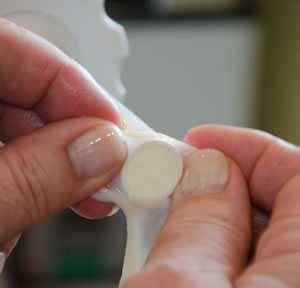
10) Tie a knot in the end of the casing.

11) Slowly feed the meat into the hopper and push it through with the plunger. It’s nice to have a helper for this step. Fill the casings so they are firm, but don’t overstuff so they pop.
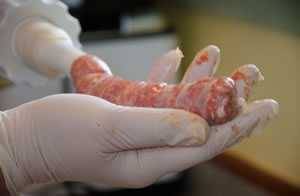
12) Tie off the other end of the casings. Look for air bubbles and pop them with a needle. Prick the casings every few inches. This will help prevent them from bursting during cooking.
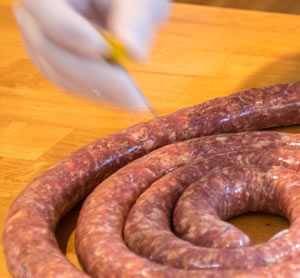
13) Twist them into links.
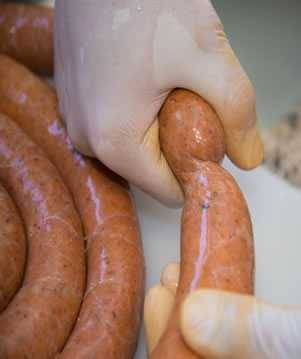
14) Cut the links apart and grill or smoke (click the link for tips). They will keep in the fridge for about five days and they can be frozen, but remember, pork fat gets rancid quickly, so it is best to use frozen sausages within a month.
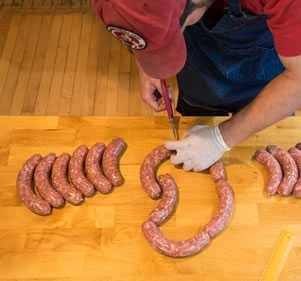
15) You can smoke them now, but they are best after a day to allow the flavors to meld and the dried herbs to come back to life. There are darn few sausages that don’t benefit from a little extra complexity from fresh smoke. I’ve even had good luck smoking Italian sausages, bangers, bratwursts, boudin blanc, chorizo, kishka, weisswurst, and breakfast sausage. Usually I use sausages that are not pre-smoked, but Polies, kielbasa, and hot dogs, which are all smoked at the factory, usually taste better with a fresh coat of smoke. Click here for tips on smoking sausages.

16) If you wish to store raw or smoked sausage in the fridge or freezer it is best to vacuum bag them or wrap them tightly in plastic wrap and then foil. Oxygen is the enemy. It changes the chemistry fast, especially fats, and there is a lot of air mixed in with this ground meat. Smoked meats will keep longer since smoke is a preservative and since you pasteurized the meat by cooking it to 160°F.

About the casings
Natural casings are usually made from hog or lamb intestines are not hard to get. As they cook they get a desirable snap to them. They are neutral tasting and won’t make salmon taste like pork or lamb but you can get collagen casings made from beef protein, not intestines.
Hog casings are the best for most sausages and probably the easiest to find. We guestimate that you will get 2 links at 6″ each weighing 5 ounces each per foot of casing. So a pound of sausage mix will give you 3 links and require 18″ of pork casings. Play it safe and buy 2′ per pound to allow for blowouts, tears, and other mishaps. If you run out, make patties. Of course this depends on how you make them and how full you stuff them.
Lamb casings, which are smaller in diameter, are also common. As a rule of thumb, they are usually 4″ long and weigh about 3 ounces, again depending on how you stuff them and twist them. So plan on getting 3 links per foot of casing, or 5 links per pound of sausage mix, so you’ll need about 2′ of casing per pound. Play it safe and buy 3′.
Collagen casings are manufactured from beef protein in a variety of diameters.
You can ask the meat department at your local grocery or butcher store and if they don’t have them they should be able to order some. There are places online where you can order them too. When you get them ask if they have been washed and if they have been in a salt brine or dry packed. If they have been washed and are clean, you are good to go. If they have been in a salt brine or packed in salt, you will need to soak them for at least 30 minutes in tepid water, or as long as two days. They will keep in the refrigerator in a salt brine for about a month and if dry packed will last refrigerated for a year. They can also be frozen.
Sausages come in different sizes, so these definitions are not set in concrete. Most of our recipes are for standard 6″ links made with hog casings.
Cocktail. 2″ long and 1/2 to 1 ounce, lamb or collagen casings.
Small links. 4″, about 2 ounces, lamb or collagen.
Standard links. 5 to 6″, 4 to 5 ounces, pork.
Jumbo. 7 to 8″, 6 to 7 ounces, pork.

High quality websites are expensive to run. If you help us, we’ll pay you back bigtime with an ad-free experience and a lot of freebies!
Millions come to AmazingRibs.com every month for high quality tested recipes, tips on technique, science, mythbusting, product reviews, and inspiration. But it is expensive to run a website with more than 2,000 pages and we don’t have a big corporate partner to subsidize us.
Our most important source of sustenance is people who join our Pitmaster Club. But please don’t think of it as a donation. Members get MANY great benefits. We block all third-party ads, we give members free ebooks, magazines, interviews, webinars, more recipes, a monthly sweepstakes with prizes worth up to $2,000, discounts on products, and best of all a community of like-minded cooks free of flame wars. Click below to see all the benefits, take a free 30 day trial, and help keep this site alive.
Post comments and questions below
1) Please try the search box at the top of every page before you ask for help.
2) Try to post your question to the appropriate page.
3) Tell us everything we need to know to help such as the type of cooker and thermometer. Dial thermometers are often off by as much as 50°F so if you are not using a good digital thermometer we probably can’t help you with time and temp questions. Please read this article about thermometers.
4) If you are a member of the Pitmaster Club, your comments login is probably different.
5) Posts with links in them may not appear immediately.
Moderators