




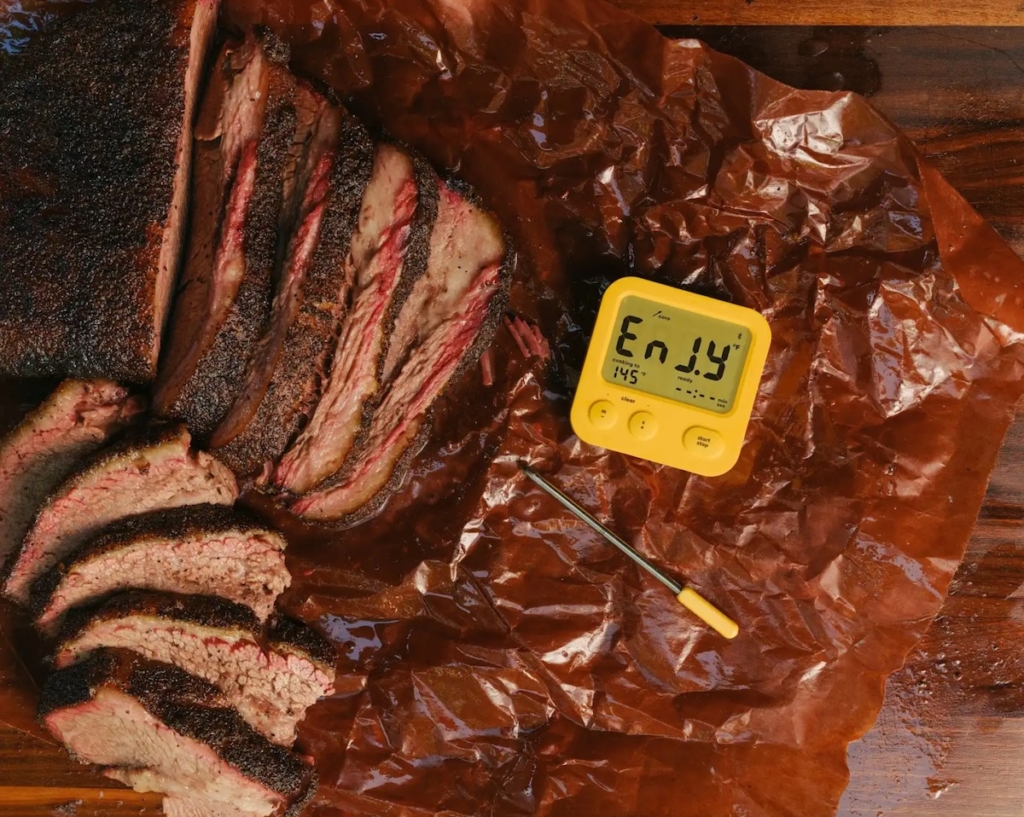
80% of Cooking Brisket Is Wasted Time—And This 6 Hour Brisket Proves It
Let’s be honest: most people avoid smoking their own brisket because who wants to stay up all night babysitting meat for 16+ hours? Here I show you how to make an outstanding smoked hot and fast brisket in just 6 hours. How?
- Invert the traditional approach
- Use science to skip the BBQ stall entirely
- Get into the “fast kinetics zone” for maximum tenderness
- Develop the perfect BBQ bark without drowning your meat in smoke
The barbecue police aren’t going to like this recipe.
Six hours and seven minutes. That’s how long it took me to cook a hot and fast brisket that was 90% as good as the best brisket I’ve ever had. Every pitmaster I know would tell you that brisket demands patience and to trust the process. I’m an impatient person and my hot and fast brisket goes a lot faster.
You already know that the stall takes hours. What you might not know is that it’s all wasted time. I spent months measuring collagen breakdown in brisket, and in a traditional 13-hour cook the first eight hours contribute less than 20% of the total tenderization. The other 80% happens during the final push to done and the early stages of holding the meat, when the brisket’s temperature is above 195°F.
Collagen doesn’t break down at a steady rate. It follows what chemists call Arrhenius behavior: the reaction accelerates exponentially with temperature, and above 195°F that acceleration gets dramatically steeper. For an impatient cook, all those hours below 195°F are just the price of admission to the zone where the real work happens.
So why waste those hours getting to this point, when you could divide and conquer and be eating an amazing brisket in six?
My hot and fast brisket method
First, tenderize
I place my trimmed and seasoned brisket on a rack set into a foil tray with water underneath, wrap the whole tray in foil, and put it into a grill running at 500 to 600°F. That sounds aggressive, but the high heat is just there to keep the water boiling. Inside the foil, the brisket is bathed in steam, which keeps it from drying out or burning and eliminates the stall entirely. The brisket climbs steadily to 205°F in about two and a half hours.
Now, build bark
I transfer the brisket to a smoker. The meat comes out of the steam phase hot but very wet, and the first job is to dry the surface so smoke can start reacting with it.
There’s a common belief that smoke won’t react with meat that’s already cooked, but that’s not really the case. Smoke will adsorb at any temperature as long as the surface isn’t too wet or too dry. What you want is tacky. That’s the sweet spot where smoke compounds stick and start reacting with the meat, forming the flavors and colors that make great bark. How dark and deep you want the bark is really the speed limit on how fast you can get your brisket done. A couple of hours is pretty good bark, three to four hours is great bark.
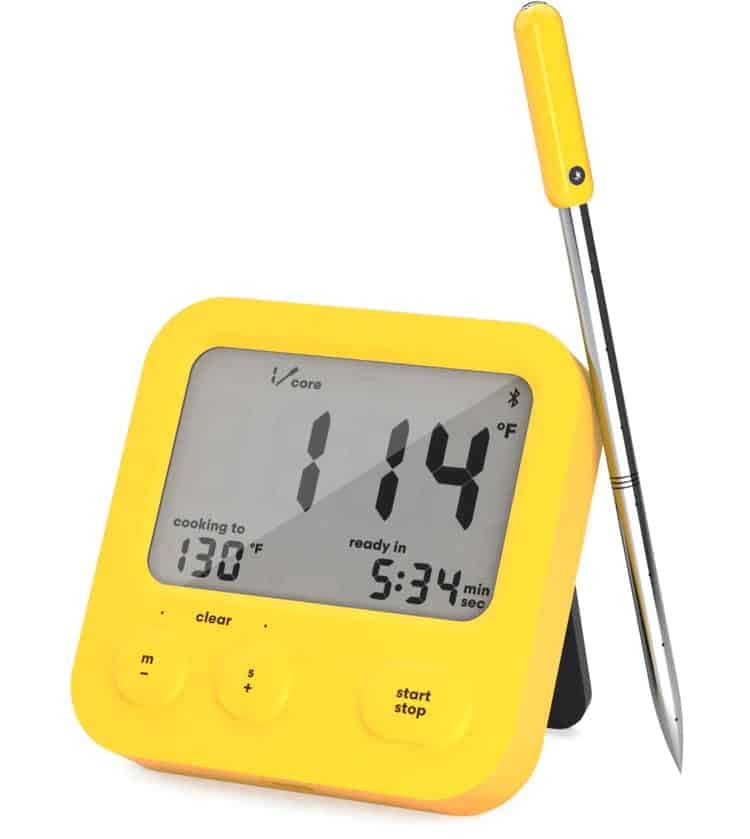
The catch is that drying the surface to build bark means evaporation, and that pulls the meat’s temperature down quickly. It’s the stall, just at a much higher temperature. If it drops the meat below 195°F, you fall out of the fast tenderization zone. I find smoking at around 300°F keeps the surface around 205°F, as measured by the Combustion Predictive Thermometer. That’s hot enough to stay in the zone while rapidly drying the surface to the tacky state where smoke does its best work.
Wrap
Once the bark has the appearance you want, wrap the brisket. Wrapping slows evaporative cooling so the meat continues to tenderize as it drops to serving temperature. It takes an hour or two to reach 155°F, which is where I like to slice. Don’t shortcut this, because the rest also finishes the bark. The humidity softens it, smoke compounds keep reacting, everything darkens, and the harshest flavors of fresh smoke mellow.
Monitor the speedrun
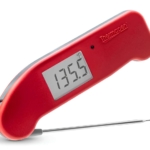
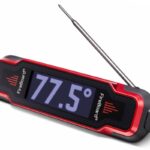
Speedrunning a brisket takes good temperature management to keep things moving fast, and inattention will cost you. I use my Predictive Thermometer to know what’s going on with my brisket and my Giant Grill Gauge to keep an eye on the pit temperature, and their WiFi connectivity gives me total temperature awareness from anywhere.
Some things are easier to show than to describe. The full speedrun, the trimming, the exact timing at each phase, and the wrapping technique that turns the resting period into a secret weapon all come together in the video. It may also help to follow the written hot and fast brisket recipe.

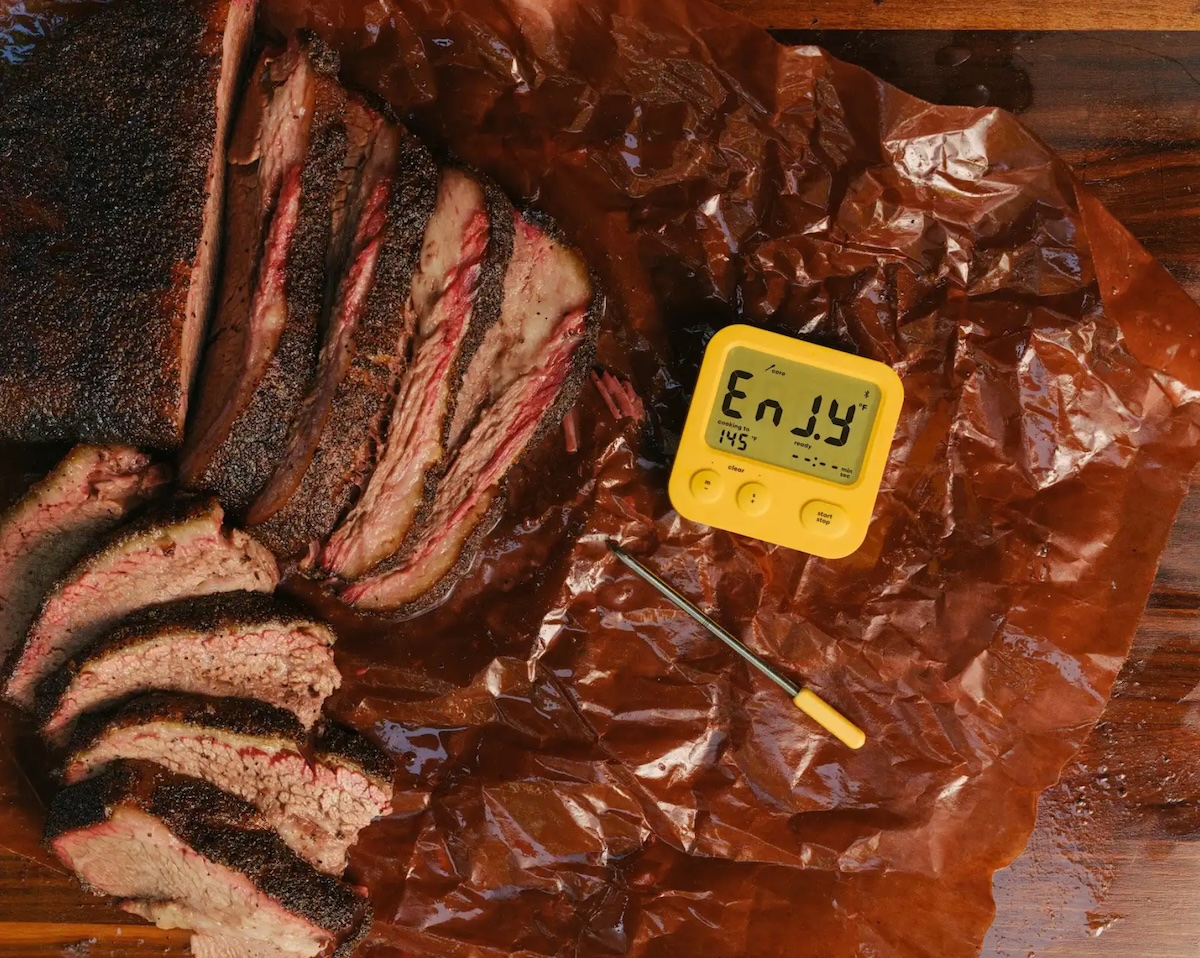
Hot and Fast Brisket (6 Hour Brisket Recipe)
Rate this RecipeSpecial Tools
Ingredients

Method
- Trim the brisket. Trim the fat from all over the brisket to about 1/8 to 1/4 inch thickness. Trim the meat to create a slab of brisket with relatively even thickness from end to end. For a 15-pound brisket, trimmed may yield a final weight of about 9.5 pounds (about 5.5 pounds of trim, including about 3 pounds fat and 2 pounds meat). The goal is the shape the brisket so it cooks evenly and there is no bad slice. Here’s a useful brisket trimming video from Joe Yim at Leroy and Lewis Barbecue in Austin.
- Mix the optional cure. This recipe cooks the meat before it can take on smoke and create a pink smoke ring. To create a smoke ring with this recipe, put the water and curing salt in a spray bottle and shake to dissolve. Spray the curing solution all over the trimmed brisket.
- Mix the rub. Mix together the salt and pepper. If you prefer, use your own spice rub. Scatter the rub evenly all over the meat.
- Monitor the temp. Insert a wireless probe Combustion Predictive Thermometer into the thickest part of the meat (in the point muscle) at a slight downward angle so that the probe tip is in the thickest part of the meat and probe end is just below the surface (the probe handle will remain outside the meat).
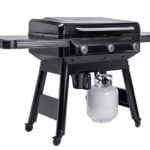
- Fire up. Fire up your grill or smoker (a gas grill works great!) to about 550°F. Keep the cooker between 500 and 600°F. You do not need to add woodsmoke at this point. In fact, you do not want to, or you could oversmoke the brisket.
- Steam the brisket. Place the brisket on a large wire rack set in a large disposable aluminum pan. Pour enough water into the pan to cover the pan bottom by about 1/8 inch. Cover the pan tightly with aluminum foil, place the pan in the center of your cooker, and cook until the internal temperature reaches 205°F, about 2 1/2 to 3 hours. The water creates steam that cooks the brisket quickly, powering through the stall. Add more water to the pan as necessary to keep a thin layer of liquid in the bottom of the pan at all times (you’ll add about 1 cup water each time). Near the end of the 2 1/2 to 3 hours, you can also spray the brisket again with the optional curing solution. With this method, the brisket becomes tender and the collagen converts to gelatin faster due to the sped-up rise in the internal temperature. Keep in mind that most of the collagen conversion happens during the latter fourth of a brisket cook, especially during the traditional “resting” or “holding” period, or in this case, during the smoking phase.
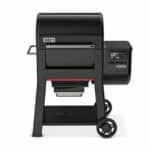
- Smoke the brisket. Fire up your smoker to 350°F with a water pan in place. (If you started with a smoker, just reduce the target temperature.) This relatively high temperature ensures that the meat’s core temperature does not drop too rapidly, so collagen conversion can continue apace, and it helps develop the bark. Unwrap the brisket, remove it from the aluminum pan and place the brisket on your smoker grate away from the fire (save the rack and pan for wrapping the brisket later). Smoke the brisket until the surface bark is deeply browned and the internal temperature returns to 205 or 206°F, about 2 1/2 to 3 hours. Add wood/fuel to the smoker as necessary to keep the smoker temperature between 300 and 350°F.
- Wrap and rest the brisket. Tear off a piece of butcher paper or foil large enough to wrap the brisket several times (you may need two overlapping smaller pieces). Place the paper or foil on a work surface with the short side near so the long side stretch away from you. Spray the paper or foil all over with water. On the short end nearest you, drizzle or spoon half of the optional beef tallow over an area the size and shape of the brisket. Place the brisket on the tallow area and drizzle or spoon on the remaining optional tallow. Wrap up the brisket tightly in the paper or foil: begin by folding in the corners toward the brisket and then over the brisket to eliminate gaps. Then fold in the long sides toward the center, creasing the paper or foil to create a “runway” the width of the brisket. Now roll the brisket toward the opposite end to tightly wrap it. in the paper or foil to eliminate gaps, and then folding in the long side. Place the wrapped brisket on the wire rack set in the disposable aluminum pan. Rest until the internal temperature of the brisket comes down to about 160°F, about 1 hour.
- Slice. Unwrap the brisket and place it on a cutting board. Slice it across the grain and serve with the juices.
 Sign up for a free trial of the AmazingRibs.com Pitmaster Club and experience everything that the world's largest membership-based BBQ and grilling community has to offer!

Before you can post a comment or question you must sign into our commenting partner, Disqus. This helps make sure everyone hanging around the grill is civil. We do not tolerate nastiness, racism, porn, inappropriate language, or attacks on others. All comments are the property of AmazingRibs.com and we reserve the right to quote them, edit them, delete them, and block people from making future comments.
Please leave comments and questions on the same page that is devoted to that subject so others can see questions and our answers when they are reading about the subject. You must enable JavaScript to use the comments section, and you must accept cookies to post comments. Note: the software that runs Disqus is different from the Pitmaster Club, so members need to sign into the Pitmaster Club separately.