



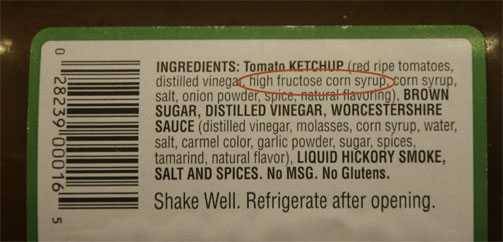
High Fructose Corn Syrup (HFCS) appears high on the ingredients list of many barbecue sauces. It has also been the subject of a lot of discussion lately. It has gotten a bad name, and sauce manufacturers have been scrambling to remove it from their formulae. Here are the facts as we know them today, although research is ongoing.
The problem stems from fructose. Many people seem to think fructose is worse for you than table sugar. But the facts are that HFCS ranges from about 42 to 55% fructose, and the most commonly used form is only 42% fructose. The rest is mostly glucose, the exact amount varies depending on what its intended use is. What the abolitionists don’t seem to understand is that table sugar, called cane sugar or sucrose, is 50% glucose and 50% fructose and breaks down into those components when eaten. So there’s more fructose in table sugar. And honey is 49%.
Regular old corn syrup is 100% glucose. Zero fructose. That’s how HFCS got its name, it is corn syrup with more fructose than normal. The anti-HFCS folks have painted all corn syrups with the same broad brush. Corn syrup is mostly a sugar called maltose. Karo Corn Syrup was introduced in 1902 and is hard to live without in many baking and other applications. Many modern barbecue sauces have corn syrup in them because they give the sauce a nice sheen.
There have been a handful of papers on the subject of HFCS and health. I have studied the studies and discussed the subject with a well known scientist at FDA. So far there has been no concrete, high quality study whose results have been published in a respected peer reviewed journal, whose data has been replicated, that has demonstrated that HFCS is more harmful than cane sugar. Every word in that sentence was carefully chosen. There are some small, poorly run tests, that the abolitionists quote extensively, but they have not been duplicated by reputable labs, and the scientific community does not accept data that cannot be duplicated.
And yes, I have seen the Princeton study, and I have read credible criticism of the experiments. Among the clearest critics is the broadly respected, deeply credentialed, very independent, molecular biologist, Marion Nestle, Ph.D., who outlines the flaws in the paper on her website. Karen Teff, Ph.D., a physiologist at the Monell Chemical Senses Center in Philadelphia has studied the issue extensively. She told EatingWell.com “This study is poorly designed and poorly controlled and does not prove or even suggest that HFCS is more likely to lead to obesity than sucrose [table sugar].” So far the Princeton data has not been repeated.
Yes I have seen the data proving that some HFCS has mercury. But not all samples did. And it was one small test. And we don’t know if this was HFCS made improperly. And the test has not been replicated. We don’t know if the problem is widespread or if it was the testing method in error. Right now, saying that HFCS contains mercury is like saying Americans are racists because the Klan still exists.
Health experts and scientists as well as consumer advocates such as the Center for Science in the Public Interest (CSPI) say there is no difference in the impact on our metabolism or health between HFCS and table sugar. CSPI is a highly regarded consumer health watchdog and generally despised by the food industry, whom they target frequently. They have a well-respected staff of scientists and lawyers. They would be the first to stand on the rooftops and scream for a ban if it was proven harmful. “Sugar is sugar”, they tell us, and all of it is high in calories and low in nutrition. The moment CSPI says otherwise, I will cut HFCS out of my diet.
CSPI and other nutritionists say we should reduce our sugar intake. HFCS and cane sugar alike. This means we should give up many processed foods, fast foods, candies, and soft drinks.
I use small amounts of sugar in many recipes because it amplifies flavors and it promotes browning, and browning is an important source of flavor in cooking. It is a small amount. Nowhere near the amounts used in factory-made foods, with the exception of some of my barbecue sauce recipes. Admittedly, they are sweet because that’s the way we like them, and because I am trying to replicate the flavor profiles of traditional regional sauce recipes. I use corn syrup (not HFCS) in only one of my sauce recipes, and it really does the job of making the meat shiny.
But I must confess that when I see HFCS on a label it does set off alarm bells in my head. Not because I fear HFCS, but because it says the manufacturer is using the cheapest sweetener possible, and is probably cutting corners elsewhere.
Pay attention to your driving. That is faaarrrr more risky than HFCS. And if you want HFCS-free barbecue sauce, try some of my recipes.



Before you can post a comment or question you must sign into our commenting partner, Disqus. This helps make sure everyone hanging around the grill is civil. We do not tolerate nastiness, racism, porn, inappropriate language, or attacks on others. All comments are the property of AmazingRibs.com and we reserve the right to quote them, edit them, delete them, and block people from making future comments.
Please leave comments and questions on the same page that is devoted to that subject so others can see questions and our answers when they are reading about the subject. You must enable JavaScript to use the comments section, and you must accept cookies to post comments. Note: the software that runs Disqus is different from the Pitmaster Club, so members need to sign into the Pitmaster Club separately.