





Create a mouthwatering main course with this whole beef tenderloin recipe plus butchering tips!
Beef tenderloin is worshipped because it is the most tender muscle on the steer. And, as such, it is usually the most expensive. Our beef tenderloin recipe below shows you how to utilize a whole tenderloin including trimmings.
The beef tenderloin is the muscle group that gives us filet mignon, tenderloin tips, and Chateaubriand. After it is trimmed and carved there can be 2 pounds or more of great spiedies/kebabs, stroganoff, boeuf bourguignon, stir fry, stew, or grinding for burgers.

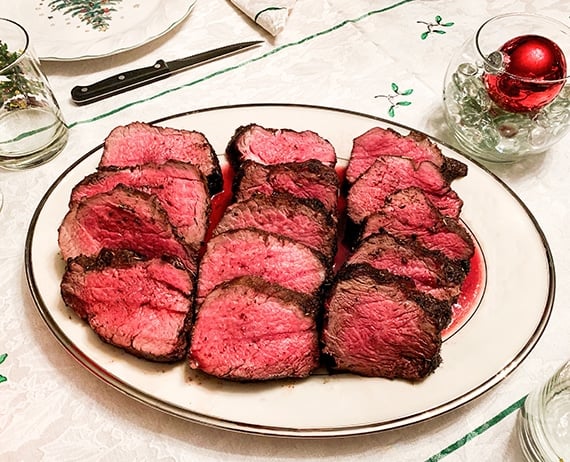
Preparing Beef Tenderloin
If you've ever come across a whole beef tenderloin at your local grocer or butcher shop but had no idea what to do with it then this recipe tutorial is for you. Here's how I take a whole beef tenderloin and make chateaubriand, filet mignon steaks, and more. All you need is a really sharp filet knife.
Ingredients
Method
- Shopping. Here is an image of the whole beef tenderloin, code #1189 in the NAMP Meat Buyer's Guide. It is varies in size, but an average is about 2 1/2 feet (76.2 cm) long, 4" (10 cm) in diameter in the center, weighs 6 to 7 pounds (2.7 to 3.2kg), and can feed 12 to 16 people depending on how it is trimmed. This is the most economical way to buy this expensive cut of meat.
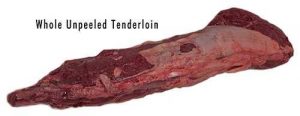
- It is bulbous on one end, called the "head" or the "nose", and tapered on the other, the "tail". In between is a nearly perfect cylinder 3 to 4" (7.6 to 10 cm) in diameter. It is typically sold in a plastic vacuum bag "unpeeled," meaning it still has silverskin, fat, and a long skinny secondary muscle called the "chain". The silverskin is tough connective tissue and needs to be removed. The fat should also be removed. It does not moisturize the meat when cooked.
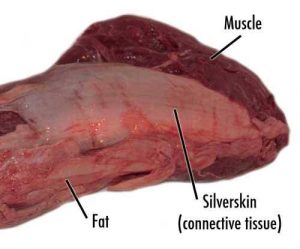
- Trim. The fat is really easy to remove. To remove the sliverskin, slip a sharp pointy knife between the silverskin and the muscle and slide it along with the blade angled upward slightly along the underside of the silverskin. Don't try to peel it with your hands or a paper towel. The meat is so tender you will damage it. When you are done, you have what is called a "Tenderloin PSMO" (Peeled, Side Muscle On), pronounced "pismo".
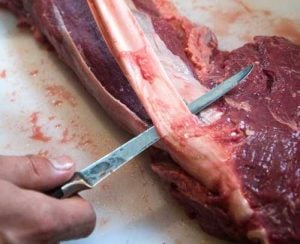
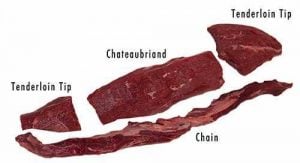
- Break it down. The large central muscle is the Psoas major. The long thin side muscle, the chain, is the Psoas minor. The football shaped muscle attached to nose end making it bulbous is the Iliacus.
- Check out this video to learn the proper way to cut beef tenderloin for steaks and chateaubriand.
- Many chefs fold the ends in and then tie them in place so you have a long tube of fairly even thickness for roasting, but I am not fond of this procedure because the exterior of the meat can be contaminated in the slaughterhouse. That is not a problem if it is browned during cooking, but if it is folded in on itself, it will not get hot enough to be pasteurized. The risk is low, but it is a risk, and I love my family so I reduce risk whenever possible. So I prefer to lop off the thin tapered tip. When a restaurant does this, you will often see "tenderloin tips" on the menu. I set the tapered tip and the chain aside and either grind it for burgers or sausage, chop it for spiedies, or slice it for stir fry.
- The whole center section is called the chateaubriand. More often, the chateaubriand is cut into filet mignon steaks about 1 1/2 to 2" (38 to 51 mm) thick, making 6 to 8 ounce (170 to 227 g) steaks. If you leave the nose on you might be able to get 2 or 3 steaks, each 10 ounces (280g). Here's the breakdown of a typical beef tenderloin:* Raw weight 7 pounds (3.2 kg)* Chateaubriand or filets mignon 3 pounds (1.3 kg)* Stir fry from chain and tip 2 pounds (907 g)* Fat trimmed off 1 1/4 pound (567 g)* Steak from nose 3/4 pounds (340 g)
- Making chateaubriand. Here is an image of the chateaubriand. Dry brine it overnight by sprinkling it with salt and let it sit uncovered on a rack in the fridge. The salt will work its way in and help the meat hold moisture and amplify the flavors. Then give it a nice coat of Mrs. O'Leary's Cow Crust before cooking. The cooking method is virtually the same as the method I describe in my article on cooking a prime rib roast, reverse sear. Warm it gently over indirect convection heat at about 225°F (107°C) for about 30 to 40 minutes until it hits about 120°F (49°C) in the center, depending on the thickness. Then lift the lid and roll it over direct infrared radiant heat and sear the surface for about 5 minutes, roll it a bit, sear, roll, sear, roll, sear, and when all sides have formed a nice dark crust, and the interior is 125 to 130°F (52 to 54°C), perfect medium rare, pull it off, slice, and serve. Here is how to cook a chateaubriand once you have it trimmed.
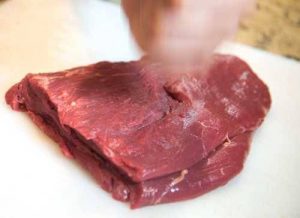
- Pound the nose. Many chefs grill the nose and sell it as tenderloin tip or just plain tenderloin, but it is a funny shape and can cook unevenly. I like to lop off the nose end and pound it into a flat steak about 1 inch thick weighing about 12 to 20 ounces (340 to 566 g). A flat filet mignon is a bit unusual, but the large surface area for browning makes it a tender treat. I cut it into 1/4" (6.3 mm) thick strips across the grain, like a flank steak. I am the only one I know who does this, but if you try it you will be a convert.
- In this video Jabin Postal demonstrate how to prepare a beef tenderloin and cook it using the reverse sear method.
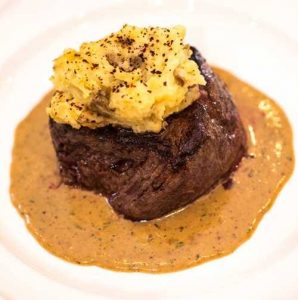
- Making filets mignon. If you prefer, you can cut the chateaubriand into individual steaks about 1 to 1 1/2" (25 to 38 mm) thick called filet mignon. Above is a classic filet mignon in a cream and cognac sauce crowned with smoked cauliflower puree. Because filet mignon is thick it really should be reverse seared, not seared first. I describe the method in my article on Steakhouse Steaks.
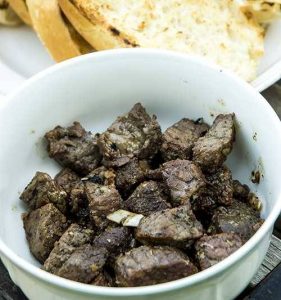
- The chain gets cut into bite size chunks for stew, stroganoff, boeuf bourguignon, stir fry, or larger chunks for spiedies/kebabs (below). It can also be ground for burgers (but you need to add some of the fat you trimmed off, it is too lean for a good burger).
Video
Notes
About the salt. Remember, kosher salt is half the concentration of table salt so if you use table salt, use half as much. Click here to read more about salt and how it works.
Before you can post a comment or question you must sign into our commenting partner, Disqus. This helps make sure everyone hanging around the grill is civil. We do not tolerate nastiness, racism, porn, inappropriate language, or attacks on others. All comments are the property of AmazingRibs.com and we reserve the right to quote them, edit them, delete them, and block people from making future comments.
Please leave comments and questions on the same page that is devoted to that subject so others can see questions and our answers when they are reading about the subject. You must enable JavaScript to use the comments section, and you must accept cookies to post comments. Note: the software that runs Disqus is different from the Pitmaster Club, so members need to sign into the Pitmaster Club separately.