



It’s easy to make maple bacon at home and here is how!
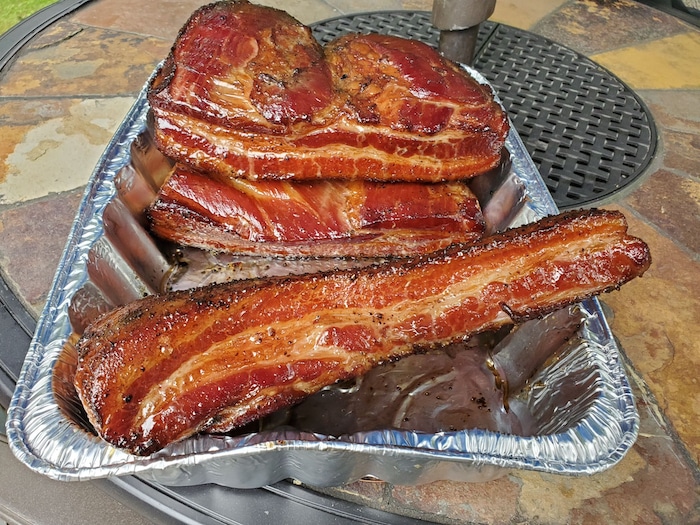
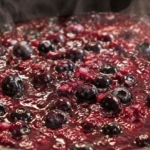
Eggs, burgers, turkey . . . . you name it. Bacon makes everything better. And there is nothing better than homemade bacon. My favorite type? Maple bacon made with dark maple syrup and dark brown sugar instead of plain old white sugar. Doesn’t it look irresistible in the photo here? Big thanks to our Pitmaster Club member Rolfe Gatchell for sharing the photo. Read on to see how easy it is to make our homemade smoked maple bacon recipe.
The science behind our maple bacon recipe
Curing meats such as bacon, ham, or pastrami is fun and the results are often better than store bought. But curing is very different from any other recipe because you are using a preservative, sodium nitrite. You must read and thoroughly understand my article on the Science of Curing Meats before attempting to cure meat, or before you ask any questions.
It’s also a great idea to watch this video about how to cure and smoke bacon and read my guide on how to make bacon, specifically, before you proceed. The rest of the recipe will make a lot more sense once you’ve done that.
Recipe Overview: Maple Bacon Success Formula
- Buy: a 3-pound slab belly bacon, 1 1/2″ thick and 6 to 8″ wide across the grain.
- Skin it: if the skin is still there and use it to make cracklins.
- Cure it: in a gallon-size plastic bag with all the curing ingredients.
- Rinse it: remove it from the bag and rinse off the pork belly after 3 to 5 days.
- Fire up: Set your grill to 2-zone cooking or use your smoker.
- Smoke: at 225°F over indirect heat using hardwood smoke until the internal temp reaches 150°F, about 2 hours. Your choice of smoking wood is not critical, but applewood and hickory are tried and true.
- Cool: let it cool on a plate in the fridge because cold bacon is easier to slice.
- Wrap it tightly: cover it with several layers of plastic wrap, and then a layer of foil, and refrigerate for up to 2 weeks or freeze for up to 3 months at 225°F.
- Slice: cut it across the grain using a meat slicer or a long thin knife.
- Cook: when you’re hungry, cook it as you would storebought bacon.
- Save: remove the bacon to drain on paper towels and let it drain, Once it’s cool, save the the bacon drippings and transfer to a glass jar, seal it and refrigerate it.
Summarize & Save this Content on:
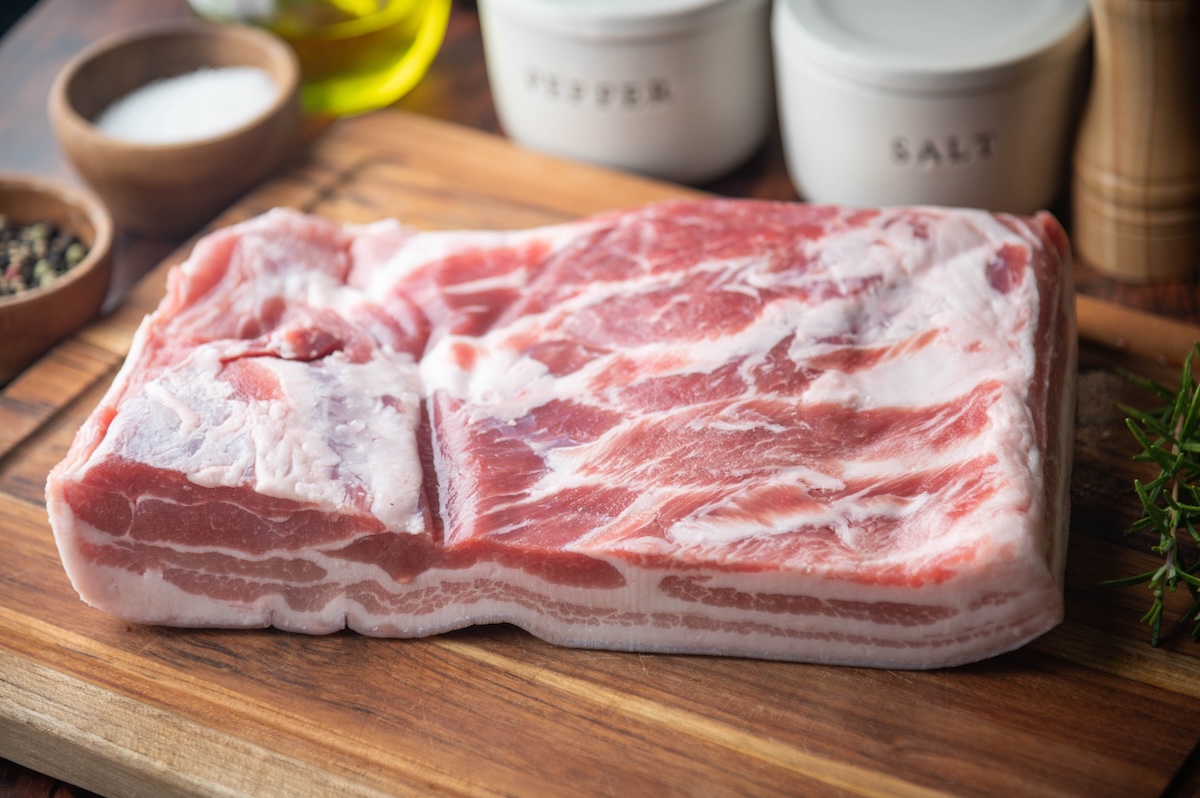
Ingredients for maple bacon
- Pork belly is what you want for this. Aim for 3-pound slab that’s about 1 ½” thick and 6 to 8″ wide across the grain. Look for a 1:1 ratio of muscle to fat; the muscle should be pink and the fat, creamy w white.
- Warm distilled water ensures the brine is free of minerals, chemicals, and unwanted bacteria that could affect safety or alter the flavor. If you do not have distilled water, you can boil regular tap water for a few minutes to kill bacteria, then let it cool completely before mixing your cure.
- Prague Powder #1 is different from what you find in the grocery store, which is Prague Powder #2 and is only appropriate for cold smoking at a lower temperature. That’s not what we’re doing here. You want #1 because we smoke this belly at 225°F, which cooks and pasteurizes the meat and makes it safe to eat right off the smoker. I do not recommend cold smoking at home.
- Dark brown sugar is sweet, but it contains molasses, which brings more complex savory flavors. Both light and dark brown sugar work fine (dark has slightly more molasses.) You could also use turbinado sugar, raw sugar, or coconut sugar.
- Morton’s kosher salt is preferred, but if you use table salt, remember to use half as much. Otherwise it will be too salty. And yes, salt is a bit of a matter of preference, but you do need it.
- Ground black pepper is world’s most traded spice, beloved in cuisines around the world, and so named for its ability to perk up almost anything it touches. If you want a thicker more textured crust on your bacon, use coarsely ground black pepper. Or use powdered black pepper if you want a smoother texture on the surface of the meat.
- Dark maple syrup is preferred here because its robust flavor stands up better to the rest of the flavors in the bacon. You can use regular maple syrup but the flavor will be more subtle.
Maple bacon recipe, step by step
- Adjust the curing ingredients to their proper weights
- Remove the skin if it’s still on the belly
- Pour everything except the meat into a gallon-size bag. Zip it closed and move the contents around to distribute the ingredients. Add the pork belly, and squeeze out as much air as possible, and close the bag. Rub the cure into the belly as much as possible and let it refrigerate for 3 to 5 days. Massage the bag every day or so to make sure everything is evenly distributed, and flip the bag over.
- Remove the belly from the bag after 3 to 5 days and throw the cure away. If any large salt deposits remain on the belly, lightly rinsed hem. Note: Do not let it dry for 24 hours; smoke sticks to wet surfaces better.
- Smoke or grill (set it for 2-zone cooking) over indirect heat at 225°F until the internal temp reaches 150°F, about 2 hours. You can use any wood you like.
- After smoking, slice off the ends, and taste them right away. They should taste heavily seasoned, more salty, and the fat will be a bit stringy.
- Cool the pork belly on a plate in the fridge, as cold bacon is easier to slice.
- Wrap it tightly with several layers of plastic wrap and then a layer of foil. Refrigerate for up 2 weeks or freeze up to 3 months. Don’t wrap it in foil by itself as it can react with the salt.
- Slice it across the grain, using a slicer or a long thin knife, aiming for slices 6 to 8” wide across the grain so it fits in your frying pan. Experiment with slice thickness, or cut into lardons and add to salads, mashed potatoes, mac and cheese, or baked beansInstruction
- Cook the bacon like you’d cook any other store-bought bacon and when it’s done, drain on paper towels set over several layers of newspaper pages. Transfer the cooled bacon drippings to a glass jar, cover, and refrigerate to reuse. Save for up to a month to reuse to fry.
Maple bacon FAQs
Yes, maple bacon is indeed a Canadian thing, and that’s because Canada produces most of the world’s maple syrup. The ingredient is commonly used in the country’s cuisine.
This term refers to a cut of pork called the jowl, which is sliced meat from the pig’s cheek or jaw. It’s sometimes used as a more budget cut or cost effective substitute for pork belly. It contains a higher fat-to-meat ratio which means it gets crispy when it’s fried.
Other than eating it just the way it is, maple bacon is great as an add-on ingredient for a savory jam or chutney, and you can also make candied maple bacon with it, too.
If you like this maple bacon recipe, you’ll love . . .
- Asian-Style Bacon Recipe
- Candied Bacon Roses
- Smoked Homemade Bacon
- Maple-Glazed Ribs
- Canadian and Irish Bacon

Marvelous Maple Bacon Recipe
Ingredients
Adjusting Curing Ingredients
Cure time: 0.8 days
Method
- Skin it. If the skin is still on the belly, remove it and use it to make cracklins. It is sometimes hard to tell if it is still there. It is usually a darker tan color compared to creamy colored fat. You should be able to make a cut in fat with your thumbnail. Your thumbnail will only make a dent in skin. Leaving skin on causes problems for salt penetration, and when you fry it, the skin gets very hard and you probably won't like the texture. Removing the skin can be tricky. Sometimes you can grip a corner and with a knife and peel it back by running the knife between the skin and fat. Sometimes you just have to shave it off with a sharp knife.
- Cure it. Pour everything except the meat into a zipper bag large enough to hold the belly. A 1 gallon bag will hold a single 3 pound slab. Zip the bag and squish everything around until well mixed. Now add the belly, squeeze out the air as much as possible and squish some more rubbing the cure into the belly and coat all sides. Put the bag in a pan to catch leaks and place in the fridge at 34 to 38°F for 3 to 5 days. If the belly is thicker than 1.5" check the calculator here. The belly will release liquid so every day or two you want to gently massage the bag so the liquid and spices are well distributed, and flip the bag over. NOTE: If you use more than one slab in a bag it is crucial that the slabs do not overlap each other. Thickness matters!
- Rinse off the cure. After 3 to 5 days, remove the belly from the bag, and throw the liquid away. Lightly rinse it to wash off any thick deposits of salt on the surface. Most recipes tell you to let the slab dry for 24 hours so the smoke will stick better, but, as the AmazingRibs.com science advisor Dr. Greg Blonder has proven, smoke sticks better to wet surfaces, so this extra step isn't necessary.
- Fire up. If you are using a grill, set up for 2-zone cooking or fire up your smoker.
- Cook. Smoke over indirect heat at 225°F until the internal temp is 150°F, about 2 hours. You can use any wood you like. Hickory and applewood are the tried and true. After smoking you should slice off the ends, which may be very dark and more heavily seasoned, and taste them right away. They will be more salty than the innards and the fat will be a bit stringy, but you'll love it all the same. Just wait til you fry up an inside slice!
- Cool. Now let it cool on a plate in the fridge. Cold bacon is easier to slice. Use on a slicer if you have one, or use a long thin knife to slice it. Try some thin and some thick slices. You can also cut bacon in cubes to make lardons and use them like bacon bits in salads, mashed potatoes, mac and cheese, baked beans, in sauces or to garnish chops, or roasts.
- Wrap it tightly with several layers of plastic wrap, and then a layer of foil, and refrigerate for up to 2 weeks or freeze for up to 3 months. Pork fat rancidifies quickly so don't push it much longer than this. Do not wrap in foil alone because it can react with the salt.
- Slice. Slice it across the grain. For evenly thick slices, a slicing machine is the best choice, but I rarely use mine because it is a pain to clean. Besides, I like to keep the slab intact and tightly wrapped in the fridge or freezer to reduce exposure to oxygen which can make the fat taste funny in a week or two. When I make bacon I usually shoot for hunks 6 to 8" wide across the grain to make sure my thin 9" knife and frying pan fit. If you put a slab in the freezer for 15 minutes or so it gets stiffer and easier to slice.
- Cook. When you are hungry, cook it just like you do storebought bacon.
- Save the bacon drippings. While your bacon is cooking lay out a section of newspaper several sheets thick, and cover it with a layer of paper towels. As soon as you take the bacon out of the oven, move it to the paper towel to drain. Let the fat in the pan cool a bit and then pour it in a glass jar and refrigerate. Hot bacon can melt a plastic tub, so be careful. Save the fat for up to a month and use it to fry. Broccoli and potatoes are especially good cooked in bacon grease.
Notes
Approximate Nutrition
Tried this recipe?
Let us know how it was!Like what you’re reading? Click here to get Smoke Signals, our free monthly email that tells you about new articles, recipes, product reviews, science, myth-busting, and more. Be Amazing!
Before you can post a comment or question you must sign into our commenting partner, Disqus. This helps make sure everyone hanging around the grill is civil. We do not tolerate nastiness, racism, porn, inappropriate language, or attacks on others. All comments are the property of AmazingRibs.com and we reserve the right to quote them, edit them, delete them, and block people from making future comments.
Please leave comments and questions on the same page that is devoted to that subject so others can see questions and our answers when they are reading about the subject. You must enable JavaScript to use the comments section, and you must accept cookies to post comments. Note: the software that runs Disqus is different from the Pitmaster Club, so members need to sign into the Pitmaster Club separately.