
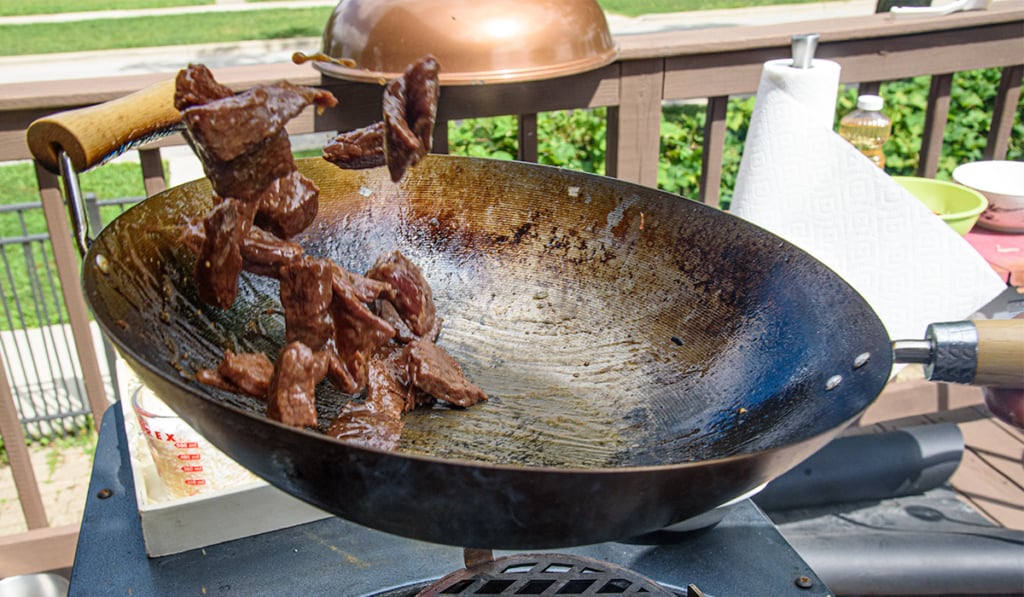
A charcoal chimney mimics the extreme heat of a wok burner in a Chinese restaurant
I know you love Chinese food, and probably you’ve attempted to stir-fry indoors. And the results were good, but not as good as the neighborhood Chinese restaurant.
The reason is simple: Your stove isn’t hot enough. For great stir-fry you need food cooked very hot and fast so it sears almost instantly. If you don’t have enough heat, the juices run out of the meats, you end up with a puddle of liquid, and the ingredients steam or poach and go limp. It can also smoke up the kitchen, set off smoke alarms, and spatter all over your stove and counters.
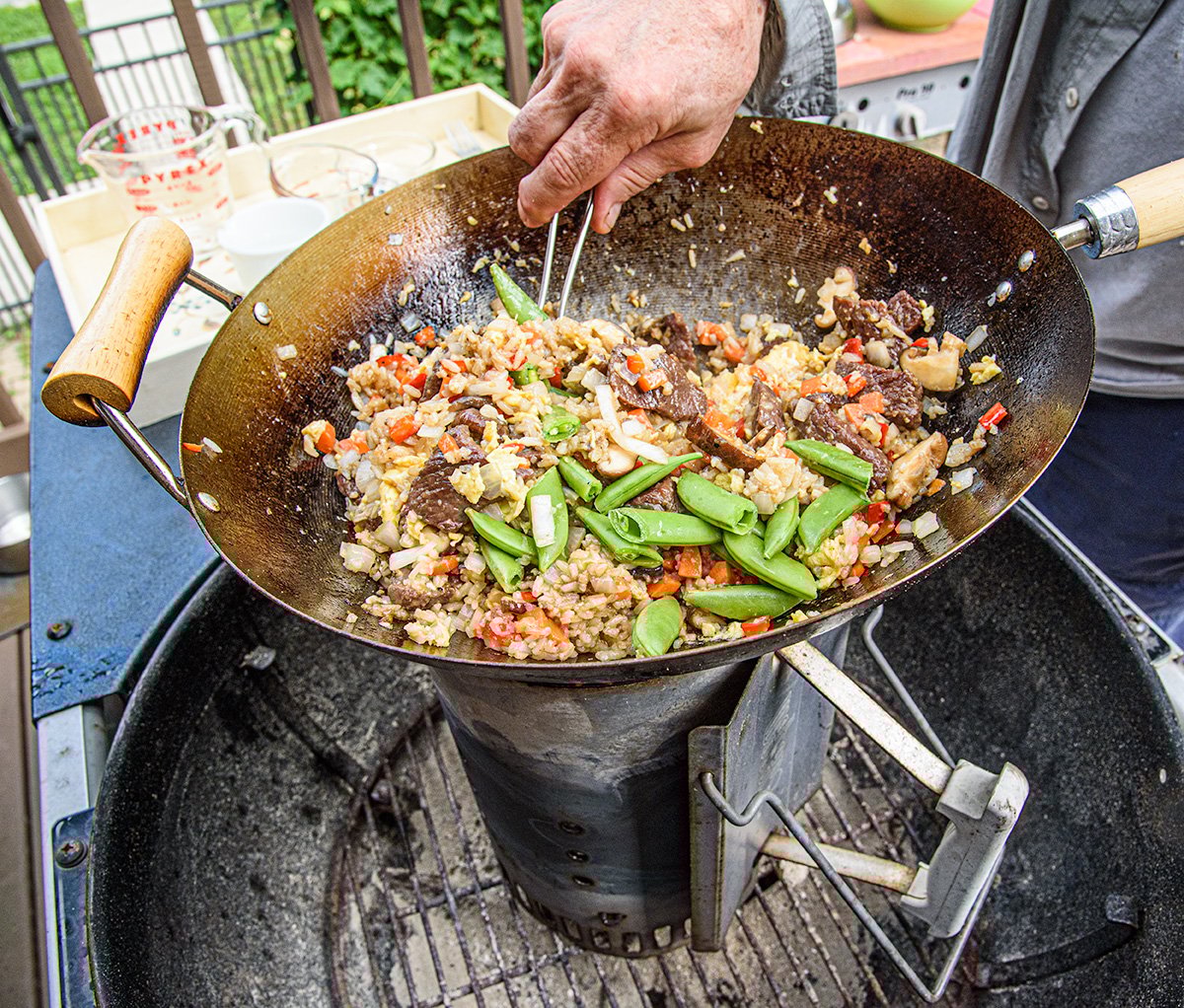
Wok cooking on a charcoal chimney
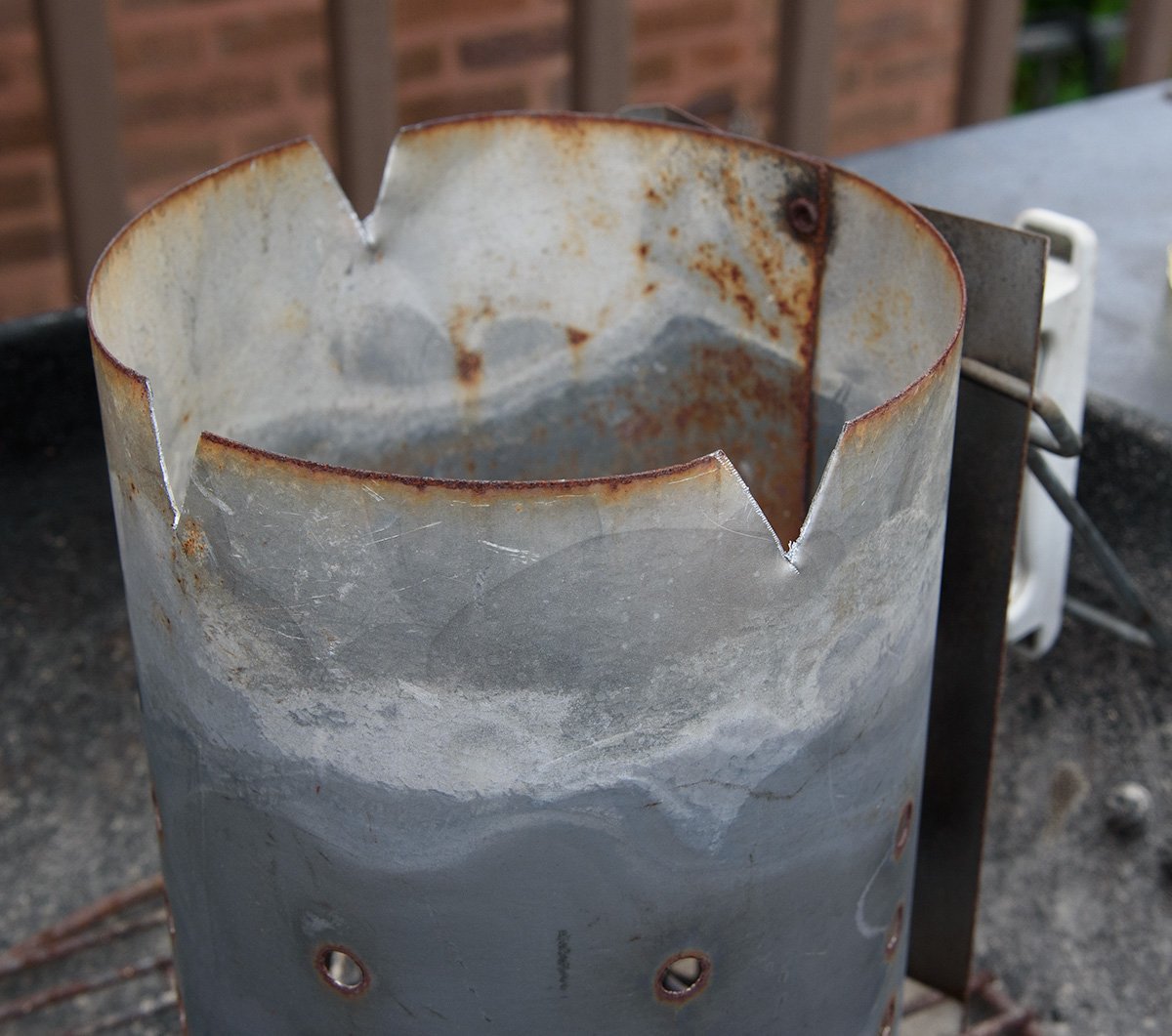
But you can make your favorite Chinese dishes brilliantly in your backyard on top of a charcoal chimney. A charcoal chimney can generate enormous concentrated heat. Most charcoal chimneys have holes near the bottom to supply the coals with oxygen. But a wok on top of a chimney can reduce the heat, because the combustion gases have no way to escape, and they can choke out the coals. So here’s the solution: Drill holes near the top lip of your chimney or use tin snips to cut vents like I did here:
Use a carbon steel wok
The carbon steel wok is a tremendously versatile pan and its design hasn’t changed in centuries. It can be used for stir-frying, deep-frying, braising, steaming, simmering, boiling, poaching, sauce making, and even smoking. In a pinch you can stir-fry in a large saucier or curved-sided pan or even in a large skillet, but part of the trick to stir-frying is controlling the heat by pulling ingredients up the side of the wok where it is cooler. Do not under any circumstances use a Teflon pan. Teflon and similar coatings can volatilize under high heat and make noxious gases that find their way into your food. And I am not a fan of cast-iron woks because they are too heavy to toss the food with a flick of the wrist. Also, they hold heat all the way up the sides. You can find excellent woks in most Asian stores and they are incredibly cheap there. They are also available online. I recommend the one sold by Milk Street shown here.
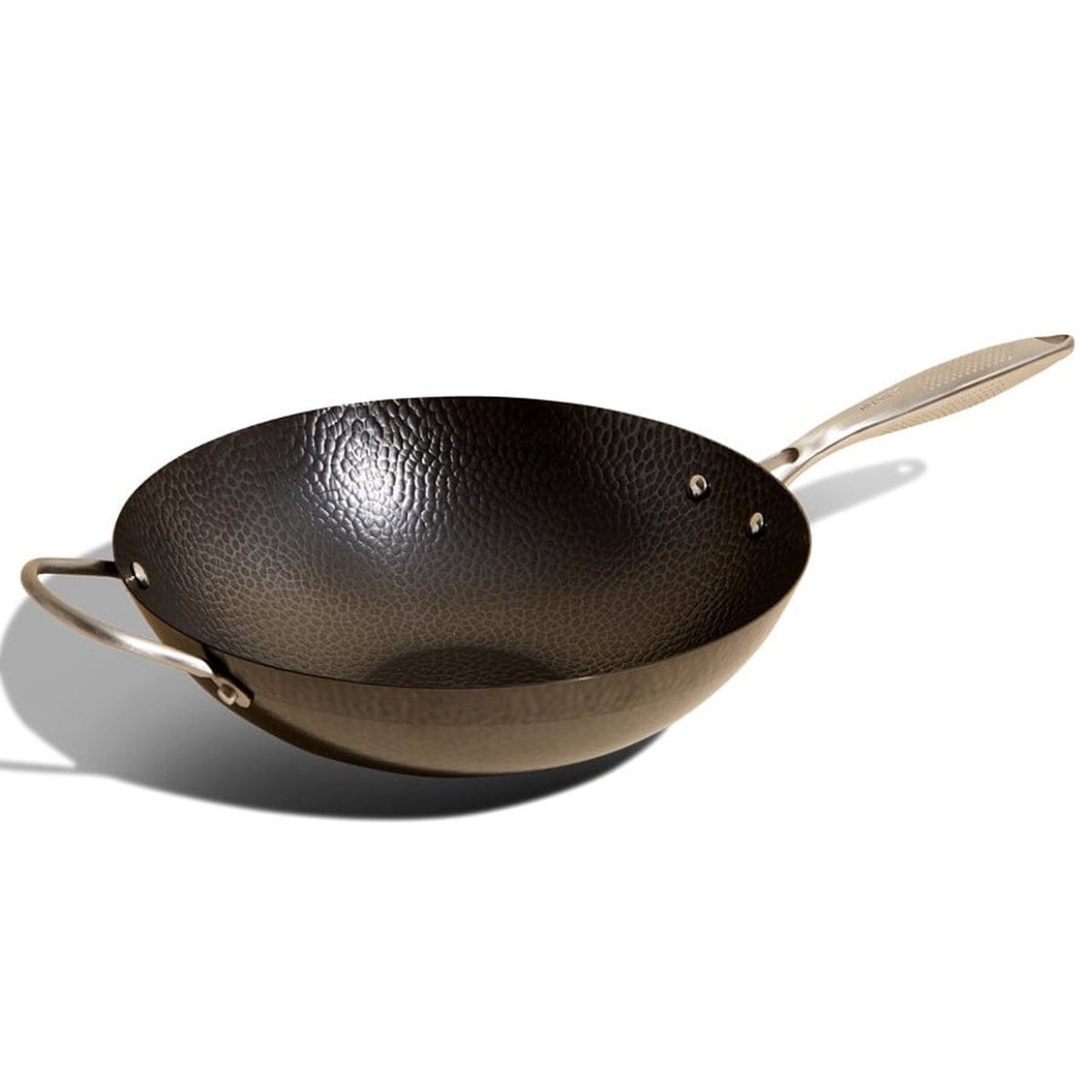
Get a 14- to 16-gauge carbon-steel wok with a flat bottom that will be stable sitting on a flat surface. Woks come in a wide range of sizes but one that is 13 to 14 inches across the top is enough for 4 servings. Larger woks are harder to handle. There is a cult around hand-hammered woks, but machine-hammered or spun woks work just fine. Get one with a long handle making it easier to carry. Make sure the handles are well riveted. If you plan to use it indoors, buy a wok ring that holds the wok steady above a stove burner. Get one with a lid and a little grate that goes inside for steaming. Carbon steel can rust, so new woks often come coated with oil to prevent rust. When you get it, you must fill it within an inch or two of the top with water and bring it to a boil for 15 minutes, dump the water, and then scrub with an abrasive cleanser, steel wool, hot water, and elbow grease. Rinse off all the soap, towel-dry, and then warm it on the stove to drive off any water in the metal pores. Then give it a thin coat of vegetable oil. Reviews of excellent woks on Amazon are burdened with 1-star rankings because the buyers didn’t follow directions for breaking them in.
How to season a wok
The seasoning process is like seasoning cast-iron pans and steel griddles. It can be smelly, so I do it outdoors on my gas grill. The goal is to fill the microscopic irregularities in the surface with oil and then harden it into a relatively slippery surface with heat. If your wok has wooden handles, remove them. Warm the wok over medium heat to remove any moisture and open the pores of the metal.
Lightly coat the inside with vegetable oil. With a lint-free cloth or Bounty paper towels, wipe off the excess. The oil starts to fill the valleys in the metal. Don’t let any oil pool in the center. In order to form the glassy coat, you need to close the grill’s lid and heat the oil to 400 to 450°F, but you don’t want to overheat it, or it could blister and flake off during cooking. An infrared gun thermometer is helpful. For new pans, two or three treatments is enough.
When you are done, the oil should have formed a smooth, dark nonstick surface. Going forward, every time you wok, the surface will darken. Then, when you are done wokking, clean it with a soft brush or scrubby sponge under warm running water with mild dish soap. But don’t use steel wool or Comet. Then wipe it dry and give it a very thin coating of oil to prevent rusting. Here are some tips on wok technique.
Get a good book
I have lots of Asian cookbooks, but The Wok by J. Kenji Lopez-Alt is my favorite. Full of great tips and recipes.
Do all your prep first
Things move very quickly when you are wok cooking, so make sure you have prepared all your ingredients and tools and have them handy, right by your side. Cut pieces so they are similar in size so, if they are to be cooked together, they will cook evenly. Make the sauce, and to thicken it thoroughly mix 2 teaspoons cornstarch in 1 tablespoon cold water to thicken 1/2 cup sauce.
Use day-old rice
Freshly made rice is too wet and sticky for most stir-fries. Use day-old rice or leftovers from your last take-out order.
Assemble your tools
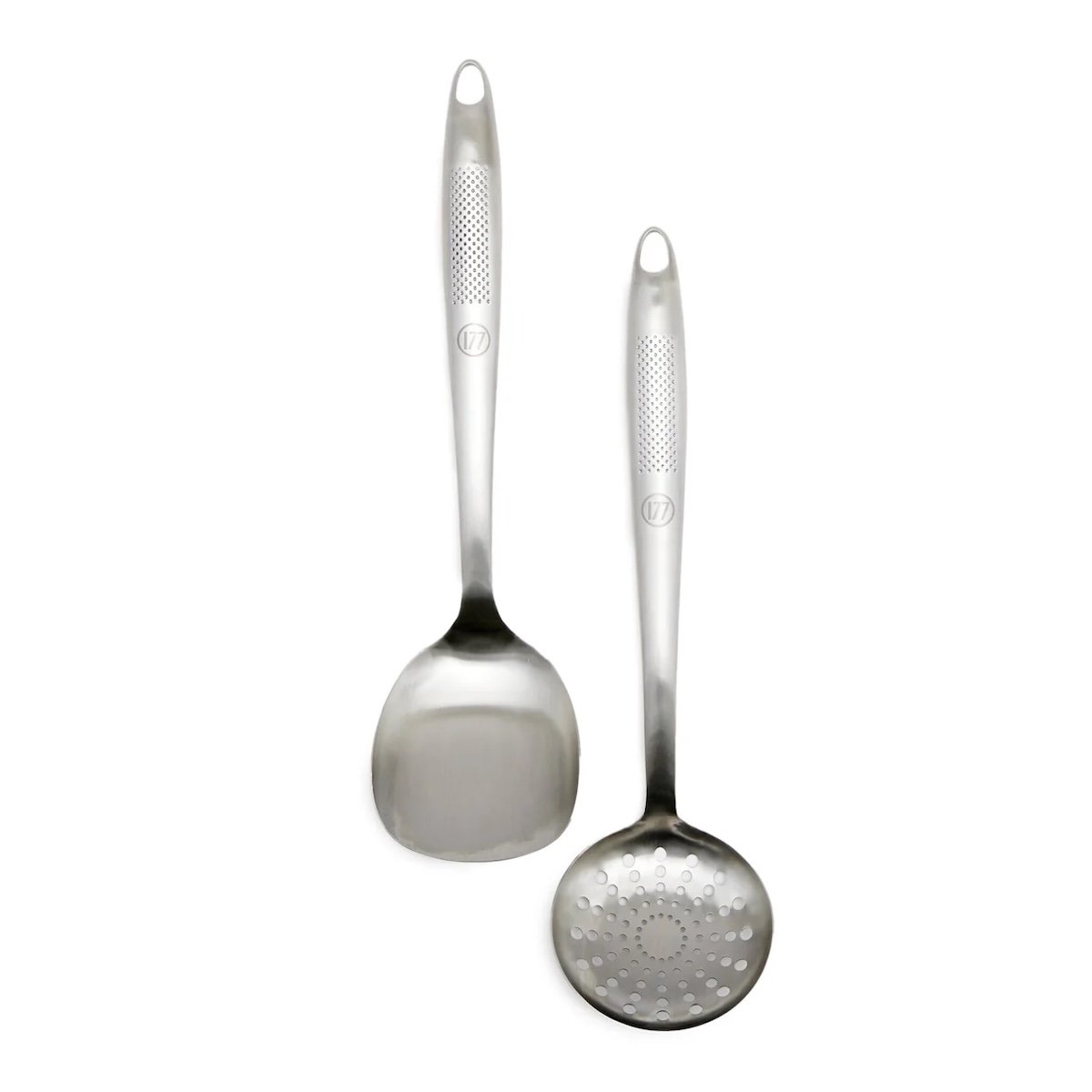
Most chefs recommend a special wok spatula that is like a long-handled spatula with a curved edge so it can scrape along the curved sides. They also recommend a spider like this, which is like a sieve with a long handle. I use the ones shown here from Milk Street. When I am wokking outdoors, I keep a pitcher of water nearby in case I need to scrub out the wok, a bucket to dump it in, a roll of paper towels, and an infrared gun thermometer. This one has a probe for reading the interior of meats and vegetables, as well as an infrared sensor for reading the surface temperature of pans.
Get the wok hot
Fill the chimney only halfway with briquets. Get the coals as hot as possible, which means wait until they are covered with white ash. Then put the wok on and get it hot. I shoot for a minimum of 500°F and I use an infrared thermometer like these.
Cook the ingredients in flights
Start with no more than 2 tablespoons oil and get it good and hot. Swirl the wok so the oil climbs the sides. Add the things that take the longest, usually thick things like carrot coins, cauliflower, broccoli, etc. Don’t crowd the wok. Each piece needs a chance to make contact with the metal at all times. If you pile things up, they will steam not fry. Cook in batches if necessary. Stir or flip every 10 seconds or so, keeping the pieces in contact with the hot part of the wok until browned, then move them to a bowl. A well-seasoned wok should come clean with a curved metal spatula. If not, a splash of water and a scrubby sponge will do the job, then let the heat dry the wok. Add more oil, swirl to coat, add the next batch of food, stirring frequently, and move it to a bowl when done. During the last batch I add the aromatics like garlic and ginger because they cook fast.
Keep things moving
Surprising as it seems, keeping the food moving cooks it better and faster than leaving it sit. The motion liberates steam so you sear better. Just be careful not to knock over the tower of power.
Finish it all in the wok
When all is done, combine everything in the wok, add quick-cooking ingredients, like peapods and greens like spinach or scallions, last. Then drizzle the sauce down the sides so it heats rapidly rather than pour it on top of the relatively cool food. Stay right there and don’t go to the bathroom. When the sauce thickens, it’s time to eat.
Clean
When you are done cooking and you’ve cleaned your wok, you should coat it with a thin layer of oil to prevent rust. But the oil can go rancid. So before you start again, rinse the wok with hot water and a sponge. Then dry it thoroughly and give it another light coat of high-smoke-point oil. If you need to make a larger portion of a recipe, consider doing it in two batches, as you never want to crowd a wok.
A tip for tenderizing beef
Here’s a trick for tenderizing beef that I learned from J. Kenji Lopez-Alt’s book The Wok. He claims this is common in Chinese restaurants. In a small bowl, stir the 1/2 teaspoon baking soda into 1 cup water and then mix it with 1/2 pound lean beef cut into strips about 1 inch long and 1/2 inch wide. Coat it thoroughly and work the meat roughly with your hands, massaging it in, and let it sit for at least 15 minutes but an hour or two in the fridge is better. Then rinse the excess baking soda from the meat with plenty of cool water, squeeze out excess water, and then pat the meat dry because too much baking soda can taste bitter or metallic. And too much water will seep out and braise the meat.
This article is adapted from Meathead’s book, The Meathead Method, published May 13, 2025. It is available on Amazon.

High quality websites are expensive to run. If you help us, we’ll pay you back bigtime with an ad-free experience and a lot of freebies!
Millions come to AmazingRibs.com every month for high quality tested recipes, tips on technique, science, mythbusting, product reviews, and inspiration. But it is expensive to run a website with more than 2,000 pages and we don’t have a big corporate partner to subsidize us.
Our most important source of sustenance is people who join our Pitmaster Club. But please don’t think of it as a donation. Members get MANY great benefits. We block all third-party ads, we give members free ebooks, magazines, interviews, webinars, more recipes, a monthly sweepstakes with prizes worth up to $2,000, discounts on products, and best of all a community of like-minded cooks free of flame wars. Click below to see all the benefits, take a free 30 day trial, and help keep this site alive.
Post comments and questions below
1) Please try the search box at the top of every page before you ask for help.
2) Try to post your question to the appropriate page.
3) Tell us everything we need to know to help such as the type of cooker and thermometer. Dial thermometers are often off by as much as 50°F so if you are not using a good digital thermometer we probably can’t help you with time and temp questions. Please read this article about thermometers.
4) If you are a member of the Pitmaster Club, your comments login is probably different.
5) Posts with links in them may not appear immediately.
Moderators